repository of the ancient and medieval organ

organo_admin

 results
Category
Material
Technique
The Terracotta of Tarsus
Date:between 2nd and 1st century BC
Location:Louvre, Paris

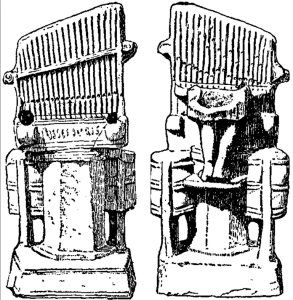
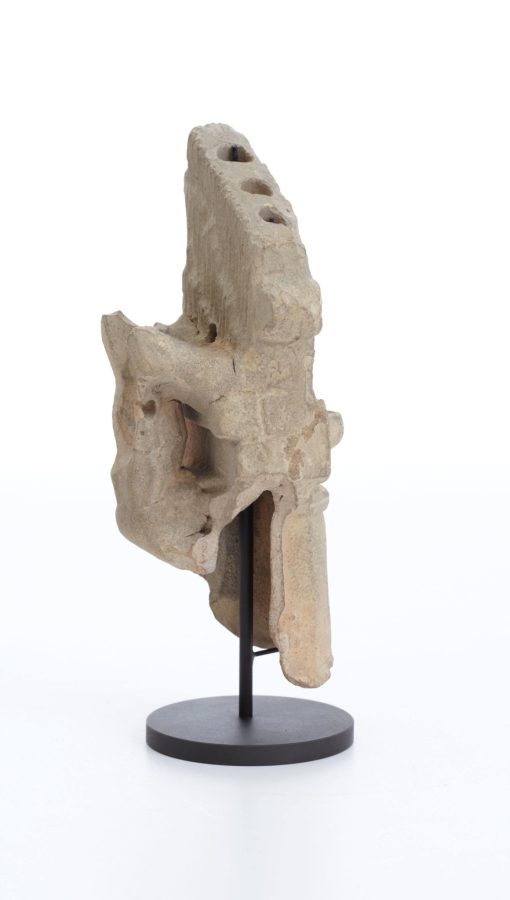
The Terracotta of Tarsus

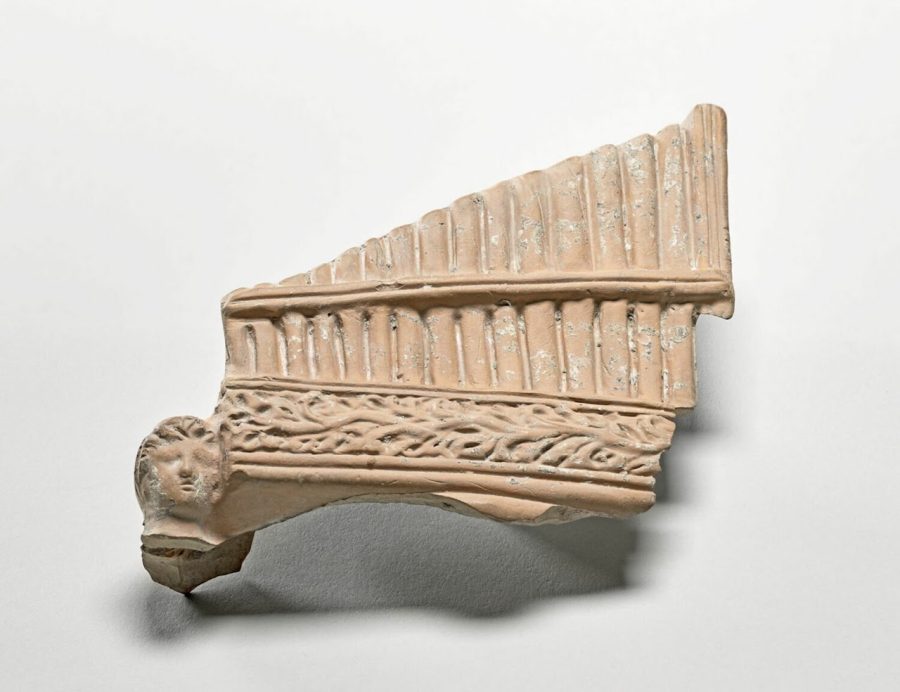
This terracotta, probably predating our era, comes from excavations carried out in the Kusuk-Kolah area in 1852 by Mazoillier and Langlois, and is preserved in the Louvre Museum. The piece, which does not appear complete, is of fine craftsmanship; it is very elegantly designed and represents the upper part of an organ. Fourteen or fifteen pipes of regularly decreasing height from right to left are held in place by means of an oblique bar decorated with a transverse notch resting on two vertical uprights. The […]

Plastic and Sculptural Arts
The Terracotta of Alexandria
Date:1st century BC
Location:Louvre, Paris; Department of Greek, Etruscan and Roman Antiquities, inv. CA 426, Paris, France

The Terracotta of Alexandria

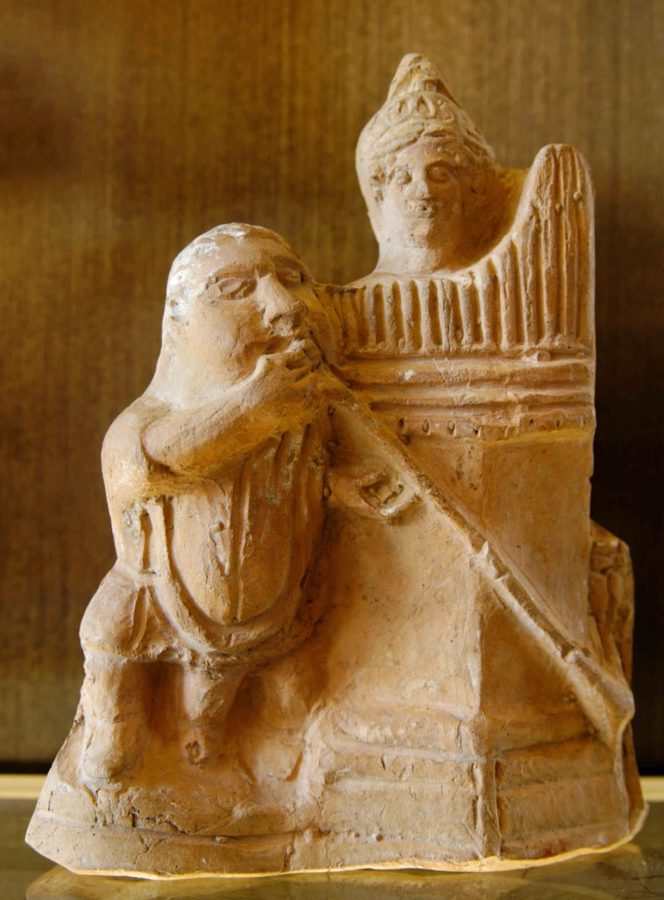
This terracotta statuette is probably the oldest known representation of an organ; it comes from Alexandria, the very birthplace of the engineer Ctesibius. Originally part of the Gréau collection, it is now in the Louvre Museum.  Most experts estimate that the piece predates the Christian era and is probably contemporary with the end of the Hellenistic period. Although rather roughly made, it gives an idea of what the ὄpγανον ὑδραυλικόν might have looked like at that time. The instrument corresponds to the descriptions of Hero […]

Plastic and Sculptural Arts
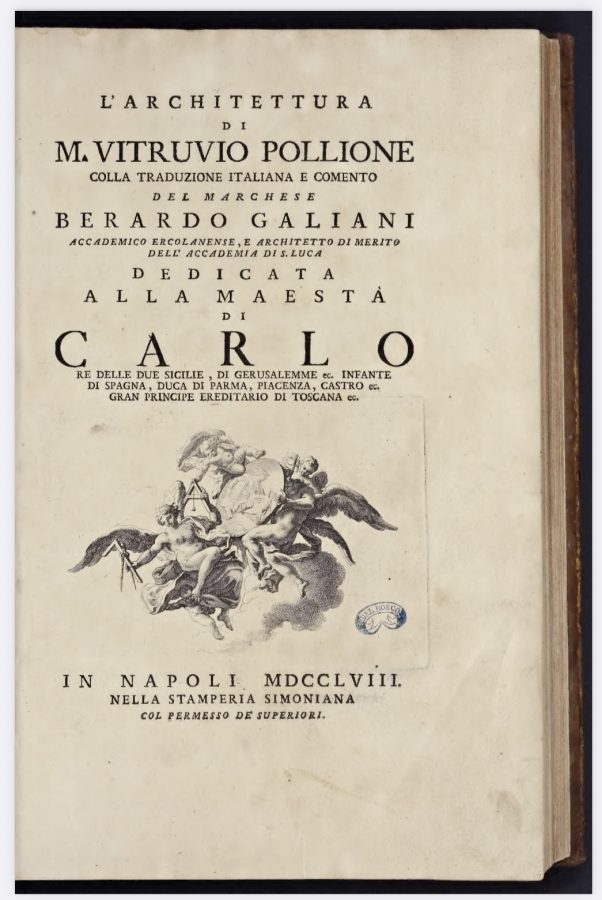
De Architectura — Marcus Vitruvius Pollio
Date:between 27 and 23 BC

De Architectura — Marcus Vitruvius Pollio

The following passages, taken from Books IX and X of Vitruvius, describe several inventions attributed to Ctesibius of Alexandria, including hydraulic pumps, pneumatic devices, and the water organ. The text illustrates the operating principles based on air compression and hydraulic flow regulation, dwelling in particular on the mechanical structure of the hydraulis: cylinders, valves, air ducts, keys, and sounding pipes. The technical terminology reflects the ancient mechanical tradition and modern translations of the treatise.

Graphics and Drawing on Paper
De architectura, Book X by Vitruvius
Date:between 27 and 23 BC

De architectura, Book X by Vitruvius

In these passages Vitruvius describes the inventions of Ctesibius of Alexandria, a Hellenistic engineer and inventor regarded as the father of ancient pneumatics. After recounting the origins of his first observations on compressed air, the text illustrates several hydraulic and pneumatic machines, leading up to the description of the water organ, an instrument in which regulated air pressure fed the sounding pipes.

Graphics and Drawing on Paper
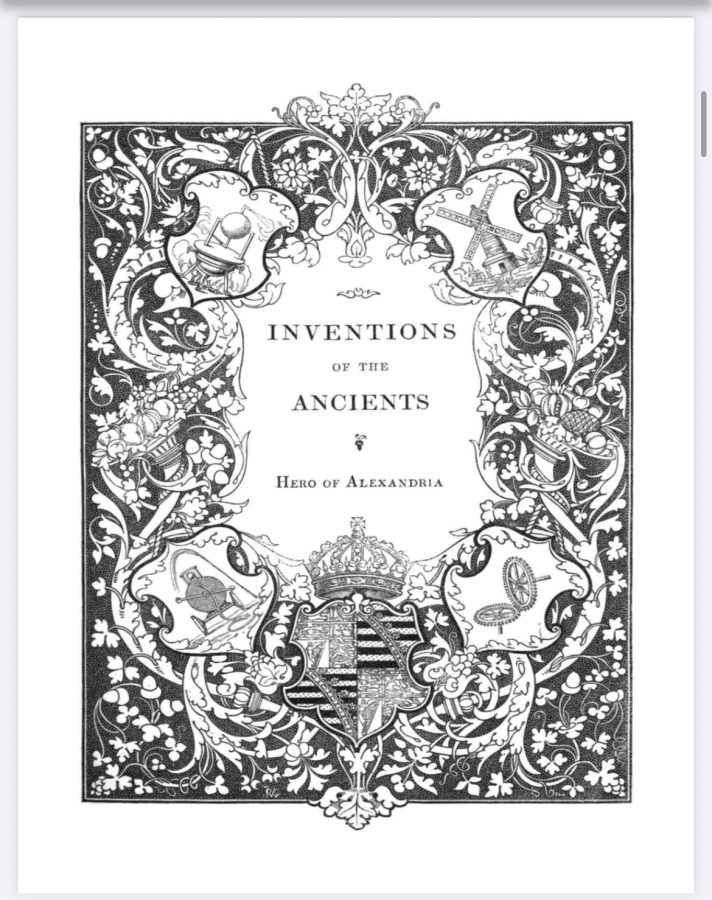
Pneumatica, Book I — Hero of Alexandria
Date:approx. 1st century BC

Pneumatica, Book I — Hero of Alexandria

In these passages from the Pneumatica, Hero of Alexandria describes two different pneumatic organs: an altar organ operated manually and a second instrument driven by wind power through a mechanism similar to a windmill. The text details the systems for compressing and distributing air, focusing on pistons, valves, hydraulic reservoirs, ducts and devices for opening the sounding pipes. Of particular interest is the description of the pipe-control mechanisms, in which primitive forms of keyboard and automatic air-supply systems applied to musical production can be recognised.

Graphics and Drawing on Paper
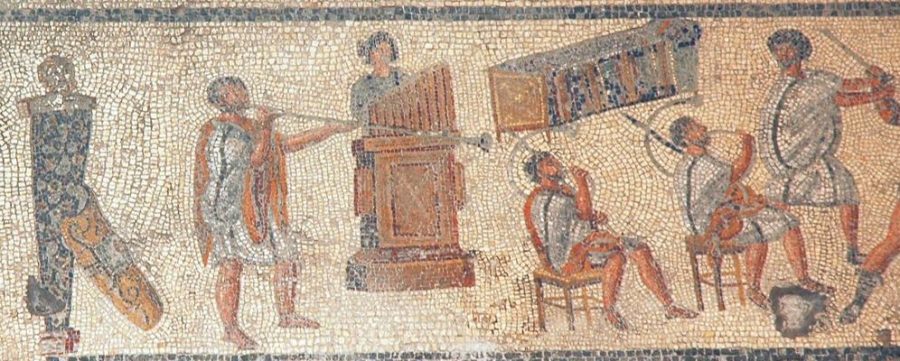
The Mosaic of Zliten
Date:second half of the 1st century AD
Location:Archaeological Museum of Tripoli, Libya

The Mosaic of Zliten

This is a large mosaic of still very vivid colours, adorning part of the remains of an imposing Roman villa built on the seafront at Dar Buk Amméra, not far from the oasis of Zliten. The central part of this mosaic is decorated with fish and geometric motifs; along the entire length of the perimeter a very narrow band shows in detail a great munus animated by two orchestras, each composed of a trumpet, an organ and two horns. Beside the traditional herma, the tubicen […]

Applied and Decorative Arts
The Lamp of the Carthage Museum
Date:2nd century AD
Location:Musée Lavigerie, Carthage, Tunisia

The Lamp of the Carthage Museum

The hydraulic organ represented by this lamp is undoubtedly the most careful and perfect reproduction of the instrument to have come down to us. The inscription “POSSESSORIS,” scratched with a pointed tool, can be compared with a mark I copied from the base of a Roman lamp reading “PVLLAEN POSSESSOR.” It also allows us to date our terracotta to a period close to the second century of our era, since the name “PVLLAENI” is frequently encountered on Roman lamps from the two reference cemeteries dating […]

Plastic and Sculptural Arts
The Lamp of the Copenhagen Museum
Date:2nd century AD
Location:Nationalmuseet, Copenhagen, Denmark

The Lamp of the Copenhagen Museum

This other lamp in the form of a hydraulic organ bears great resemblance to the previous one, though of less careful workmanship. The water cistern is hexagonal and has on its front a decorative motif consisting of leaves. There is only one pump, on the left, whose proportions are comparable to those of the instrument described above. The wind chest is thicker, without any inscription, and is decorated with a kind of moulding framing it. On each side are the lamp nozzles, simple domes with […]

Plastic and Sculptural Arts
The Organ of Gentilla
Date:undated (possibly 2nd–3rd century AD)
Location:Not documented; discovered in the underground cemetery of Commodilla, Rome

The Organ of Gentilla

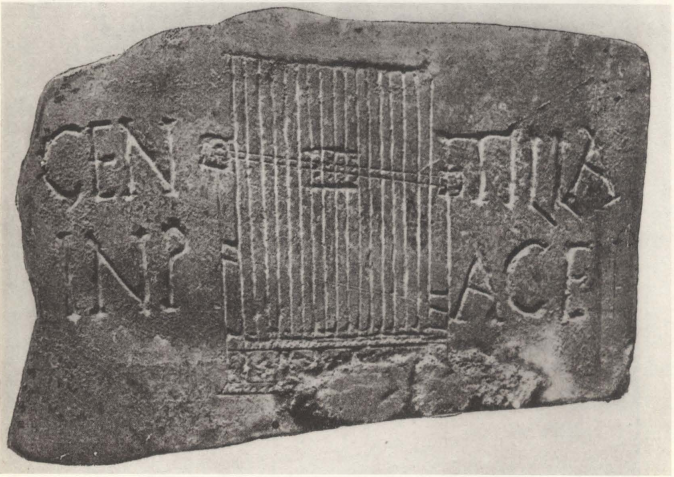
In 1936 Father Bellarmino Bagatti published a graffito bearing a Christian inscription with a very mysterious drawing in which he believed he could see a weaver. The terms refer to a woman whose activity is what can be seen in the drawing.It is a marble fragment found in the underground cemetery of Commodilla, near Ostia.Even a cursory examination shows that this is in fact an organ. Sixteen pipes of equal diameter and slightly decreasing in height from left to right can be clearly distinguished. Near […]

Mural and Architectural Decoration
The Medallion of Orange
Date:between 2nd and 3rd century AD
Location:Archaeological Museum of Saint-Germain-en-Laye, France

The Medallion of Orange

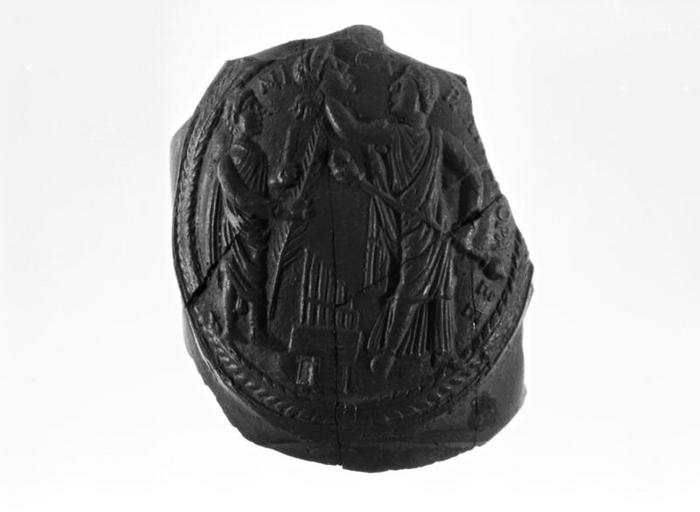
The scene depicted resembles the previous one: we are once again at the theatre. The medallion is oval, showing two people in actor’s costume: the one on the right, clad in a long sleeveless tunic, holds a double thyrsus in his left hand and brandishes a theatrical mask triumphantly in his right, while the other, of decidedly smaller stature, appears to be an adolescent. He wears a long garment covering his legs and a sleeved tunic. With his left hand he grasps a kind of […]

Applied and Decorative Arts
The Monument of Tatarevo
Date:between 2nd and 3rd century AD
Location:Bulgaria

The Monument of Tatarevo

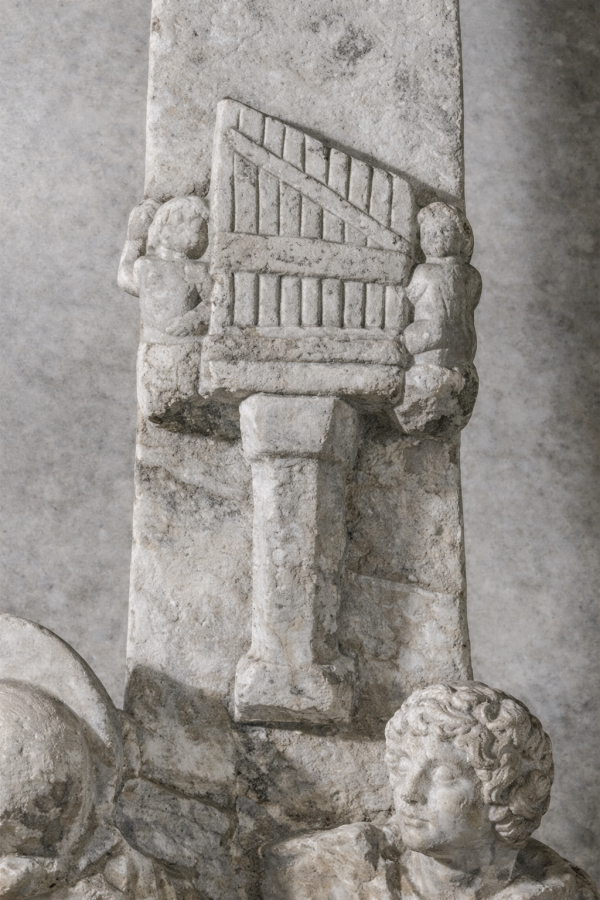
This is a small funerary monument discovered in Bulgaria in 1936 and little known in France until the exhibition of Treasures of Bulgarian Art held in Paris in the spring of 1963. Near Tatarevo, a small village in the Borissovgrad region, excavations brought to light this white marble stele composed of a quadrangular base and a column in the form of a prism. On the front face of the base three figures are depicted: on the left, standing, a gladiator in iron armour protected by […]

Plastic and Sculptural Arts
The Ceramic of the Saint-Germain Museum
Date:between 2nd and 3rd century AD
Location:Archaeological Museum of Saint-Germain-en-Laye, France

The Ceramic of the Saint-Germain Museum

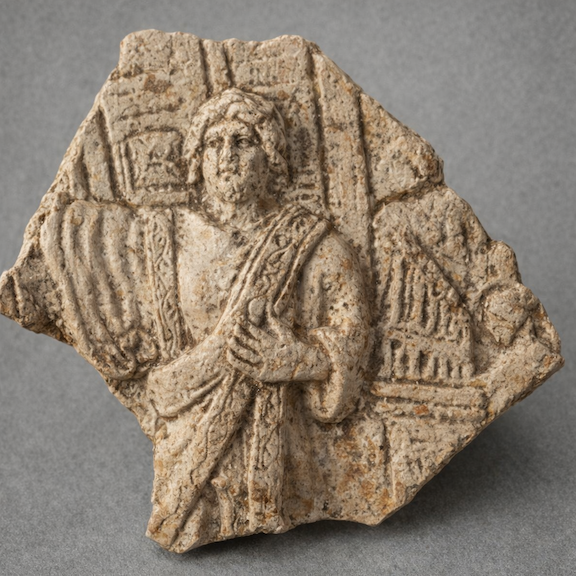
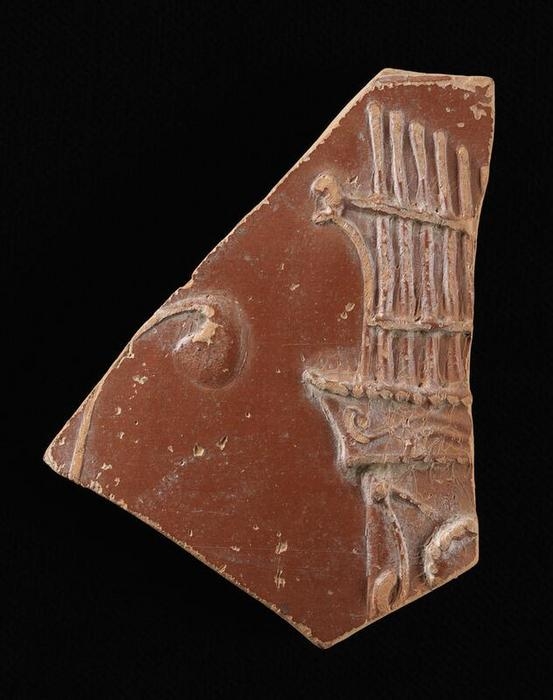
In 1948, while studying various fragments of Samian ware from Lezoux preserved in the Saint-Germain Museum, it was possible to find the image of a hydraulic organ on a polygonal terracotta shard. On the left of the fragment the upper part of a leaf ensemble can be seen, while further to the right the organ appears. Although the instrument cannot be seen in its entirety, this is a hydraulic organ. The water cistern, of which only the upper left part can be seen, is decorated […]

Plastic and Sculptural Arts
The Sarcophagus of Julia Tyrrania
Date:between 2nd and 3rd century AD
Location:Museum of Ancient Arles, France

The Sarcophagus of Julia Tyrrania

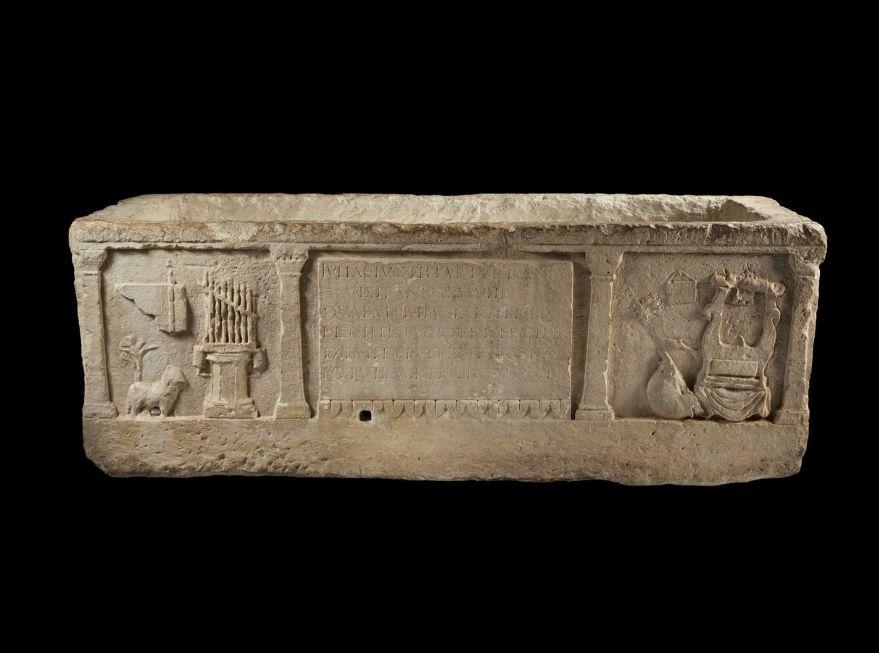
This beautiful white marble sarcophagus preserves the memory of a young organist, whose inscription reads: “Juliae Luc(i) filiae Tyrraniae vixit ann(os) XX m(enses) VIII quae moribus pariter et disciplina ceteris feminis exemplo fuit. Aurarcius nurui, Laurentius ucxori” (“To Julia Tyrrania, daughter of Lucius. She lived twenty years and eight months. By her good conduct as by her learning she was an example to other women. Autarcius to his daughter-in-law. Laurentius to his wife”).The accomplishments of this young woman, snatched so soon from her husband’s affection, […]

Plastic and Sculptural Arts
The Mosaic of Nenning
Date:between 2nd and 3rd century AD
Location:Roman Villa of Nenning, Saarland, Germany

The Mosaic of Nenning

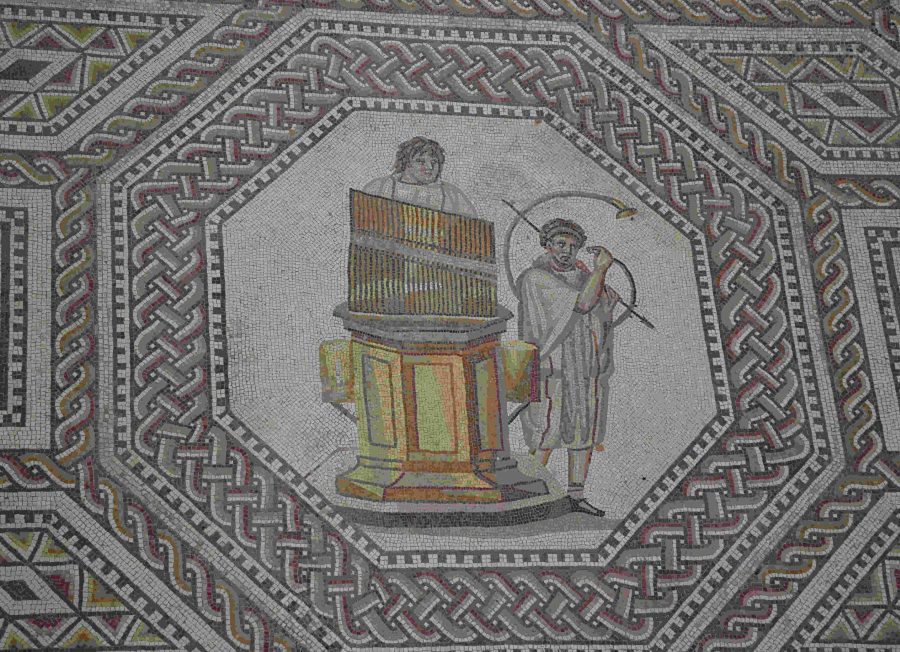
In 1852 the remains of a rich Roman dwelling, generally dated to the Hadrianic period, were discovered at Nennig, a small village in the Saar situated 40 kilometres from Trier, not far from the right bank of the Moselle. The floor of one of the rooms is adorned with a magnificent mosaic in very good condition. It comprises nine medallions, seven octagonal and two square, separated by geometric motifs and depicting various amphitheatre scenes: gladiatorial combat and venatio. One of the medallions shows an orchestra […]

Applied and Decorative Arts
The Graffito of the Via Appia
Date:between 2nd and 3rd century AD
Location:Not documented

The Graffito of the Via Appia

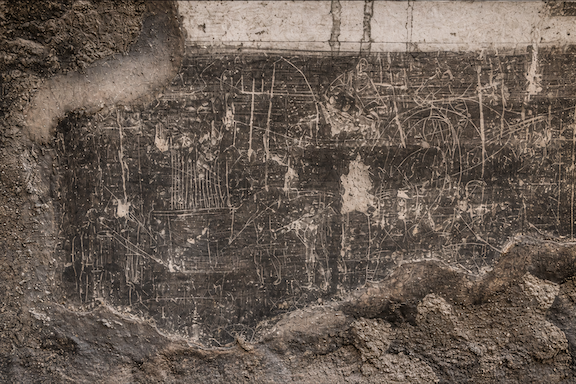
An amphitheatre scene is depicted in a graffito traced on one of the walls of a Roman villa discovered beneath the Basilica of Saint Sebastian in Rome. It is a simple sketch, the naive work of a child or, at least, of a non-professional. Two pairs of gladiators can be seen fighting to the sound of a hydraulic organ, a trumpet and a horn. On the left the tubicen blows into his instrument, which he holds tilted downward; on the right the cornicen plays standing […]

Mural and Architectural Decoration
The Vase of Reims
Date:between 2nd and 3rd century AD
Location:Petit Palais, Paris; from the Gréau Collection

The Vase of Reims

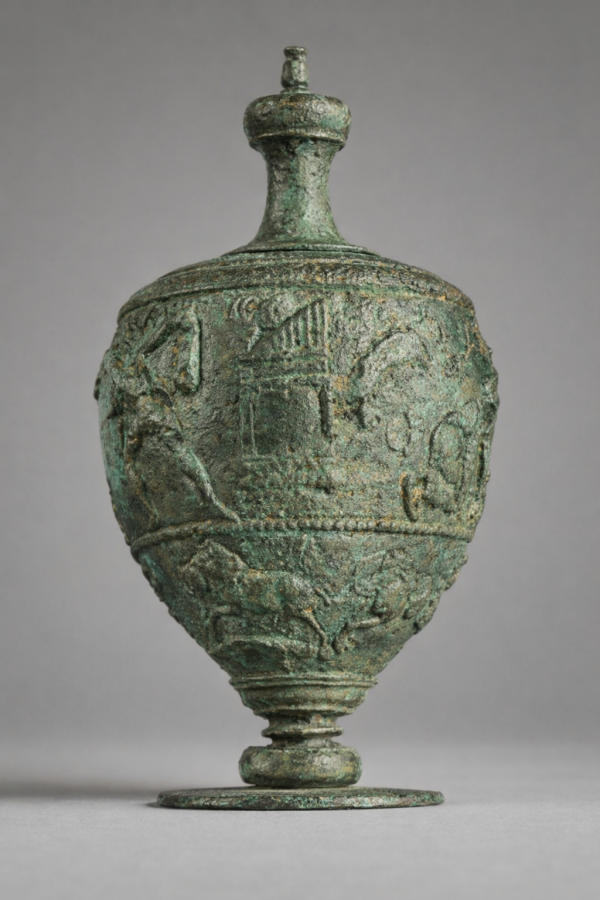
A hydraulic organ can be seen on a small bronze vessel: it is said to have been found in Reims in 1852 and is part of the Gréau collection. Ovoid in shape, it is decorated with motifs arranged in two registers: at the bottom various animals can be seen — lion, boar, panther, antelope — taking part in a venatio; above, a munus is depicted comprising two pairs of gladiators in action, whose names appear inscribed above the frieze.Between the two groups of combatants the […]

Plastic and Sculptural Arts
The Vase of Copenhagen
Date:3rd century AD
Location:Nationalmuseet, Copenhagen, Denmark

The Vase of Copenhagen

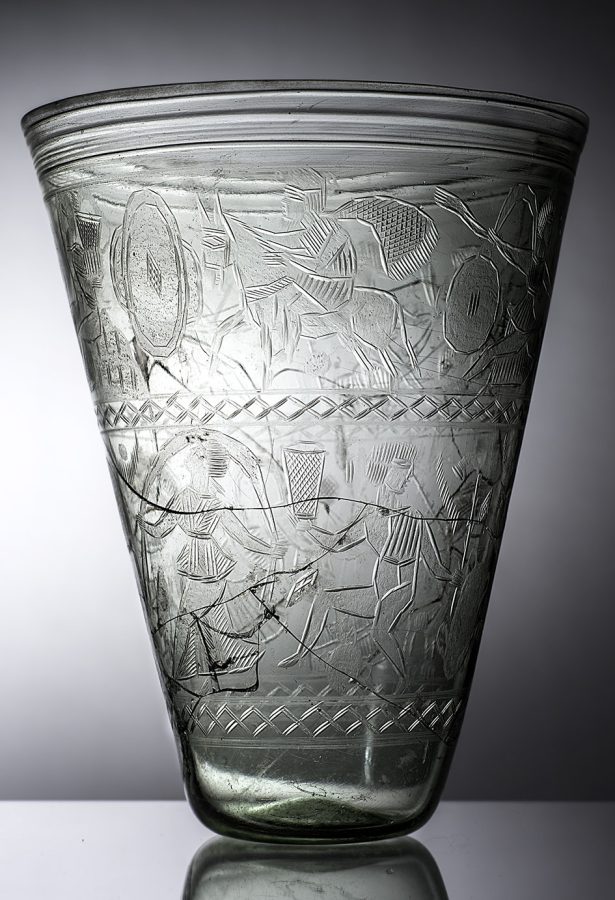
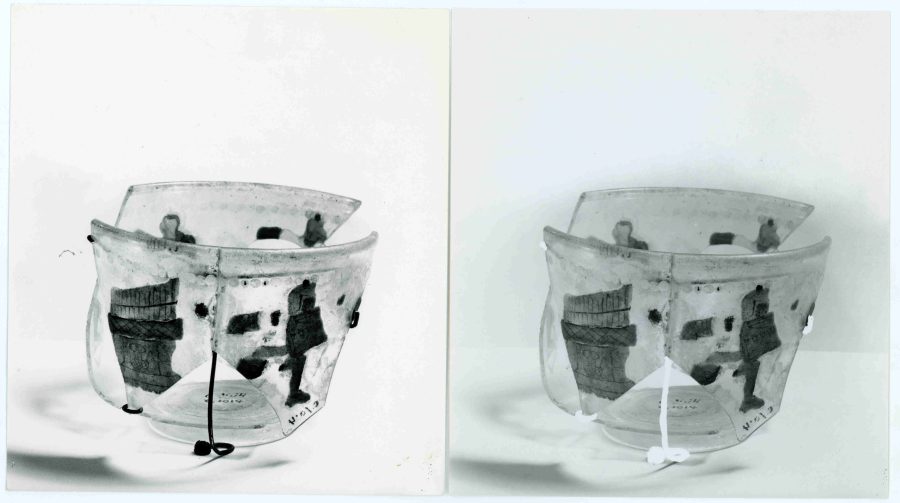
A scene of the same kind is depicted on this glass vessel found in 1870 at Thorslunde, near Roskilde, and now preserved at the Nationalmuseet in Copenhagen. Unfortunately it was found mutilated, lacking certain fragments. The vessel is decorated with polychrome ornaments of rough design, depicting a gladiatorial combat. Three combatants can be distinguished in full action and a hydraulic organ with its organist. The instrument has a wide base above which the water cistern rests. This, wider than it is tall, shows on its […]

Applied and Decorative Arts
The Vase of Rheinzabern
Date:3rd century AD
Location:Historical Museum of the Palatinate, Speyer, Germany

The Vase of Rheinzabern

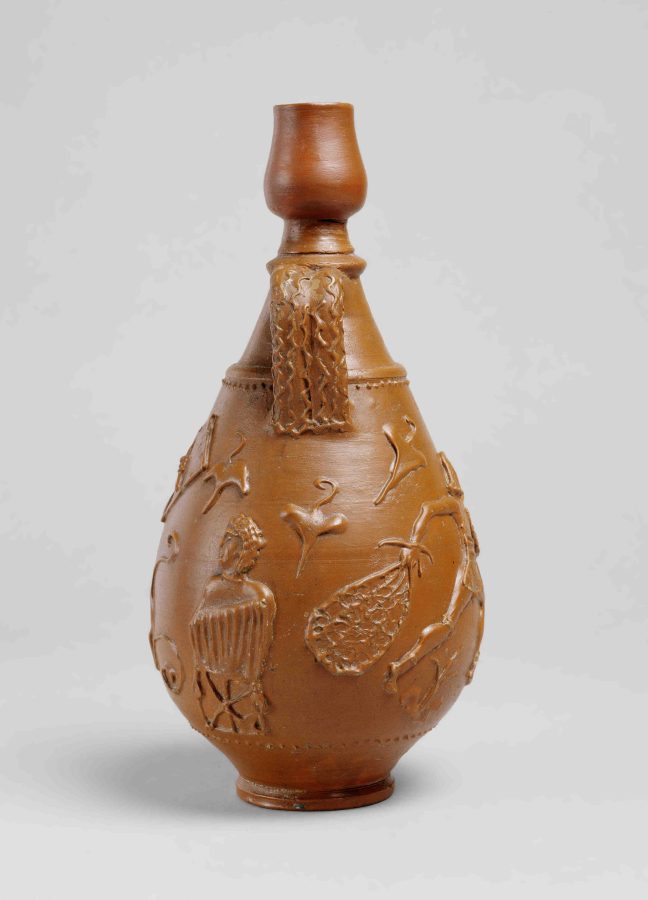
Wilhelm Ludowici published between 1901 and 1904 the image of a small terracotta vessel on which an organ can be seen. Of graceful form, with an ovoid belly and a narrow neck, this vessel, from Rheinzabern, is currently exhibited at the Museum of Speyer. On its sides a gladiatorial combat is depicted. Two men are facing each other: a retiarius armed with net and trident charges his opponent; a secutor, who awaits him, holds a threatening dagger. Beside them a third figure plays the organ […]

Plastic and Sculptural Arts
The Gem of the British Museum
Date:3rd century AD
Location:British Museum, London

The Gem of the British Museum

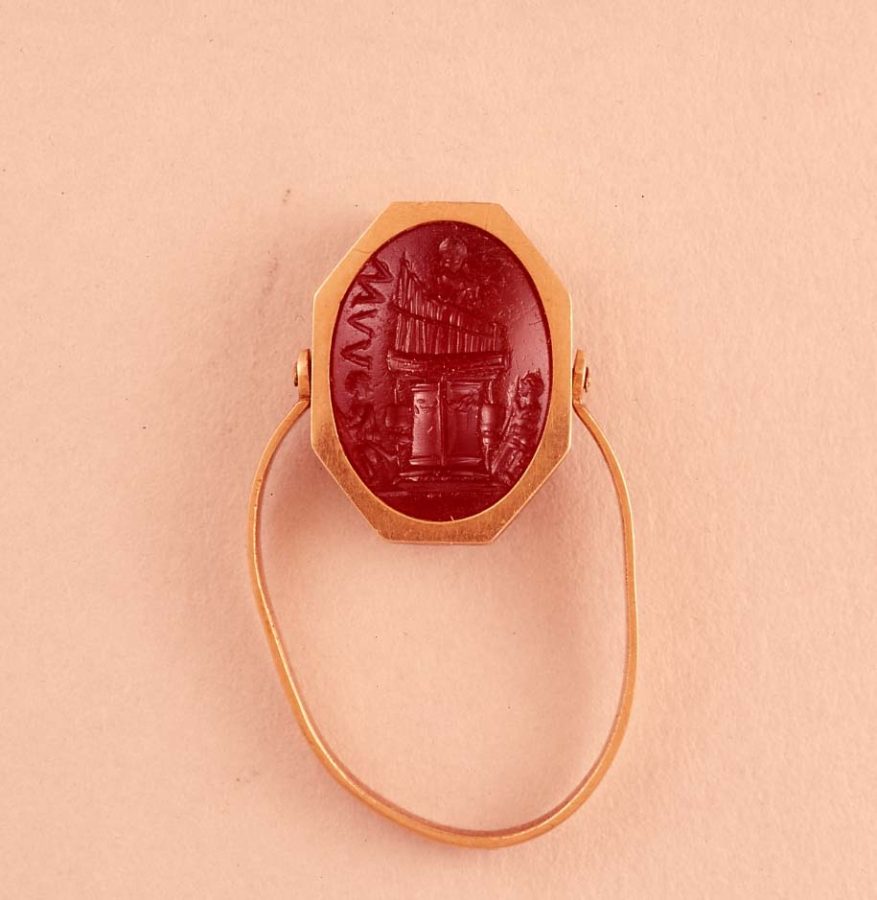
This beautiful jewel of reddish sardonyx, preserved at the British Museum in London, is of unknown origin: it is only known to come from the Hertz collection. Oval in shape, it depicts a finely engraved hydraulic organ with its organist and two bellows operators in full activity.The instrument, of imposing dimensions, is of the type commonly encountered in iconography. On a plinth the water cistern can be seen, cylindrical, decorated at top and bottom with a circular band probably intended to reinforce its structure, and […]

Applied and Decorative Arts
The Funerary Stele of Autun
Date:3rd century AD
Location:Museum of Autun, France

The Funerary Stele of Autun

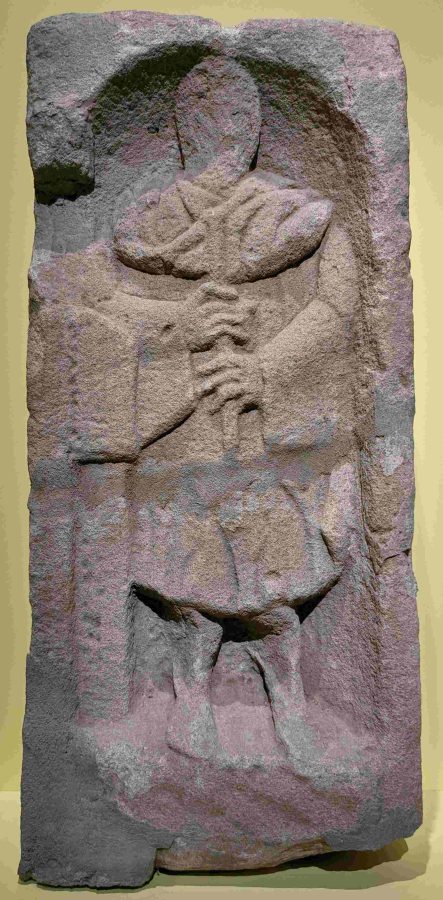
This is an uninscribed funerary stele from the outskirts of Autun, preserved in the Museum of that city. The deceased can be seen, certainly a professional musician, dressed in a wide cloak with broad sleeves, holding in his hand a long tibia. To his right an instrument of six or seven pipes decreasing from right to left is depicted. One is entitled to think this is an organ rather than a large syrinx, the latter being normally arranged in the opposite direction. A wind chest […]

Plastic and Sculptural Arts
The Terracotta of Rome
Date:late 3rd century AD
Location:Museum of the German Cemetery in the Vatican, Rome

The Terracotta of Rome

This small ceramic fragment is said to come from the Villa Ludovisi and to have been found in the final years of the last century (i.e., the nineteenth century). In the foreground a thick-haired man appears to be declaiming or greeting, his right arm outstretched, his left hand resting on the fold of a rich toga picta. Behind him a large decorated two-leaved door can be seen, perhaps that of a temple or theatre. To his left but on a distinctly more recessed plane an […]

Plastic and Sculptural Arts
The Glass of the Naples Museum
Date:between 3rd and 4th century
Location:National Archaeological Museum of Naples

The Glass of the Naples Museum

This very graceful glass depicts a Bacchic procession, in which various musical instruments can be seen: cymbals struck by a dancer, a syrinx held by another; a lituus and, in all probability, a small pneumatic organ placed on the ground. This has approximately twenty-five pipes held by a wide transverse bar and placed on a very flat wind chest. The whole ensemble greatly resembles the sounding section of the British Museum gem. Neither a water cistern nor pumps are present, while the air supply is […]

Applied and Decorative Arts
The Sarcophagus of Saint-Maximin
Date:first half of the 4th century
Location:Basilica of Saint-Maximin, Var (France)

The Sarcophagus of Saint-Maximin

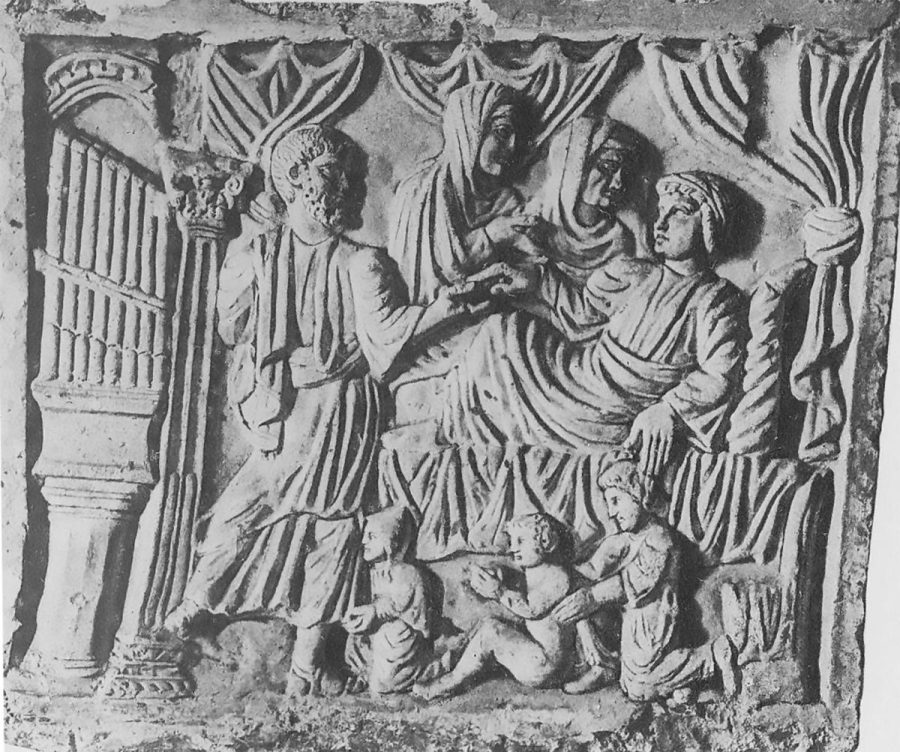
In the crypt of the Basilica of Saint-Maximin (Var) a beautiful marble sarcophagus is preserved dating from the Constantinian period. On one of the lateral faces, unfortunately poorly lit, a bas-relief is visible depicting a well-known Christian scene: the Resurrection of Tabitha, narrated in the Acts of the Apostles (IX, 36–43). The resurrected woman is sitting up on the bed and Peter takes her hand. At the foot of the girl’s bed, behind a column, a hydraulic organ is depicted. The water cistern, grooved, appears […]

Plastic and Sculptural Arts
The Organ of Rusticus
Date:4th century
Location:Convent of San Paolo fuori le Mura, Rome

The Organ of Rusticus

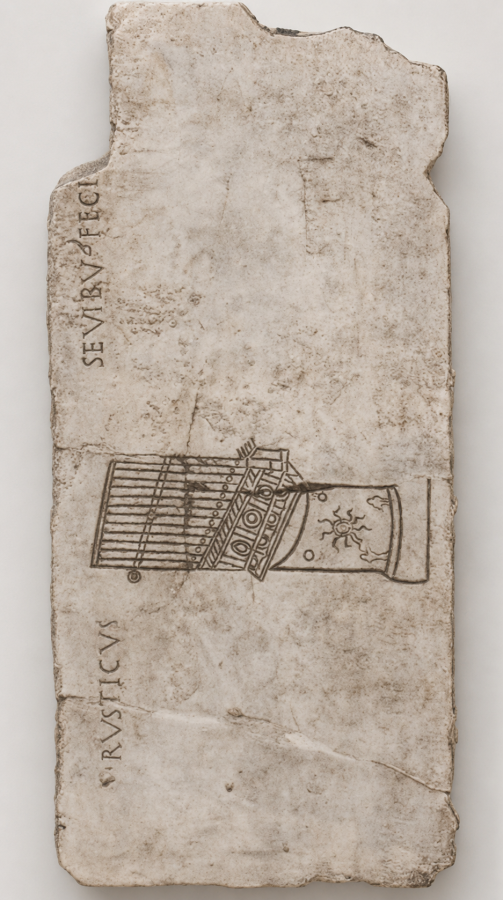
On the first floor of the convent complex of San Paolo fuori le Mura, in Rome, there is a small museum housing Christian inscriptions found in the areas adjacent to the basilica of the same name; among these is a large marble slab depicting a hydraulic organ. This is a rectangular slab, found under the altar of the Confession of Saint Paul and would have formed part of the ancient floor of the basilica in the time of Sixtus V. It shows the image of […]

Plastic and Sculptural Arts
The Terracotta of Rheinzabern
Date:4th century
Location:Historical Museum of the Palatinate, Speyer, Germany

The Terracotta of Rheinzabern

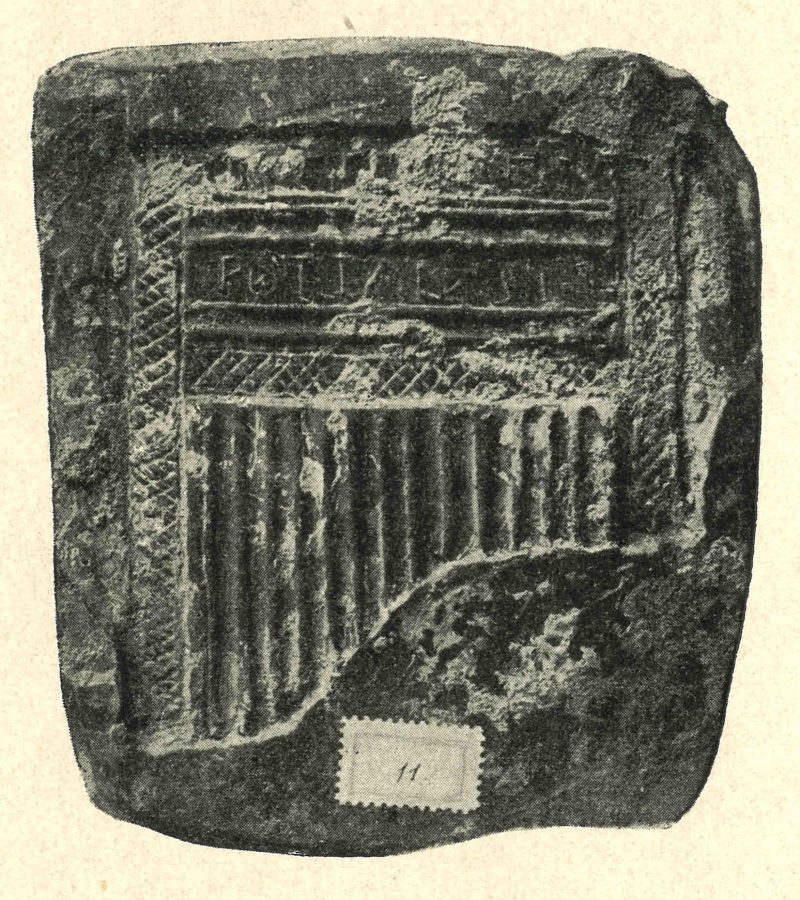
This terracotta, published by Ludowici in 1904, is preserved at the Museum of Speyer. It is very difficult to interpret and yet seems to show the image of an organ with a pneumatic wind chest. The instrument has fourteen pipes all of equal diameter, held by two sturdy vertical uprights decorated with square motifs. There is no transverse bar. The wind chest, relatively large, is surrounded by frames with the same decoration and bears a reversed inscription reading: “POTTALUSF.” Above the pipes, curved like those […]

Plastic and Sculptural Arts
The Contorniates of Caracalla
Date:second half of the 4th century
Location:British Museum, London

The Contorniates of Caracalla

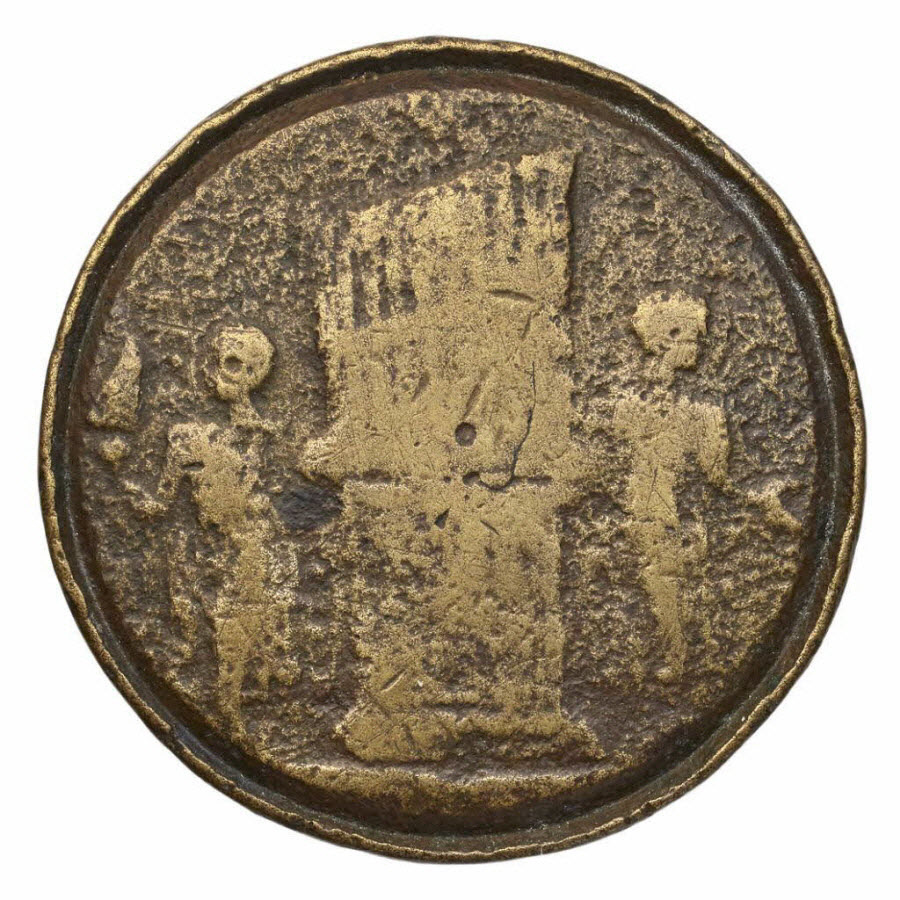
These are medallions depicting on the recto the effigy of an emperor (Caracalla or Trajan) or an incised monogram, with a subsequently added incised palm in one specimen. On the reverse, all the medallions show a hydraulic organ with variable but similar characteristics.First medallion: The organist is seated before the cistern, which appears as wide as it is tall and partly concealed. On the sides two cylindrical pumps with operating levers can be seen. The sounding section has 11 pipes held by a horizontal bar […]

Plastic and Sculptural Arts
The Contorniates of Nero
Date:second half of the 4th century
Location:First: not documented; second: British Museum, London

The Contorniates of Nero

Both medallions depict the emperor in profile on the recto and a hydraulic organ on the reverse.First medallion: The organ has a hexagonal cistern on a flattened plinth, a wind chest of 0.90 m, 7 pipes held by an oblique bar and lateral uprights. Keyboard and pumps not visible; an oblique lever on the right indicates the bellows mechanism. The organist, an adolescent dressed in a long tunic, holds a triangular object in his hand. The overall height of the instrument reaches almost 2 metres.Second […]

Plastic and Sculptural Arts
The Medallion of Valentinian III
Date:second half of the 4th century
Location:Cabinet des Médailles, Paris

The Medallion of Valentinian III

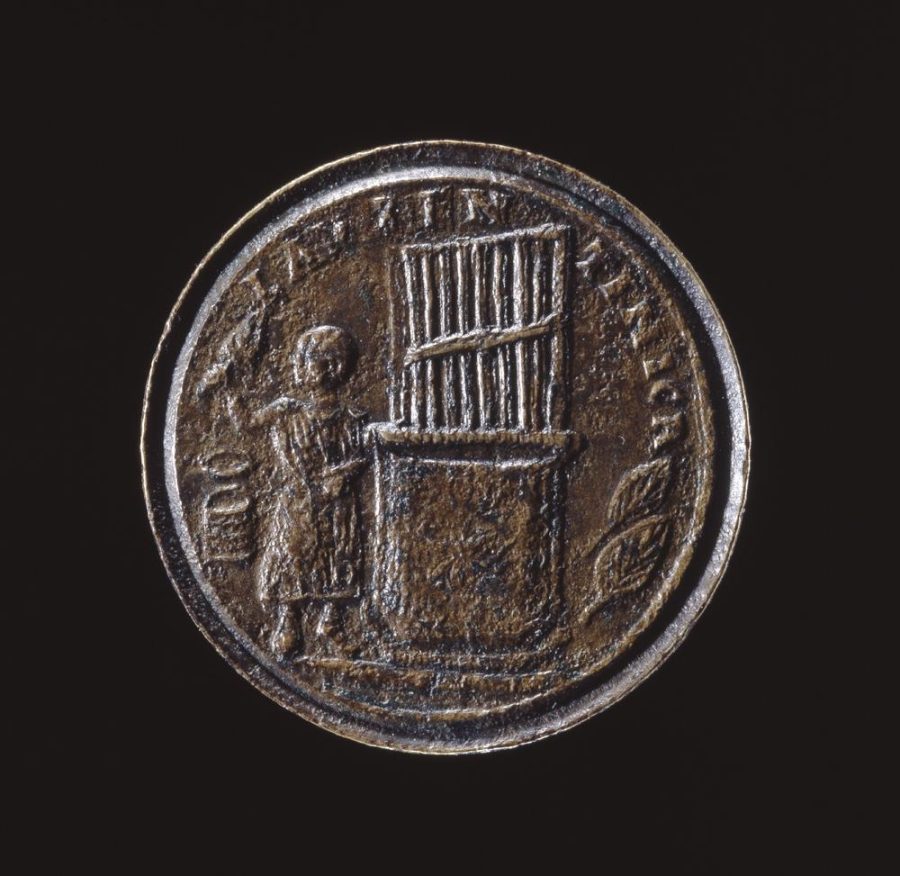
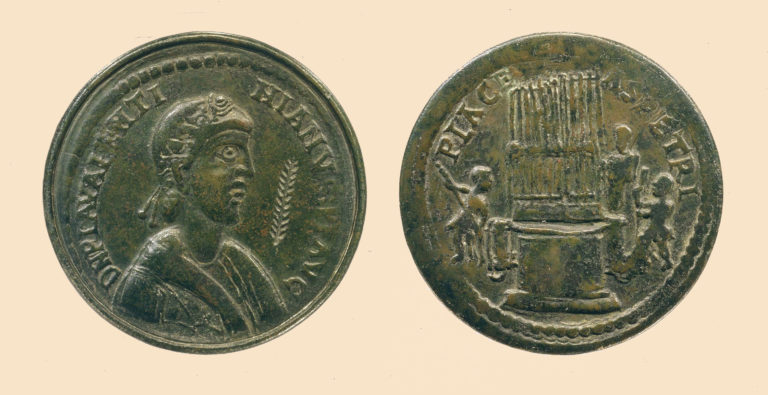
This is a large-format medallion with a bust of Emperor Valentinian III on the recto and, on the reverse, a hydraulic organ with organist and two bellows operators. The water cistern is wide, taller than wide, and rests on a plinth; the lateral air pumps are operated by young men. The wind chest supports 10/11 pipes of extraordinary height, held by two bars, with slight inclination and the treble pipes to the right of the organist. The overall height of the instrument exceeds 2 m, […]

Plastic and Sculptural Arts
The Medallion of Grenoble
Date:second half of the 4th century
Location:Museum of Grenoble, France

The Medallion of Grenoble

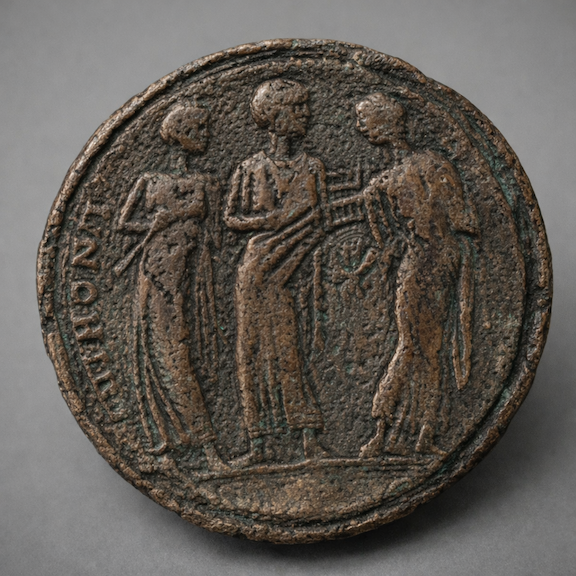
The medallion bears the name of Salustius Autor. On the reverse three individuals are depicted, probably actors in a theatrical scene. The central figure holds a small pipe instrument in his left hand, interpreted by Sabatier as an organ. The instrument has 5 pipes, held at mid-height by a transverse bar but without a wind chest. The attitude of the figures suggests that the instrument was light. On the reverse the words “PETRONI PLACEAS” appear arranged in a circle, probably a votive formula.

Plastic and Sculptural Arts
The Obelisk of Theodosius
Date:390
Location:Sultanahmet Square, Istanbul, Turkey

The Obelisk of Theodosius

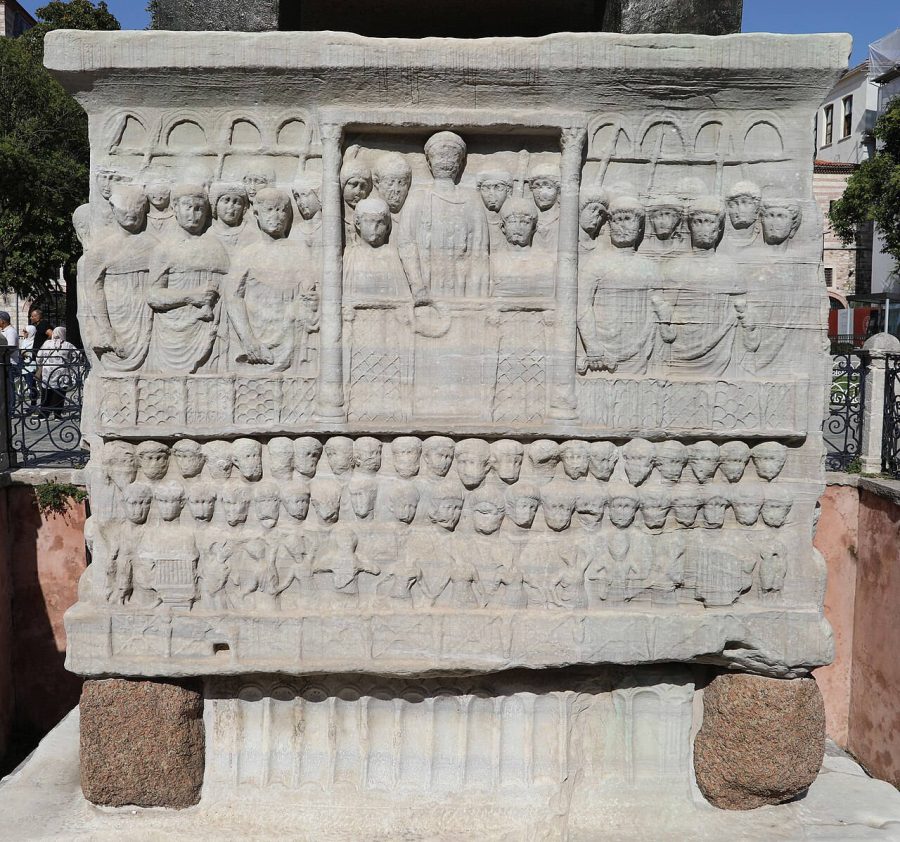
At the base of the obelisk erected in 390 by Theodosius the Great at the centre of the Hippodrome of Byzantium, various circus scenes are carved: one of these shows an orchestra composed of various instruments, syringes, aulos and two organs. The emperor stands upright in the pulvinar surrounded by his dignitaries, holding in his right hand the crown he is about to offer the winner. Below him, in front of some forty spectators, the dancers, carried away by the music, perform their evolutions. Each […]

Plastic and Sculptural Arts
The Consular Diptych of Verona
Date:517
Location:Capitulary Museum of Verona

The Consular Diptych of Verona

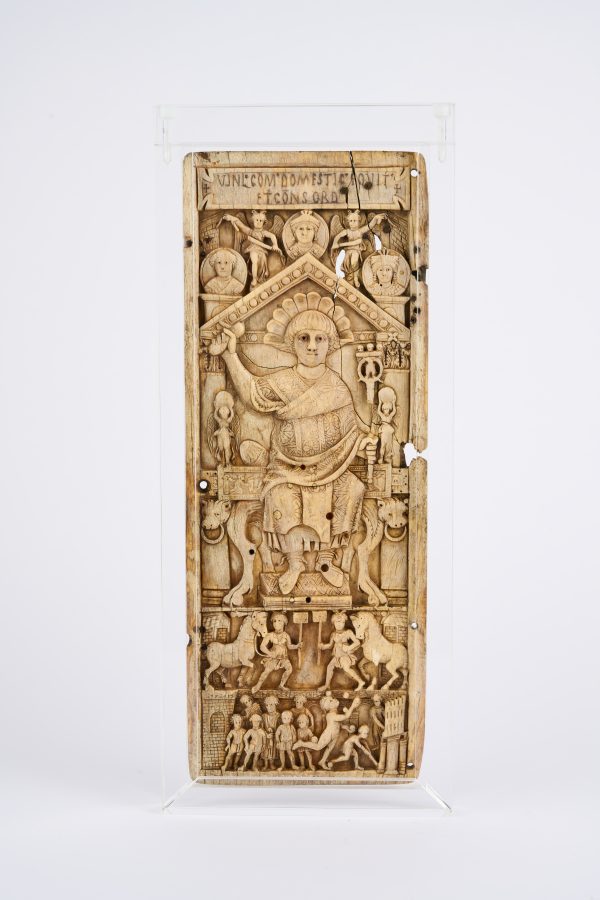
This is a Byzantine diptych depicting Emperor Anastasius I enthroned with circus scenes in the lower section. Among the figures a hydraulic organ can be seen being played during public celebrations. The instrument, seen in semi-profile, presents a water cistern on a plinth, flanked by two air pumps operated by young attendants. The wind chest supports 6 open pipes, held by two oblique bars, with the treble pipes to the right of the organist. The musician, a young curly-haired man, plays with both hands and […]

Plastic and Sculptural Arts
The Utrecht Psalter
Date:816-835
Location:Utrecht University Library, Netherlands

The Utrecht Psalter

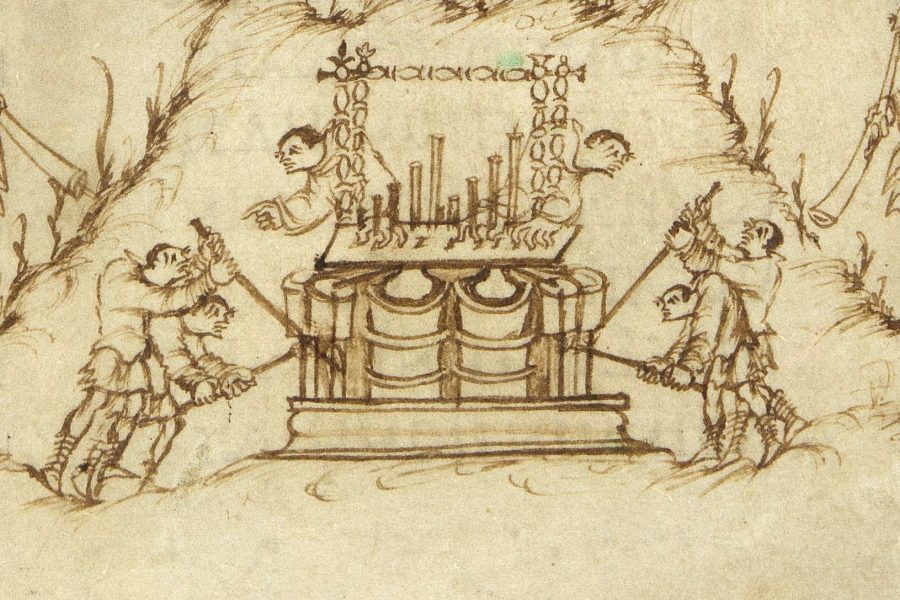
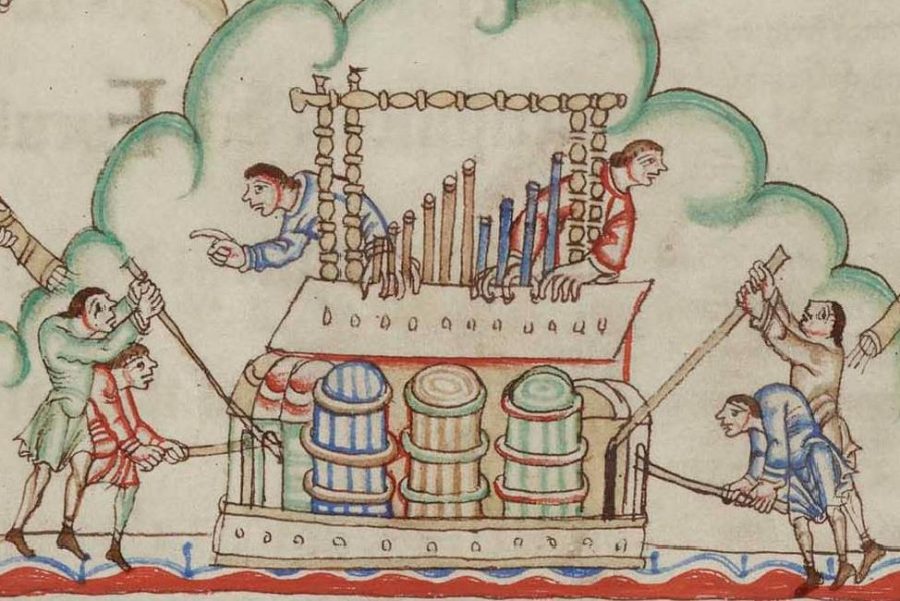
The miniature, illustrating Psalm CL, presents at the centre a double hydraulic organ of exceptional conception. The instrument consists of two side-by-side cisterns and an apparently shared wind chest feeding two identical rows of 5 pipes, with the treble pipes on the right. On the sides cylindrical pumps operated by four attendants are depicted; two organists play simultaneously, each on one series of pipes, with no visible keyboard. A double-frame structure surmounts the pipes, exceeding their height. The ensemble combines technically coherent elements and formal […]

Graphics and Drawing on Paper
King David Depicted as a Shepherd
Date:820-830
Location:Stuttgart, Baden-Württemberg, Württembergische Landesbibliothek, Bibl.fol.23, f. 164v

King David Depicted as a Shepherd

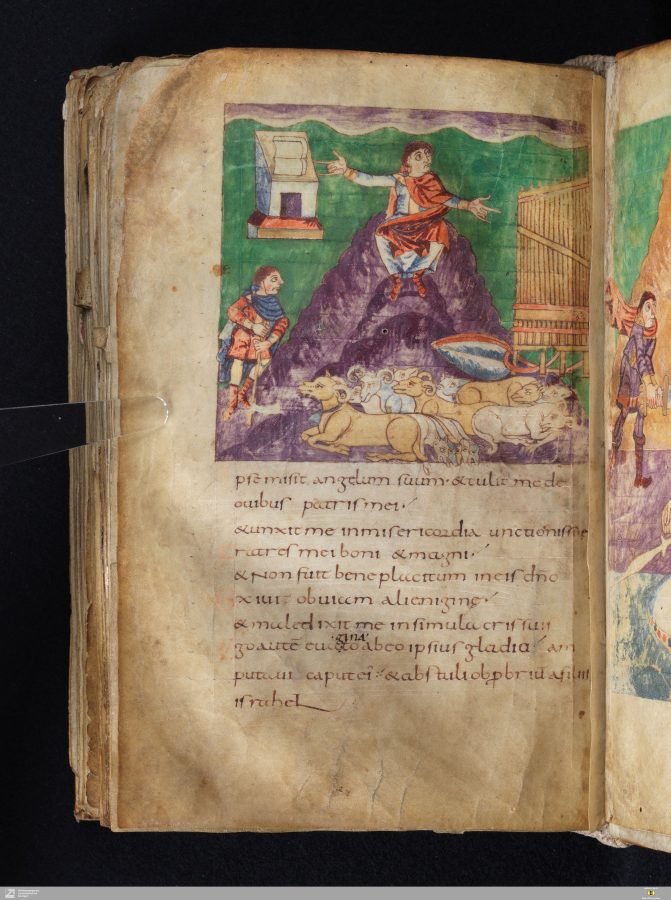
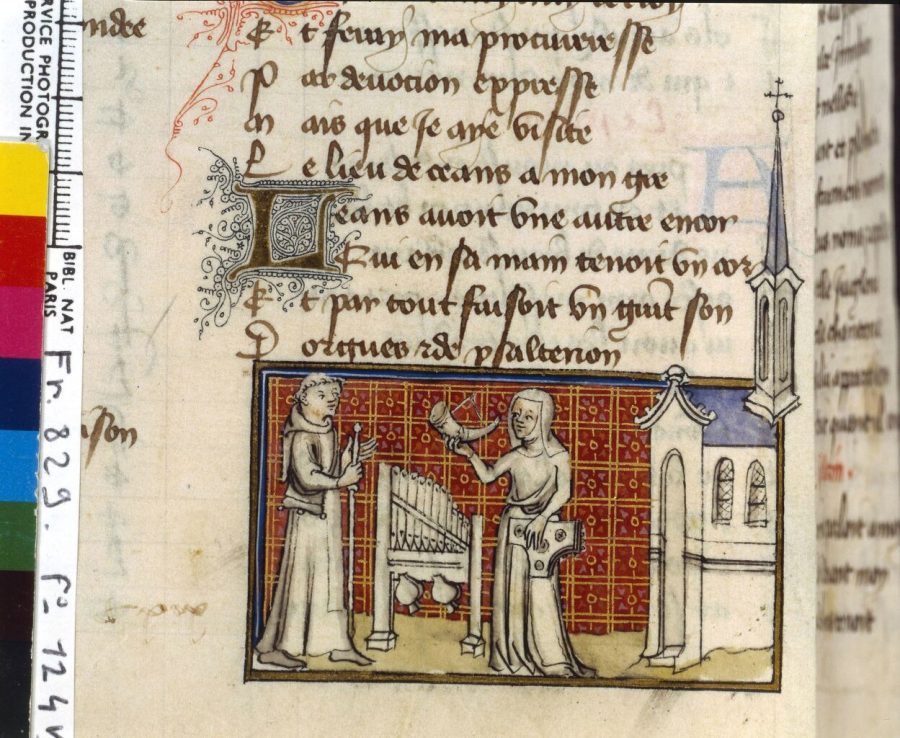
This miniature illustrates the second verse of Psalm 151, which reads: “I tended my father’s sheep; my hands made an organ and my fingers tuned a psaltery.” In the left part of the scene, David is depicted in his role as shepherd, leaning on the typical curved staff (the pedum) beside his flock. At the centre, he is found again seated on a hill performing a double symbolic gesture: with his right hand he points to the open book of Psalms placed on an altar, […]

Graphics and Drawing on Paper
The Stuttgart Psalter
Date:820-830 ca.
Location:Württembergische Landesbibliothek, Stuttgart, Germany

The Stuttgart Psalter

The manuscript presents four organ depictions of summary execution but of remarkable interest for their antiquity. The first two images show portable organs suspended from the branches of a willow, in reference to Psalm CXXXVII (super flumina Babylonis). Each instrument is furnished with approximately 7 pipes held by an oblique bar; the keyboard sliders are visible, while the bellows cannot be distinguished. The other two depictions show larger positive organs, with a flat wind chest, visible manual and approximately 10 pipes supported by an oblique […]

Graphics and Drawing on Paper
De Mensura Fistularum in Organis — Anonymous
Date:9th century

De Mensura Fistularum in Organis — Anonymous

These texts in the anonymous treatise De Mensura Fistularum in Organis describe the mathematical and proportional criteria used in the construction of medieval organ pipes. The passages illustrate the ratios between length, diameter and musical intervals, dwelling on the procedures for calculating consonances, the arrangement of ranks, and the methods for measuring pipes in relation to the theoretical systems of medieval music. Some sections also include directions for the construction of cymbals and the organistrum, within the framework of medieval organological and craft practices.

Graphics and Drawing on Paper
The Pommersfelden Psalter
Date:early 11th century
Location:Graf von Schönborn Library, Pommersfelden, Germany

The Pommersfelden Psalter

The miniature depicts a small footed organ traceable, in conception, to Theophilus’s first description (De domo organaria lignea). The instrument presents 13 treble pipes, placed to the right of the organist, with square mouths and inserted in a rudimentary wind chest. The manual comprises eight keys, operated by a performer kneeling in front of the instrument. No elements of the ventilation system (bellows or pumps) nor wind operators are visible. The image, although extremely schematic, documents an early phase of the medieval organ with a […]

Graphics and Drawing on Paper
Tractatus de mensura fistularum — Eberhard of Freising
Date:11th century

Tractatus de mensura fistularum — Eberhard of Freising

These introductory texts to the treatise De mensura fistularum in organis, attributed to Eberhard of Freising and transmitted in several medieval manuscripts, illustrate the theoretical and practical principles used in the measurement of organ pipes. The passages describe the ratios between length, diameter and musical consonances, presenting different methods for calculating pipes, the organisation of organ ranks and courses, and directions for the casting of nolae, that is, small organ bells.

Graphics and Drawing on Paper
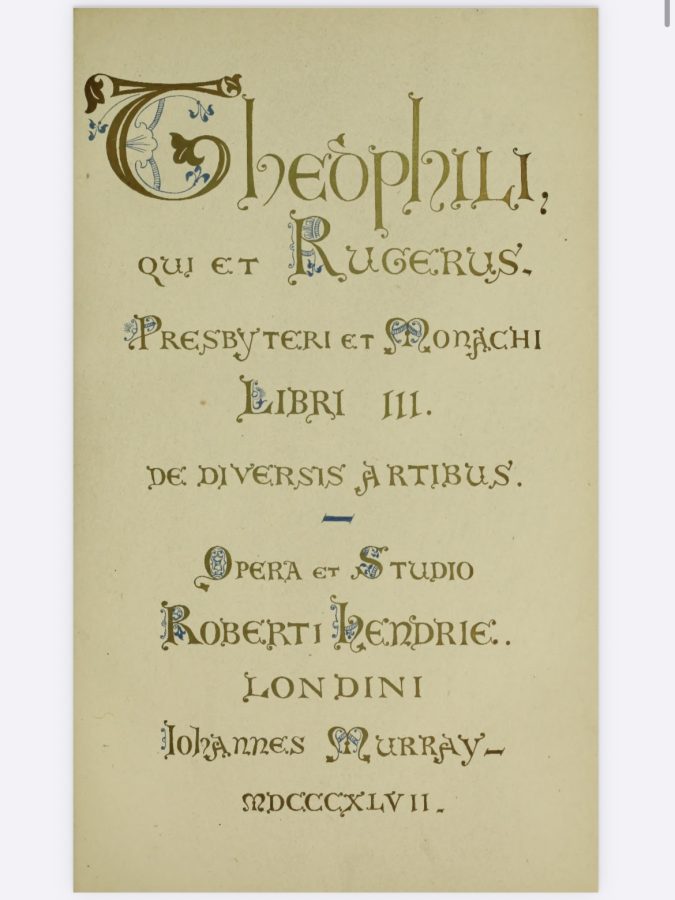
De Diversis Artibus — Theophilus
Date:first half of the 11th century

De Diversis Artibus — Theophilus

These chapters of the De diversis artibus by Theophilus describe the construction of a medieval organ, focusing both on the fabrication of pipes and on the making of the wind chest, sliders and bellows. The text documents with remarkable precision the craft techniques employed in working copper, in soldering and in assembling the various parts of the instrument. Of particular relevance are the directions concerning the ventilation of the organ, the air-supply systems and the arrangement of the sliders, which show a fully developed organbuilding […]

Graphics and Drawing on Paper
The Bible of Stephen Harding
Date:late 11th – early 12th century
Location:Municipal Library of Dijon, France

The Bible of Stephen Harding

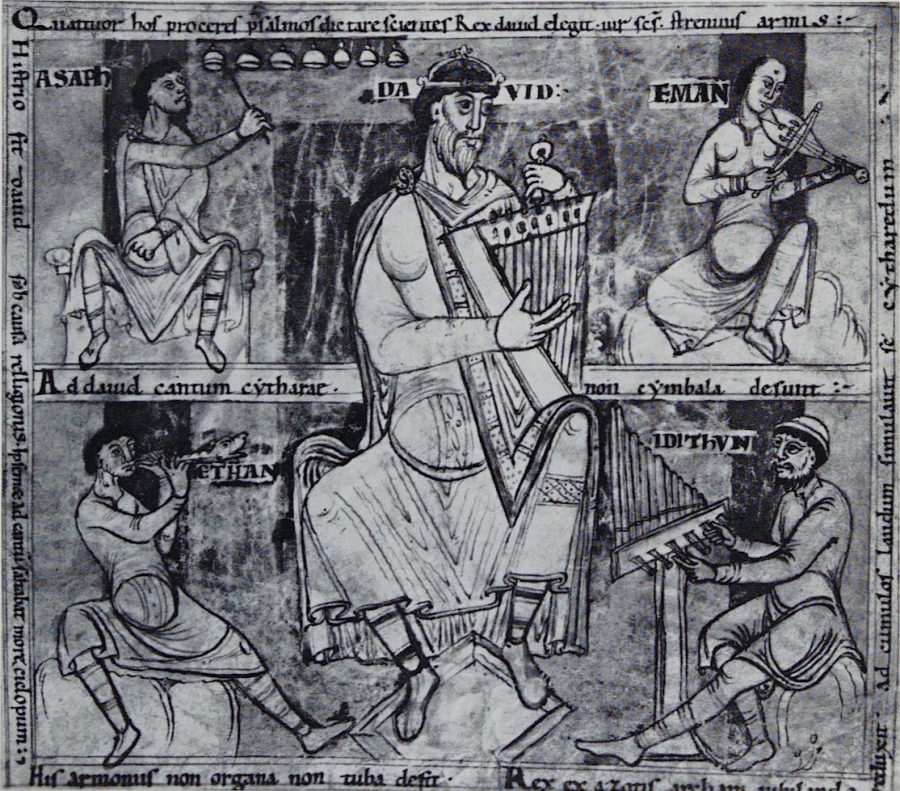
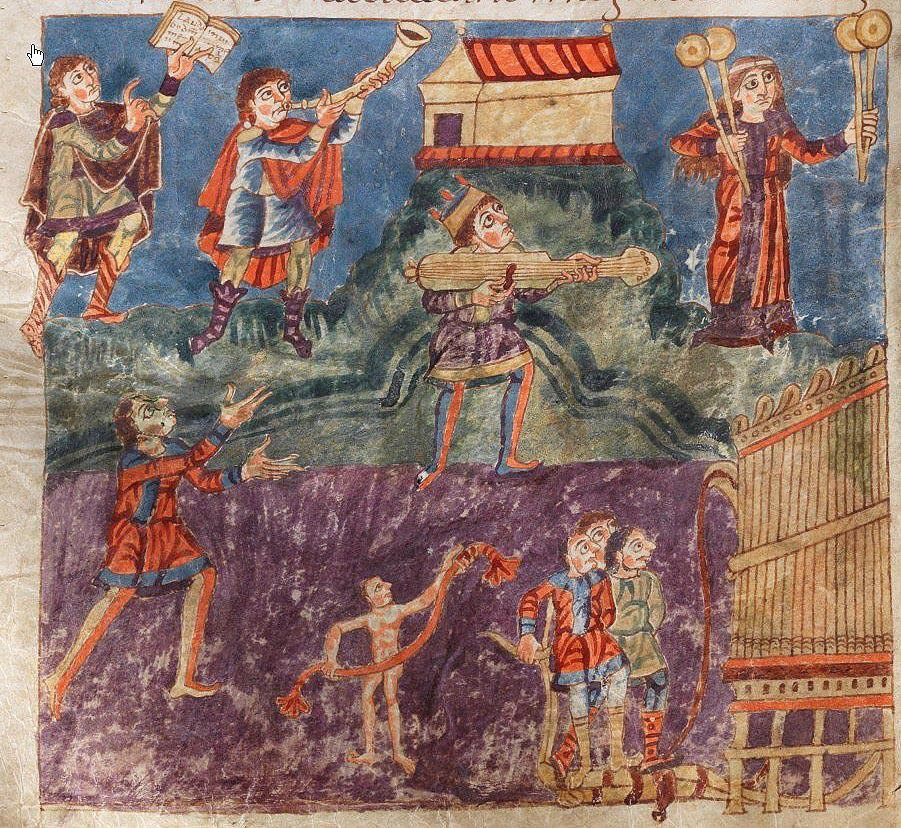
The text describes a slider organ depicted in the Bible of Stephen Harding, Abbot of Cîteaux, dated between the end of the eleventh and the beginning of the twelfth century. The illustration shows King David seated with the harp and sceptre, flanked by various musicians, including a simply drawn organist, seated and with his back bent. The instrument has a thick wind chest supported by two large oblique wind conductors serving as feet, connected to a conflatiorium receiving air from twelve bellows, although not all […]

Graphics and Drawing on Paper
Musica, Book III — Ioannes Cotton
Date:11th–12th century

Musica, Book III — Ioannes Cotton

These passages from the De musica of Ioannes Cotton deal with the nature of musical sound, the classification of instruments and the role of music in medieval theoretical and ecclesiastical tradition. The text distinguishes between natural and artificial instruments, mentions organs, cymbals and stringed instruments within the framework of music theory, and also introduces the concept of diaphony or organum, linking it to medieval polyphonic practice and the terminology of the organ.

Graphics and Drawing on Paper
Ancient Choir of Gerona Cathedral
Date:12th century
Location:Fundació Maurí, La Garriga, Spain

Ancient Choir of Gerona Cathedral

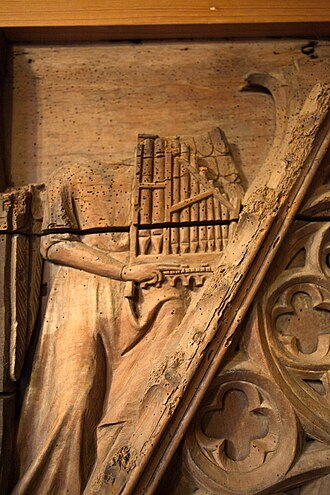
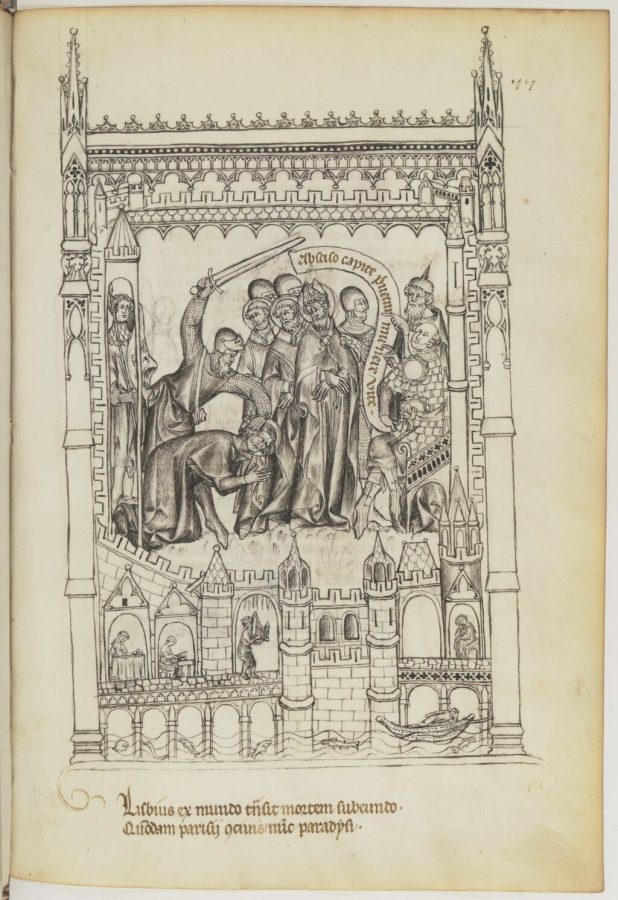
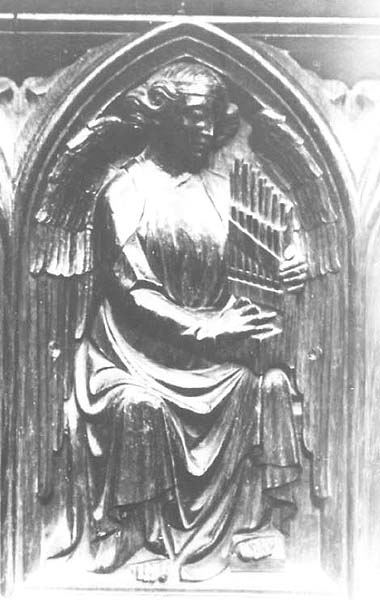
Records exist of a Gothic carved choir stall made at the beginning of the second half of the fourteenth century with the participation of the artist Aloi de Montbrai. Comparing and studying the style of the bishop’s throne with the rest of the stalls, it is excluded that master Aloi intervened in anything more than the bishop’s throne alone; moreover, a document of 1352 exists in which Ferrer de Groins is named as “engaged in finishing the choir of the cathedral.” This choir disappeared when […]

Mural and Architectural Decoration
The Eadwine Psalter
Date:1150
Location:Trinity College, Cambridge, United Kingdom

The Eadwine Psalter

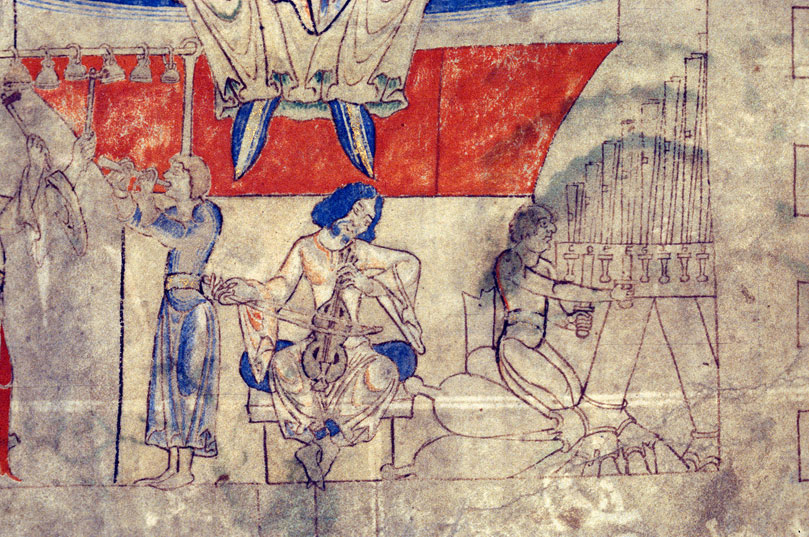
The organ illustration from the Eadwine Psalter (Canterbury; Cambridge, Trinity College, MS R.17.1), c. 1150 AD, has appeared in a number of published works, often accompanied by quotations and descriptions that are comical, in honest error, or that are palpably false. The image itself illustrates some of the hazards encountered in musical iconography, particularly when dealing with visual material dating from the Middle Ages, material that often provides the only clues to the musical practice of that period. The image shows two men apparently in […]

Graphics and Drawing on Paper
King David at the organ
Date:1220-1230
Location:New York, Morgan Library and Museum, M.313, f. 84v

King David at the organ

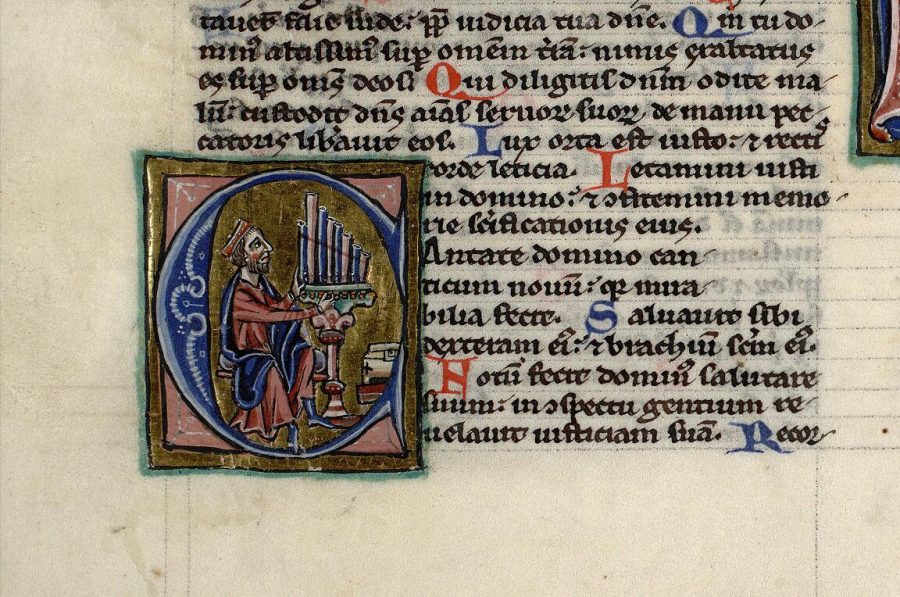
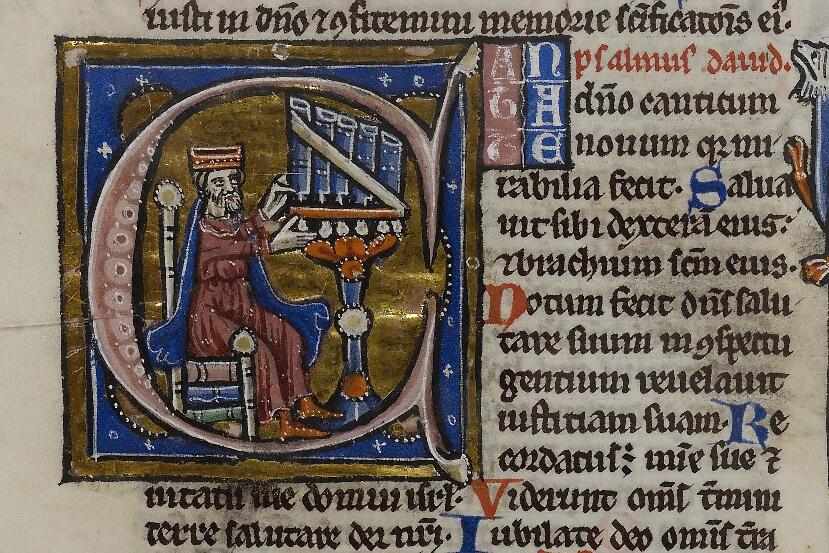
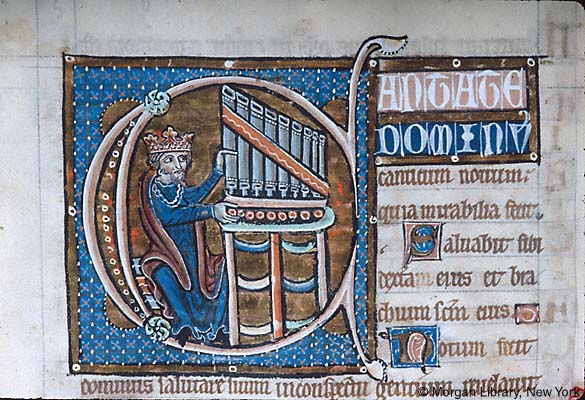
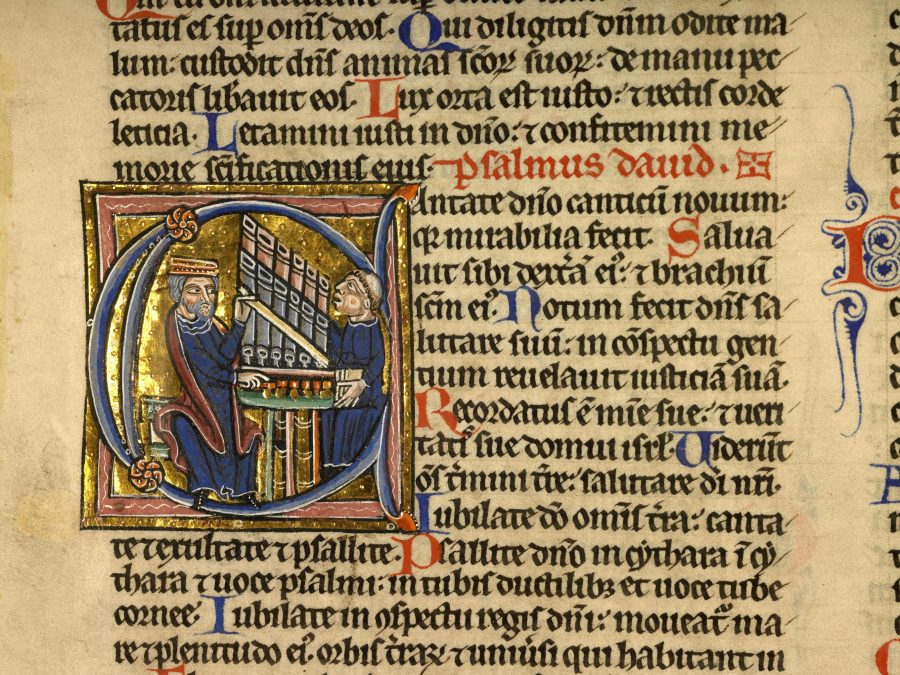
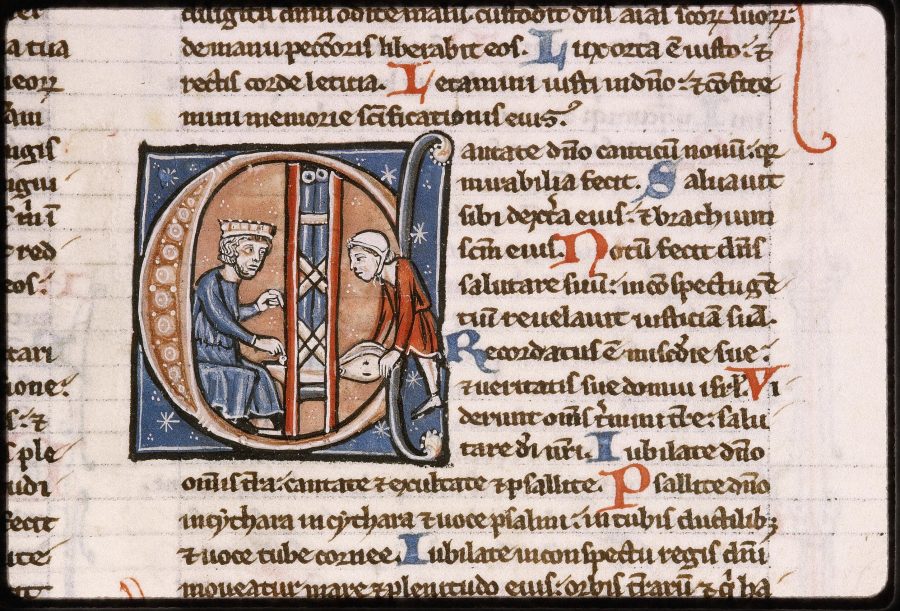
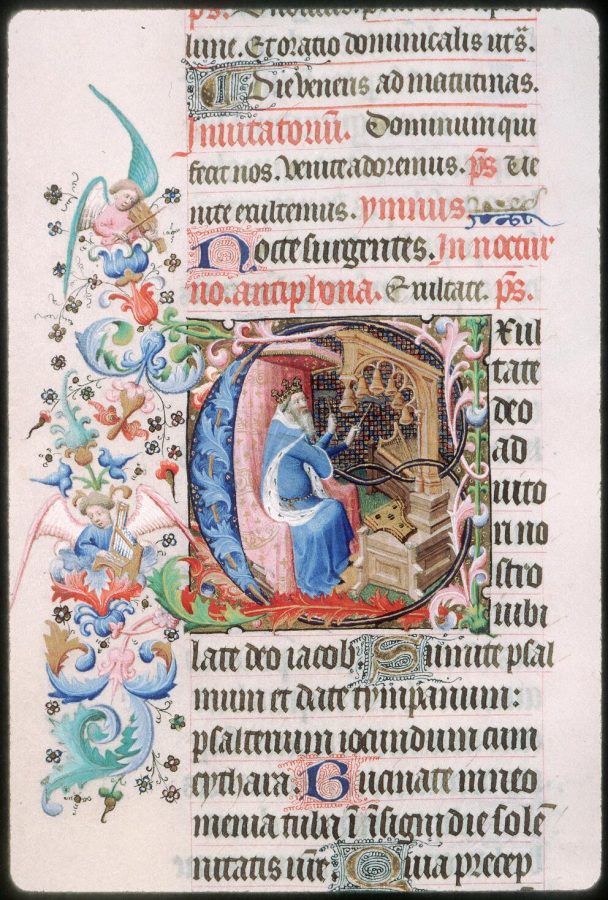
At the opening of Psalm 98, the initial letter “C” is finely decorated and encloses within it the figure of King David as a musician. The sovereign, wearing his crown, is depicted seated on a bench while supporting a positive organ with both hands. The entire scene is embellished by a golden background that makes the royal figure stand out, and is enclosed within a richly ornamented frame that underlines its liturgical and artistic importance.

Graphics and Drawing on Paper
Portative Organ from the Cantigas de Santa Maria
Date:1221-1284
Location:Royal Library of the Monastery of San Lorenzo de El Escorial, near Madrid

Portative Organ from the Cantigas de Santa Maria

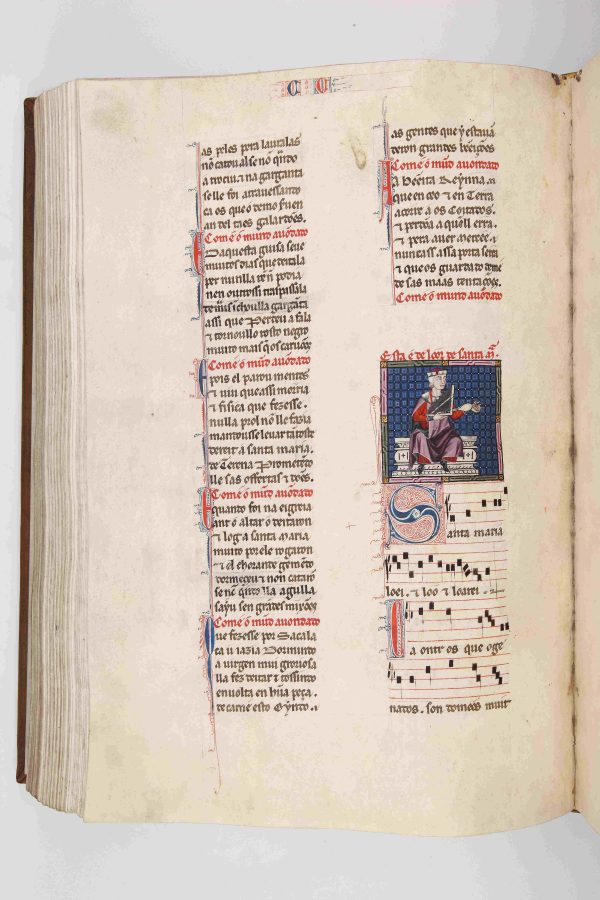
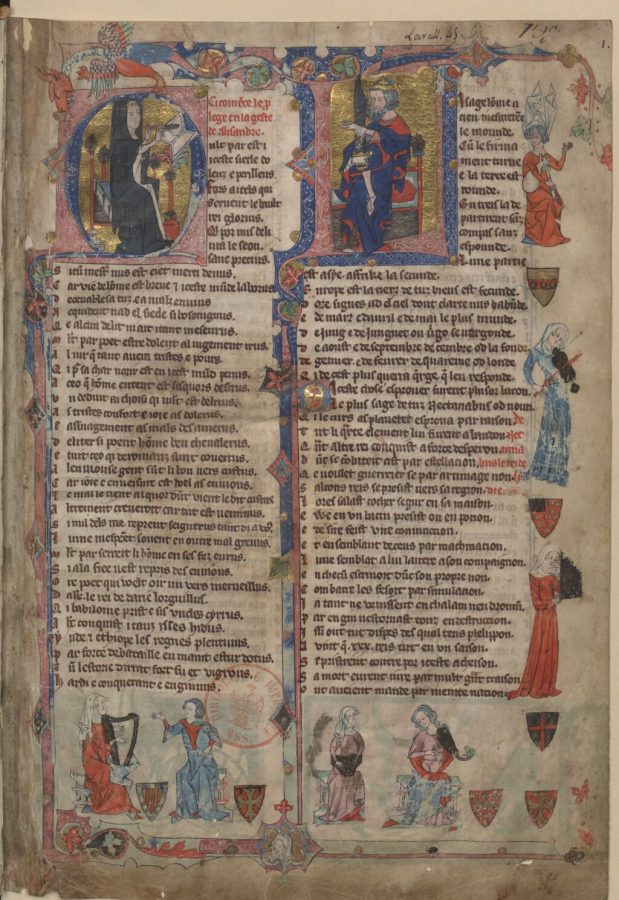
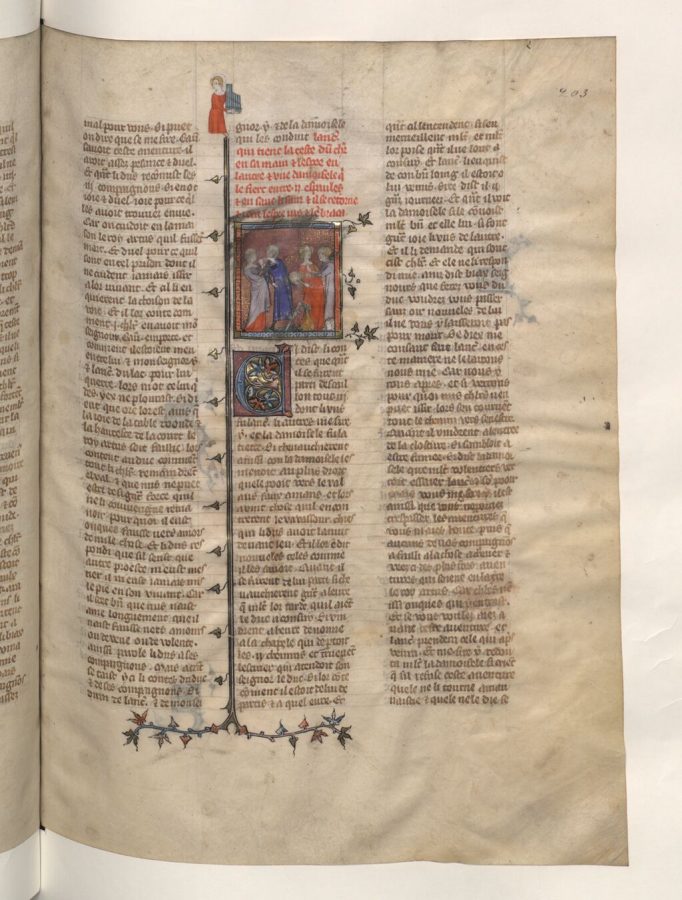
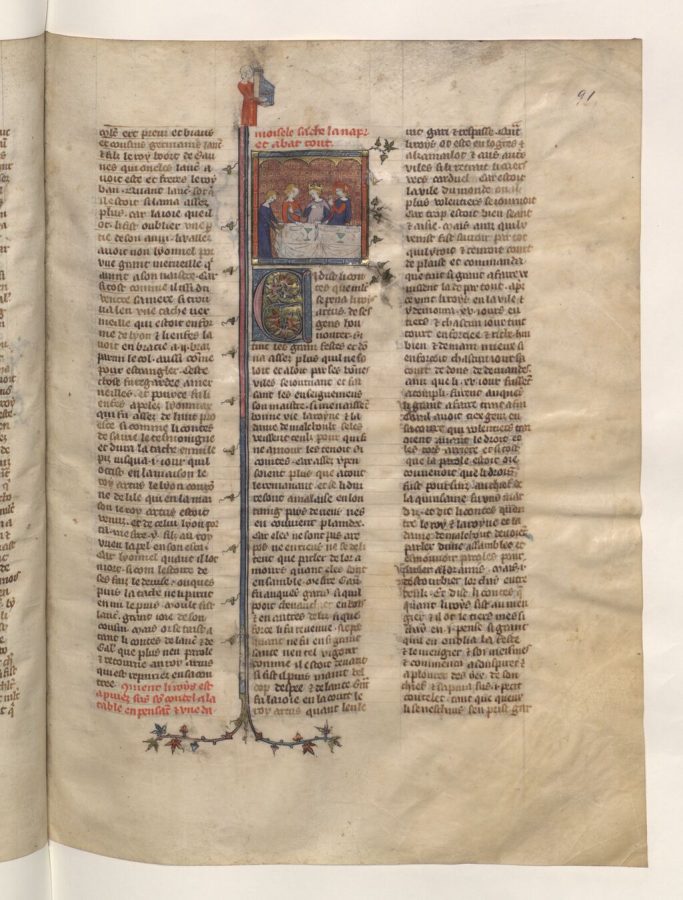
The Cantigas were strongly influenced by the poetry and music of the troubadours, the poets and singers of Occitania, what is now southern France. From the late eleventh to the late thirteenth century, the troubadours developed various song styles, the most famous being fin’amor, refined or perfect love. For the troubadours, perfect love was unrequited. The typical fin’amor song follows these themes: I am in love with an unavailable woman; she is perfect physically and in personality; my life would be complete if only she […]

Graphics and Drawing on Paper
The Last Judgement Portal at León Cathedral
Date:13th century
Location:Cathedral of León, Spain

The Last Judgement Portal at León Cathedral

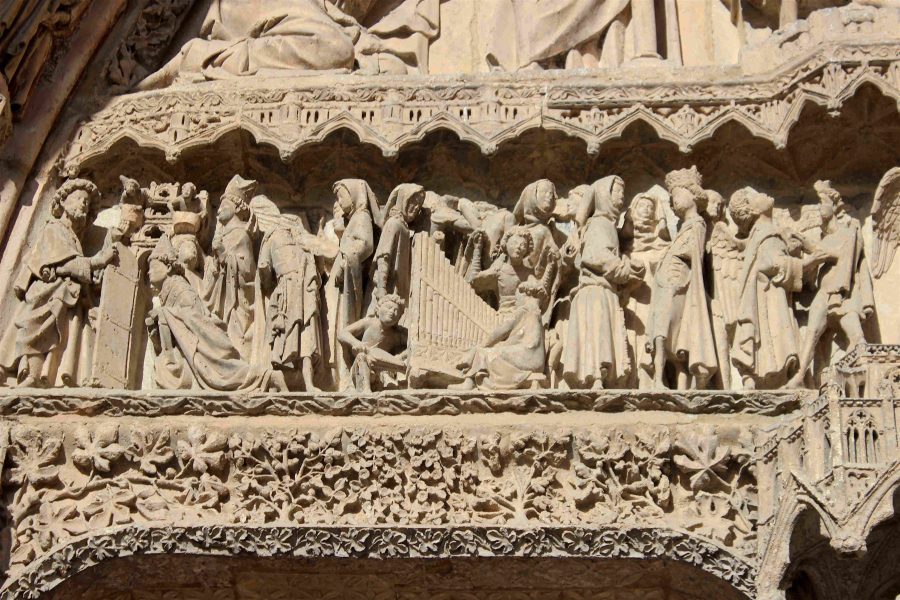
León Cathedral is defined the “pulchra leonina” for the beauty and purity of its style and is considered a masterpiece of Gothic architecture in Spain. The scene of the Last Judgement appears on the deep central portal of the facade. In the central band of the tympanum we see the enthroned Christ, wearing a crown, displaying the wounds of the crucifixion and resting his feet on the holy city, the celestial Jerusalem. He is flanked by two angels holding the instruments of the Passion: the […]

Mural and Architectural Decoration
The Cambridge Psalter
Date:13th century
Location:St. John's College, Cambridge

The Cambridge Psalter

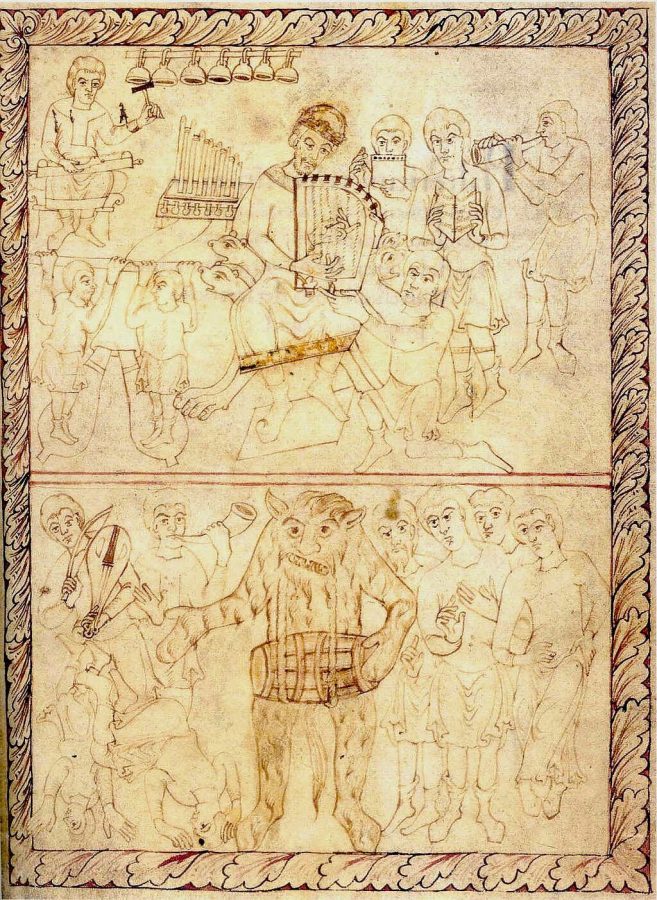
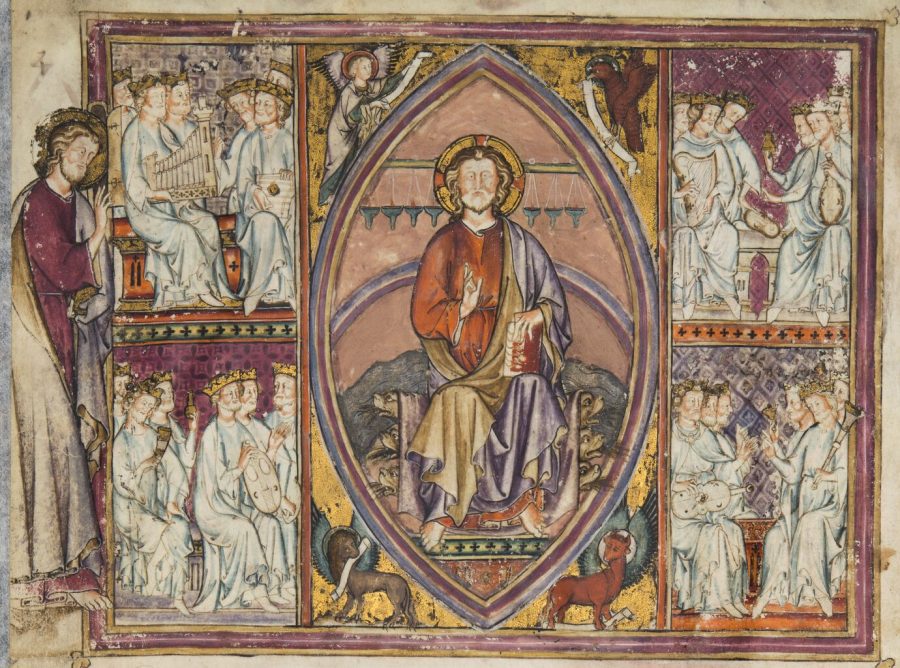
The frontispiece page of the Psalter of Saint-Rémi de Reims is organised in two registers of different sizes, the larger of which occupies the upper part of the image. These two registers are arranged according to a system of symmetry. David, placed at the centre of the upper register, is answered by a bear figure or a mask — the ambiguity is undoubtedly deliberate — striking a drum. In Christian exegesis, which relies largely on analogies, instruments do not intrinsically possess positive or negative symbolic […]

Graphics and Drawing on Paper
Manuscript 11560 of the National Library
Date:13th century
Location:Bibliothèque Nationale de France, Paris

Manuscript 11560 of the National Library

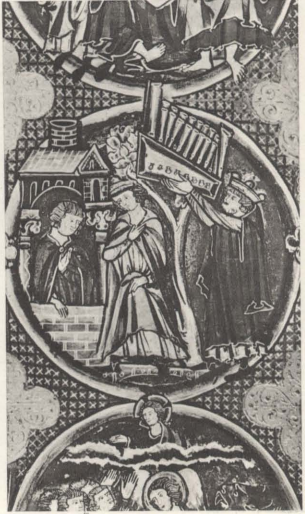
The miniature, inserted in a rich psalter, depicts a positive organ being carried by a sumptuously dressed figure, in the act of hanging it on a tree, in reference to the psalm verse “… in salicibus suspendimus organa nostra.” The instrument presents an imposing wind chest supporting two rows of 10 conical pipes: the front row, with visible mouths, is lower than the back row. The outermost pipes are unusually tall and show no evident supports. The manual comprises eight rounded keys. No bellows is […]

Graphics and Drawing on Paper
The Glossary of Solomon
Date:13th century
Location:Bavarian State Library (Bayerische Staatsbibliothek, München), Germany

The Glossary of Solomon

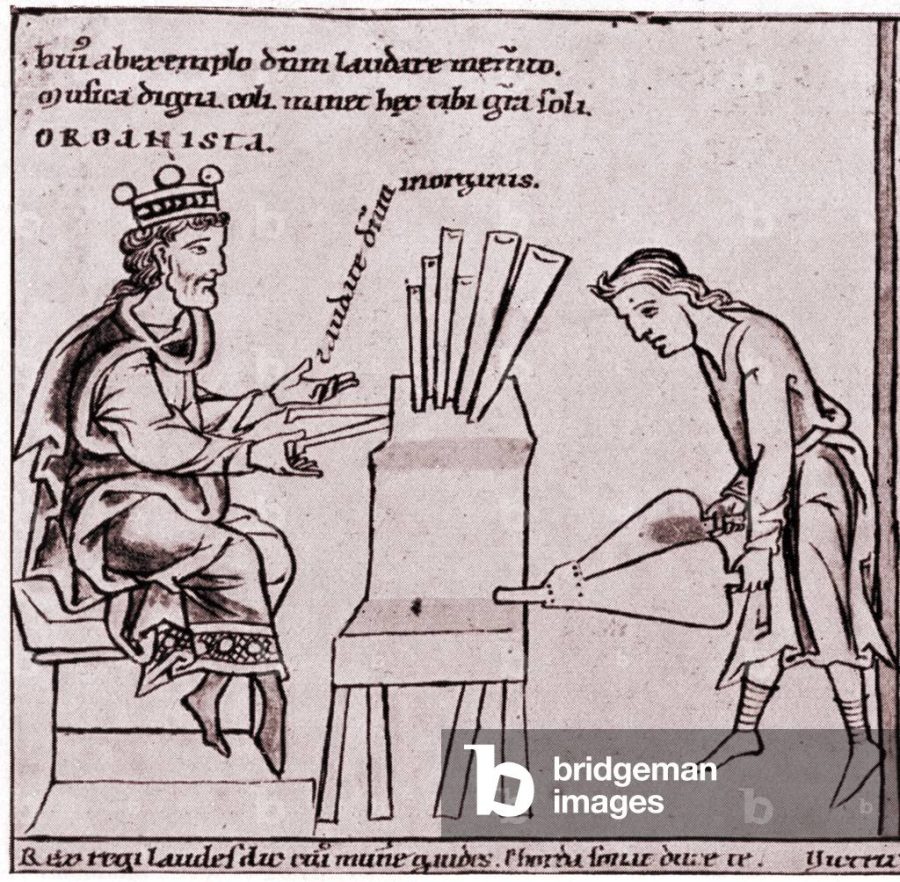
The miniature of the Glossarium Salomonis depicts crowned and richly dressed King David playing a small quadrangular organ resting on four feet. The wind chest supports 6 conical pipes; the keyboard, extremely reduced, is represented by two long curved sticks, one of which is pressed with the organist’s right hand, while the left symbolically accompanies the words of the overhanging psalm: “Laudate Dominum in organis.” The air supply is provided by a two-handled bellows, operated by a standing assistant, with a duct inserted into the […]

Graphics and Drawing on Paper
The Munich Manuscript
Date:13th century
Location:University Library of Munich (Ludwig-Maximilians-Universität München)

The Munich Manuscript

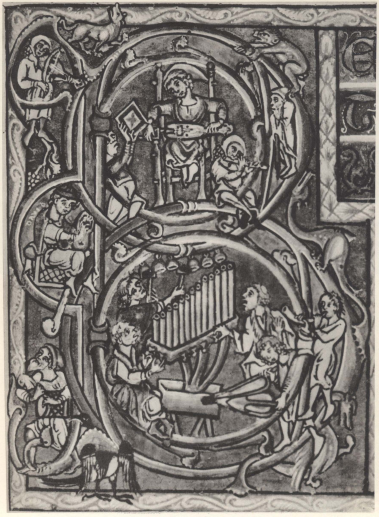
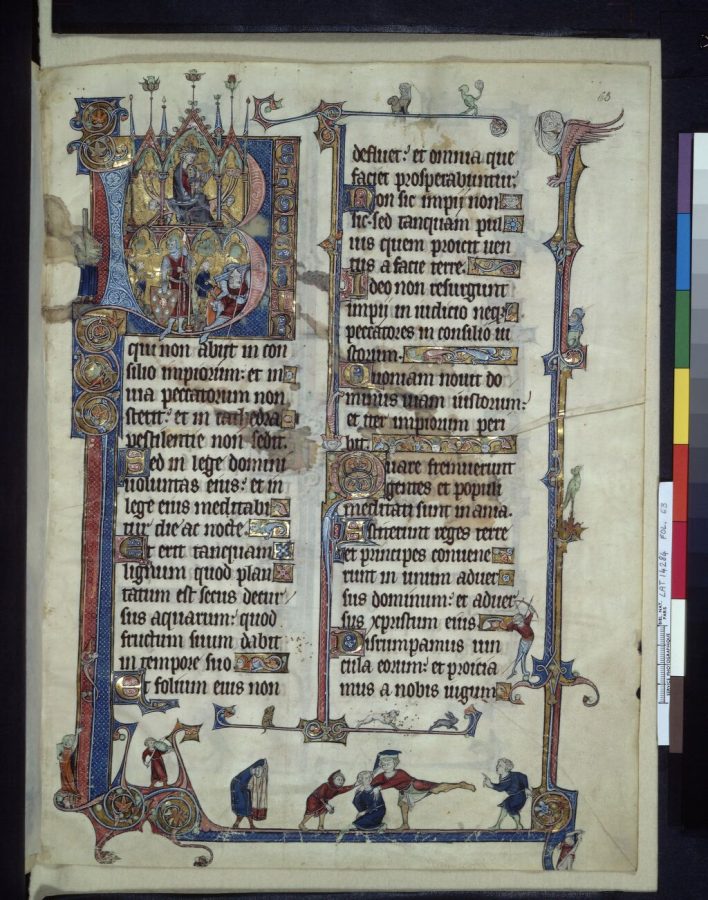
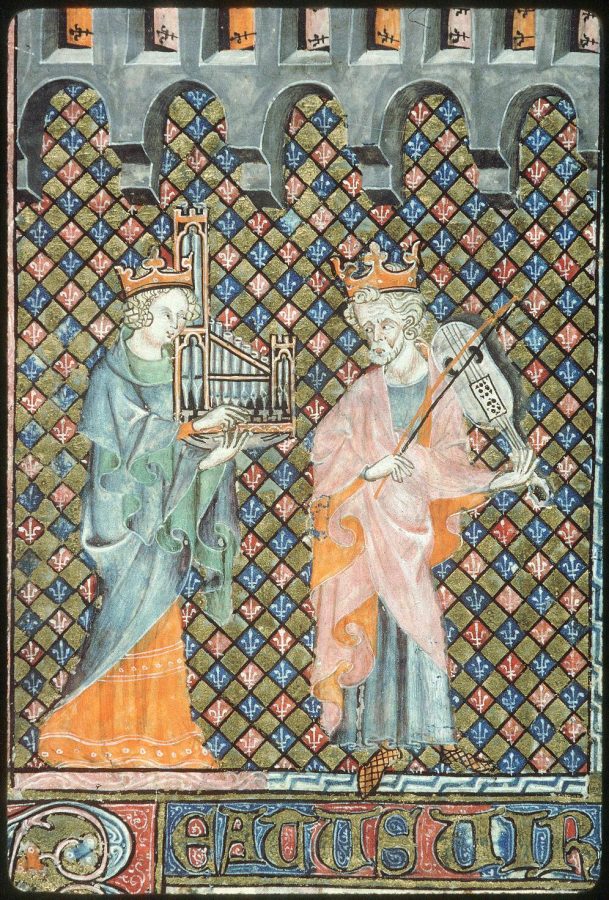
The miniature, inserted in the initial B of the psalm Beatus vir, depicts a concert scene with various instruments, giving particular prominence to the organ and the cymbalum, while King David is placed in a marginal position. The organ, considerably larger than the other instruments, is played by two tonsured organists and is assisted by a bellows operator. The rectangular wind chest is supported by three wind conductors supplying the treble, middle and bass sections. On the front face four rounded keys can be seen, […]

Painting on Movable Support
The Rutland Psalter
Date:1260
Location:British Museum, London

The Rutland Psalter

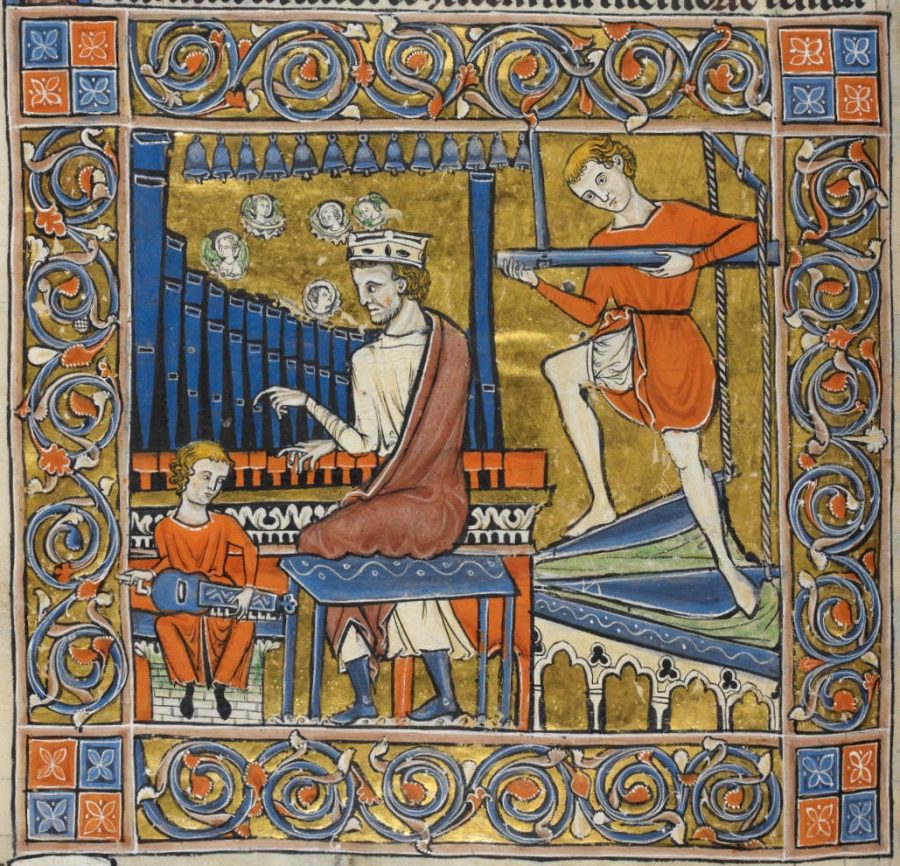
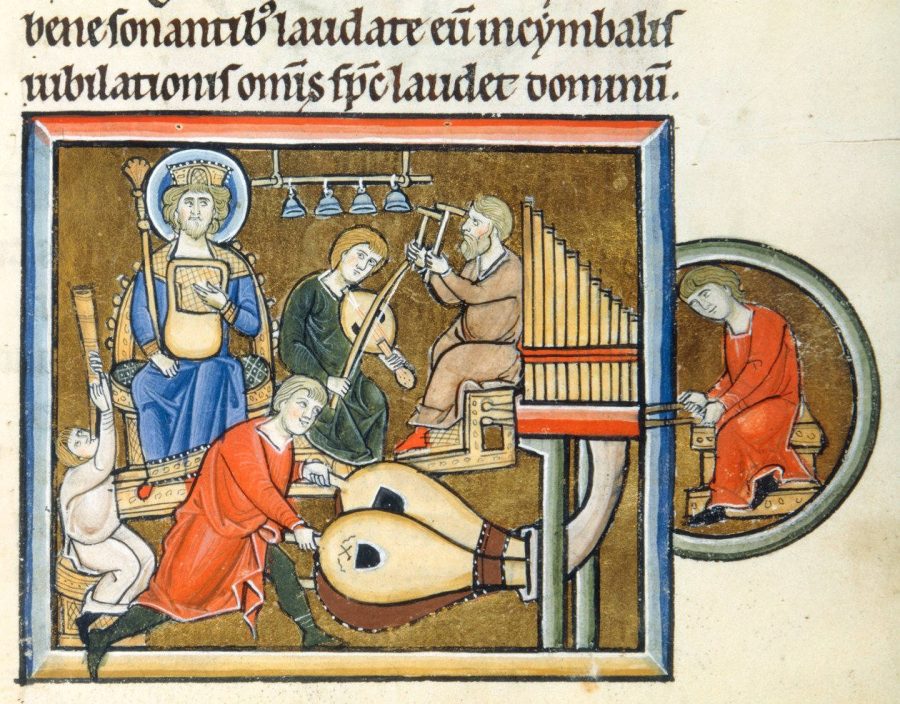
Towards the end of Psalm 96 in the Rutland Psalter, this miniature is found in which King David plays a pipe organ, assisted by a figure operating the bellows and striking a row of bells.The decoration in this volume is the work of four master artists and their assistants (see Morgan, “The Artists of the Rutland Psalter,” 1987). The thirteenth-century illuminators were rather more figurative and many details are lacking, such as the strings. However, the overall size and shape of the instrument can be […]

Graphics and Drawing on Paper
A hooded monkey playing the organ
Date:1275-1299
Location:New York, Morgan Library and Museum, M.729, f. 306r

A hooded monkey playing the organ

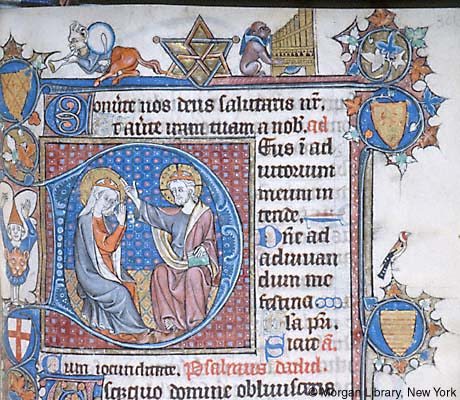
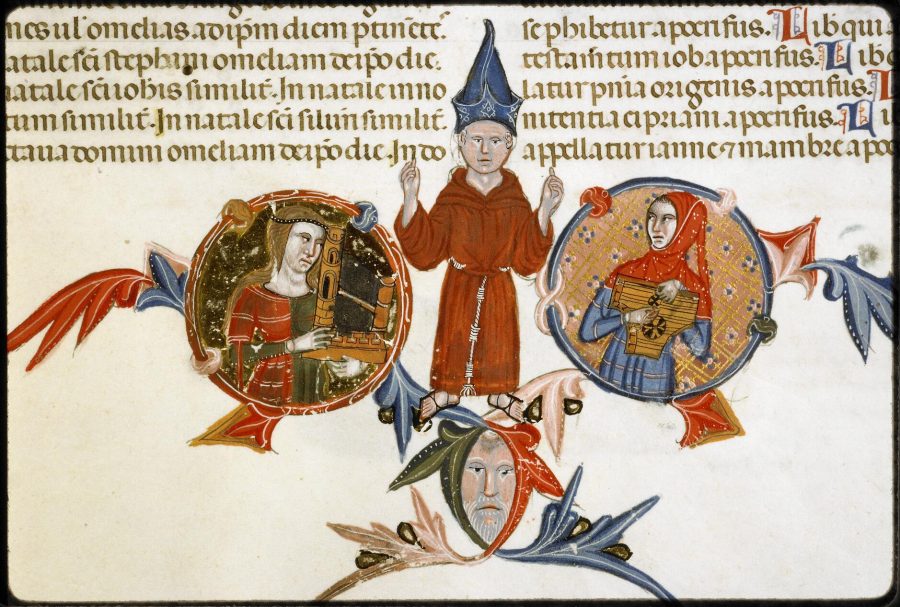
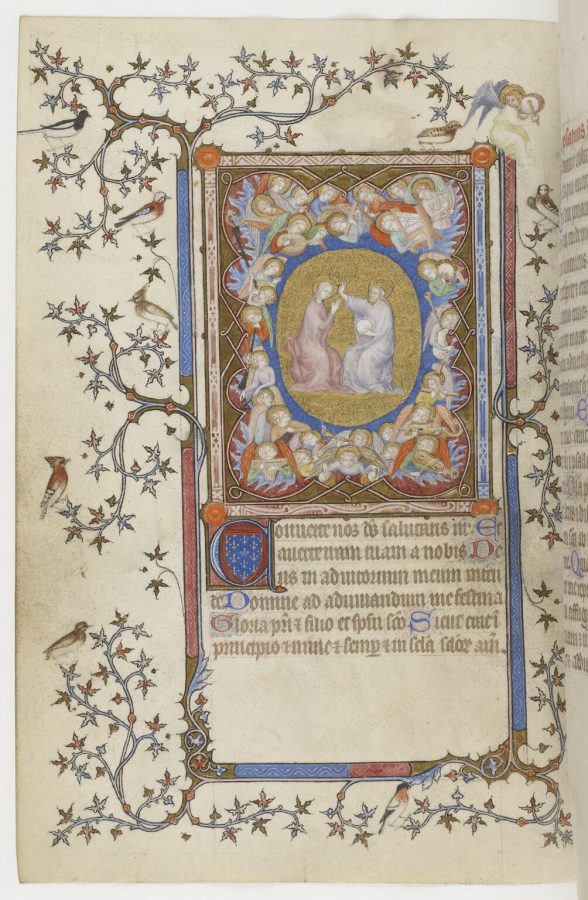
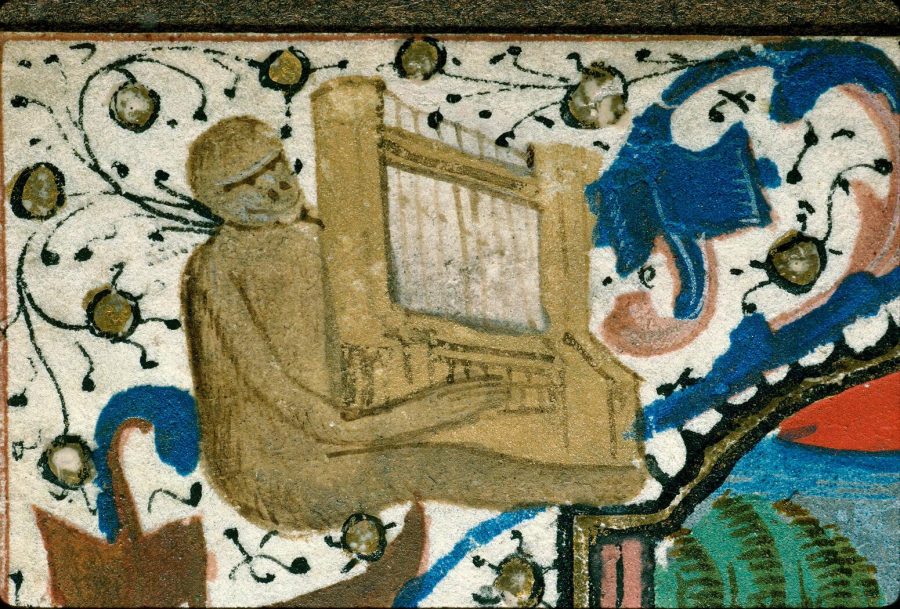
Within a large letter “D” decorated with geometric motifs and a small diamond-pattern background, the Coronation of the Virgin is depicted. Mary, veiled and crowned, raises her joined hands in prayer toward Christ. He, surrounded by a pearl halo, holds a book in his left hand and raises his right toward his Mother in a gesture of blessing. Both are seated close together on a bench covered with a precious drape. All around, the margins of the page are adorned with leaf and interlacing motifs […]

Graphics and Drawing on Paper
Musical Angels and The Anguish of Hell
Date:1290
Location:Walters Art Museum, Baltimore, United States

Musical Angels and The Anguish of Hell

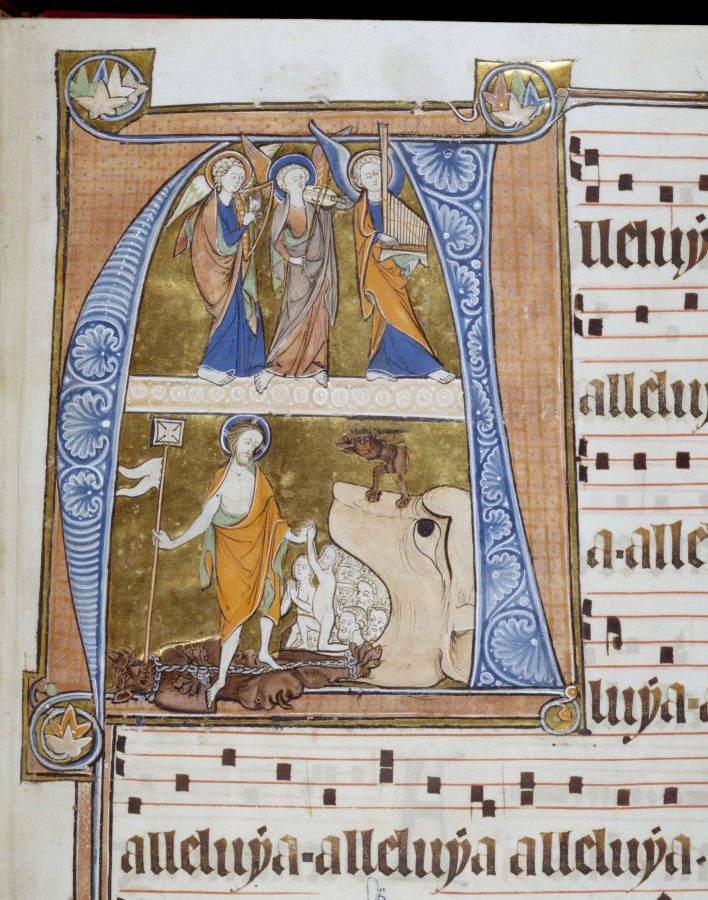
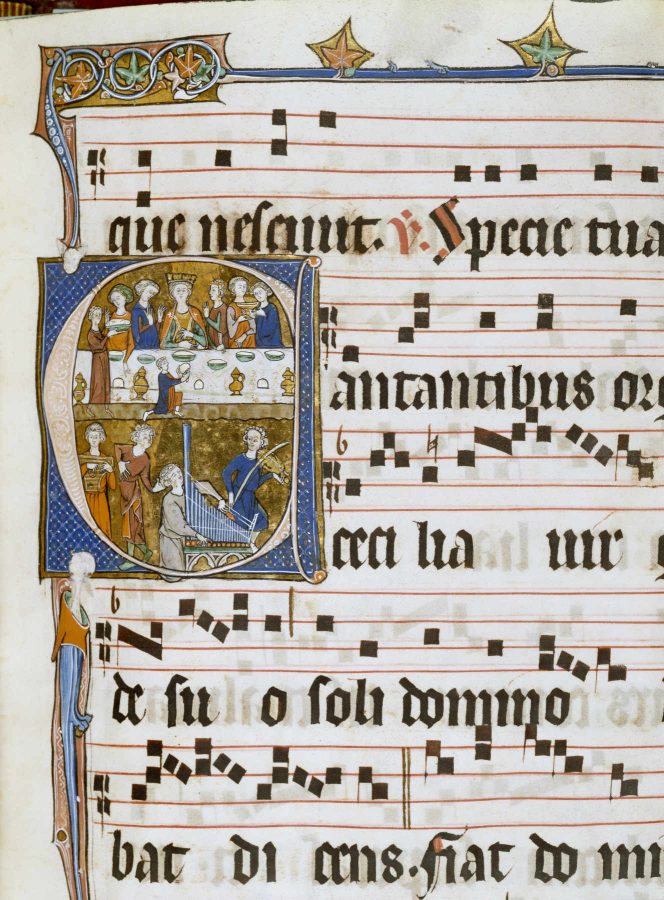
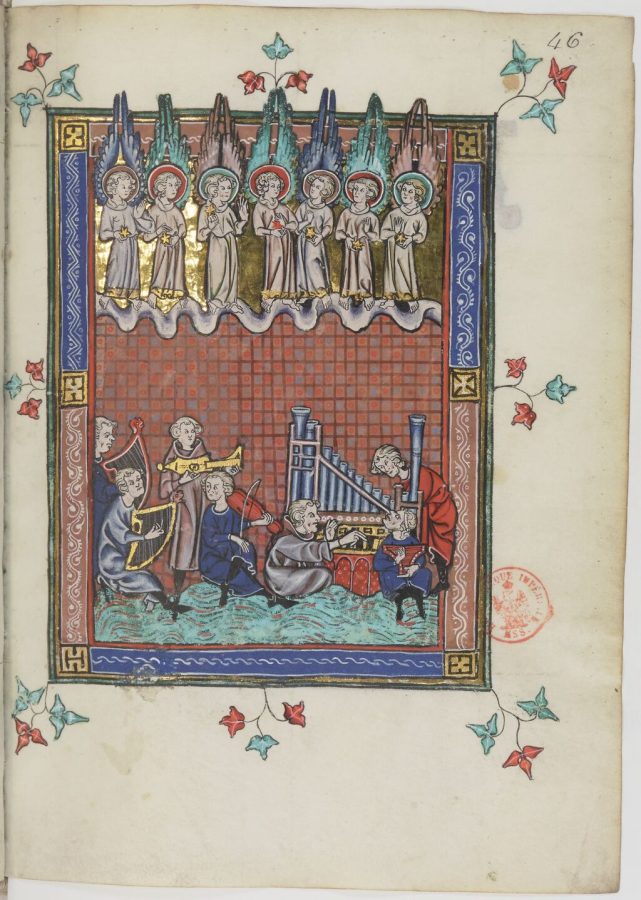
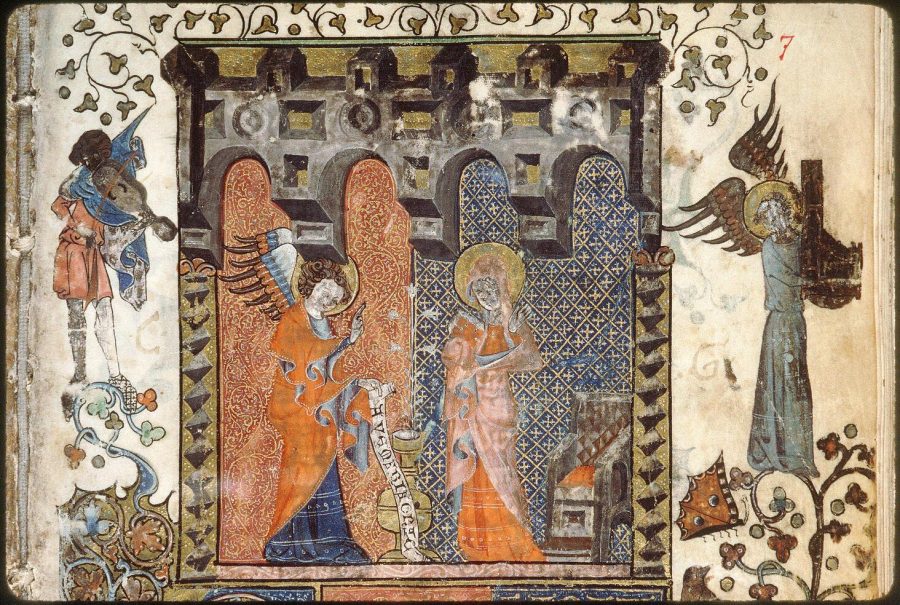
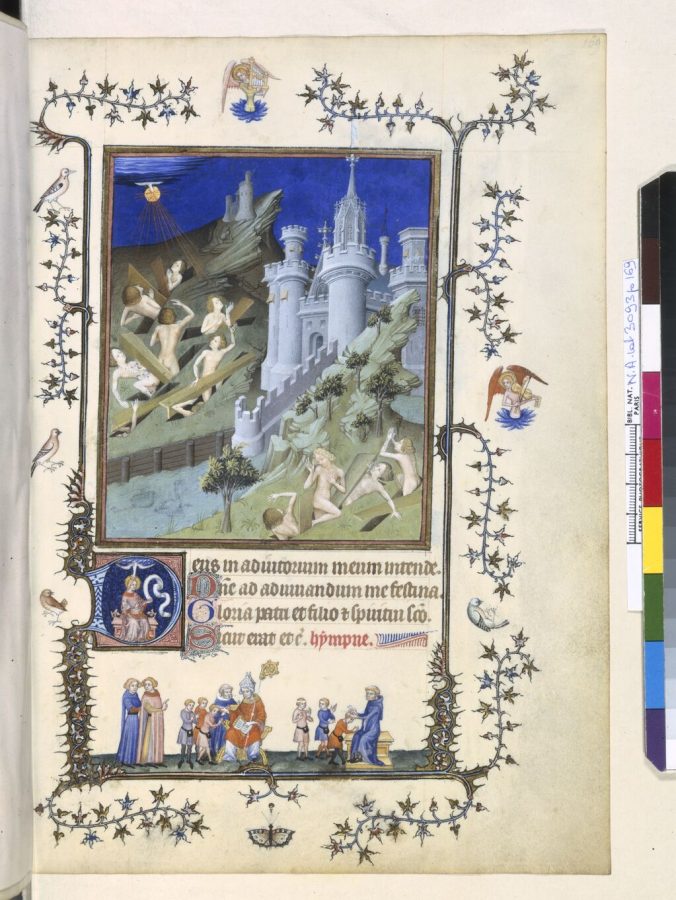
The page is divided into two registers within a decorated initial: in the upper register three musical angels play three instruments (from left: harp, vielle and small portative organ) in a celestial scene, probably celebrating the resurrection. The lower register instead depicts the apocryphal scene of the “Harrowing of Hell” in which Christ, wearing a bright orange robe and carrying a white banner, frees the righteous souls (including Adam and Eve) from the mouth of Hell, represented as a large monstrous mouth.

Graphics and Drawing on Paper
King David sitting on the floor, playing the organ
Date:1300-1320
Location:New York, Morgan Library and Museum, S.10, f. 7r

King David sitting on the floor, playing the organ

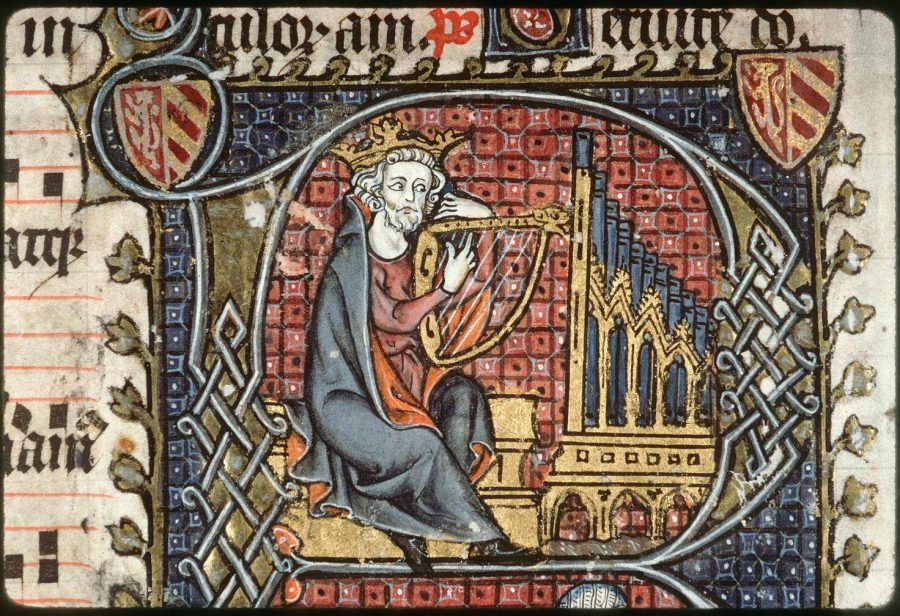
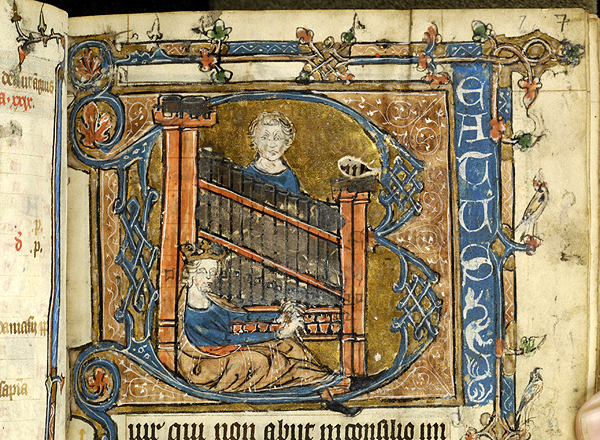
Within a large letter “B” formed by complex interlacing, King David is depicted with the crown on his head, seated on the ground while reaching his hands toward the keyboard of a small portable organ. Behind the instrument the bust of another male figure emerges. The entire scene and the text block are enclosed in a geometric frame in blue, pink and gold, decorated with leaves. In the margins of the page the decoration becomes more lively: on the right small birds can be seen […]

Graphics and Drawing on Paper
King David at the harp with the organ and a set of bells
Date:1300-1310
Location:New York, Morgan Library and Museum, M.751, f. 8r

King David at the harp with the organ and a set of bells

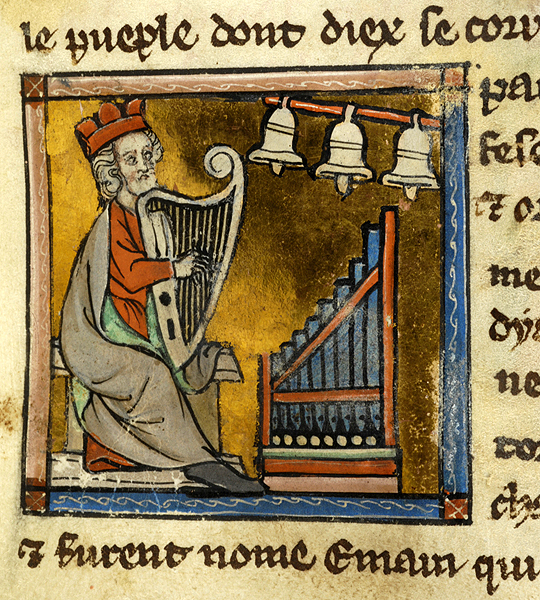
In this miniature, which illustrates the preface dedicated to David as a musician, the King is depicted wearing a crown while seated on a bench playing the harp. Before him stands a rod from which three bells (the cymbals) hang, while at his feet a small portable organ rests. The scene stands out against a luminous golden background and is enclosed in a pink and blue frame, enriched with delicate white decorations. The illustration is inserted in the manuscript right beside the texts celebrating David’s […]

Graphics and Drawing on Paper
A Miniature of Pope Sylvester with a Steam Organ
Date:1300-1310
Location:Morgan Library and Museum, New York

A Miniature of Pope Sylvester with a Steam Organ

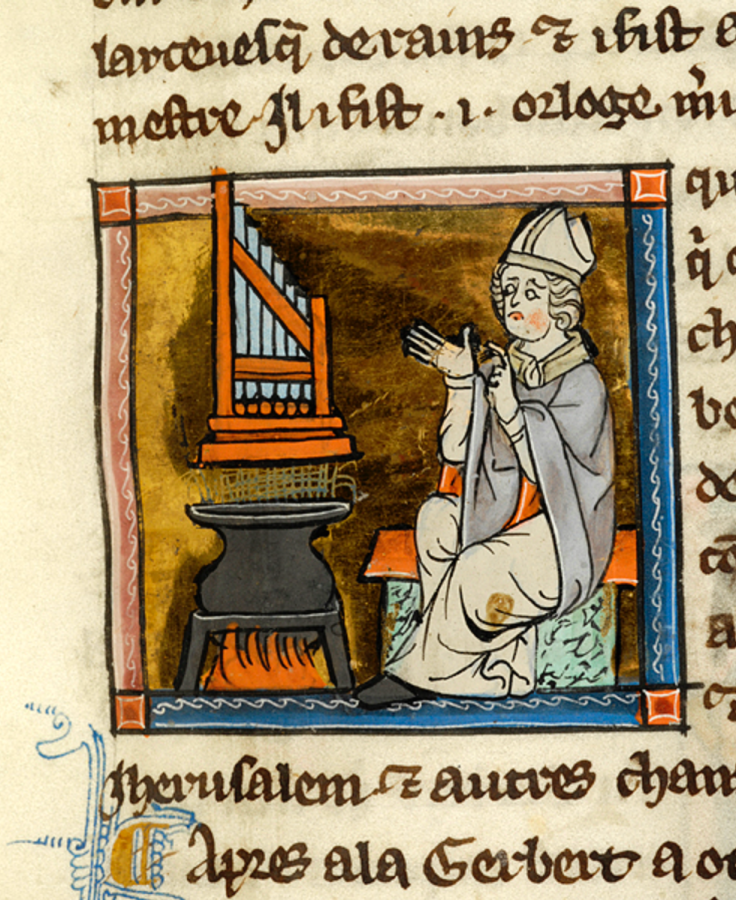
This miniature illustrates a celebrated legendary episode associated with Sylvester II, known as the “scientist pope.” The scene, enclosed in a pink and blue frame against a precious golden background, shows a portable organ suspended above the steam rising from a cauldron placed over a fire. On the right, Sylvester II is depicted in episcopal vestments, with mitre and chasuble, gesticulating with both hands while seated on a bench, turned toward the instrument. The image serves as an iconographic illustration to the text narrating the […]

Graphics and Drawing on Paper
The Portal of the Cathedral of Saint-Jean-Baptiste de Lyon
Date:early 14th century
Location:Cathedral of Lyon, France

The Portal of the Cathedral of Saint-Jean-Baptiste de Lyon

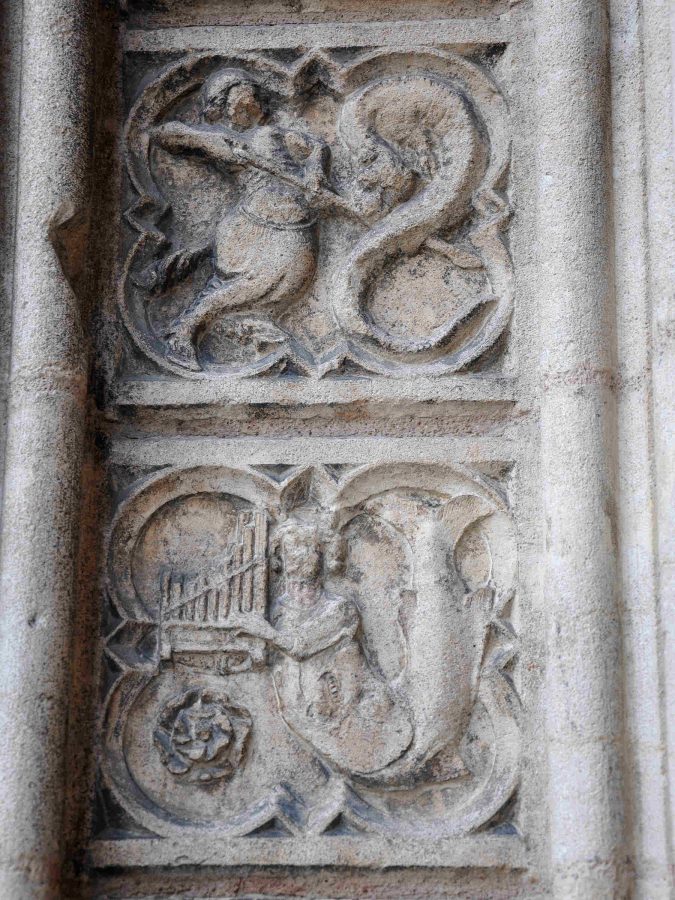
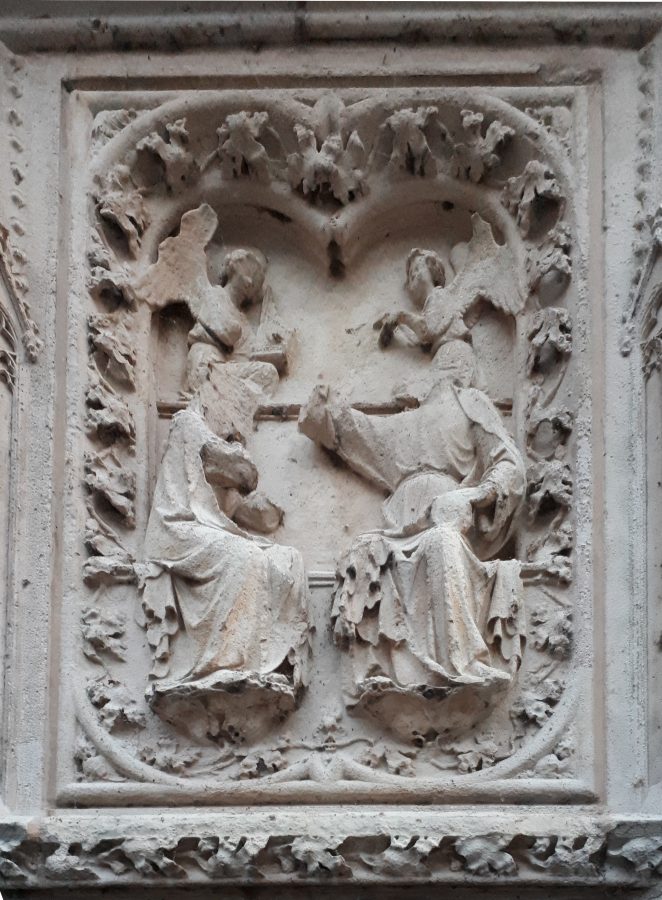
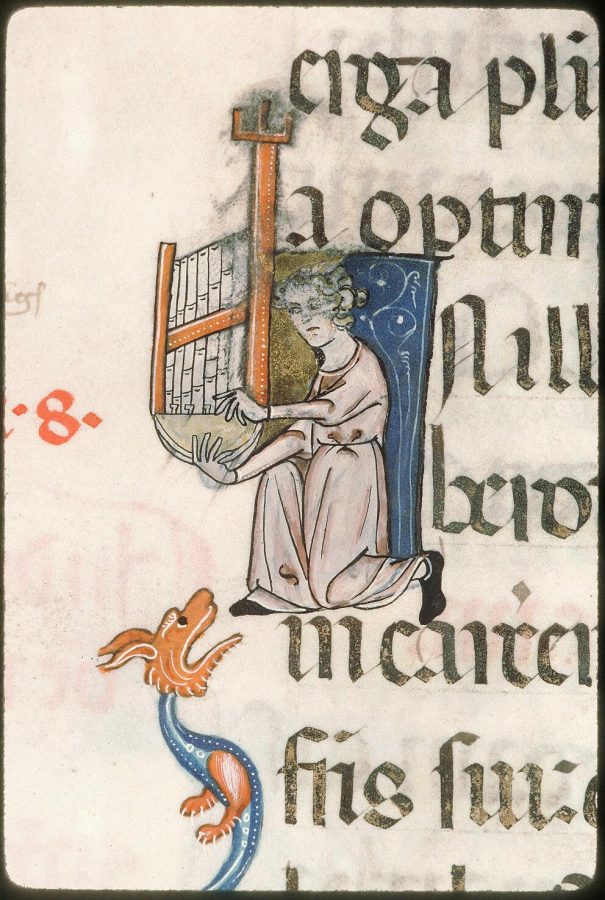
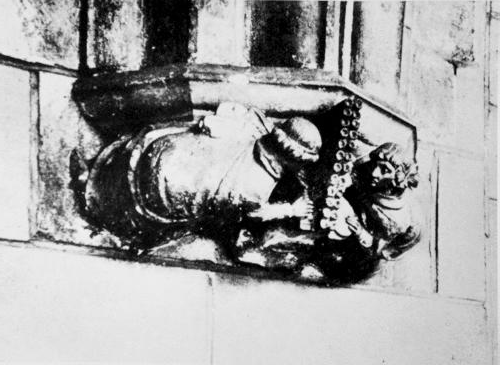
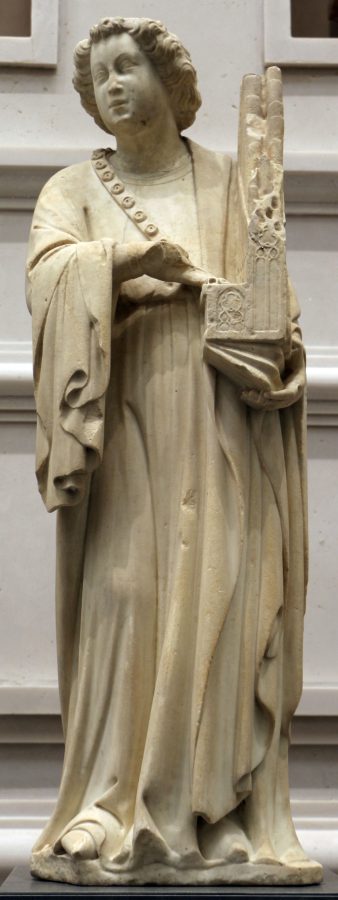
The image shows two carved stone reliefs, which are architectural details from the Primatiale Saint-Jean in Lyon, France. The reliefs are on the external facade of the cathedral: the upper one shows a figure wrestling with a dragon or serpent, while the lower one depicts a seated figure beside what appears to be a pipe organ or similar musical instrument.

Mural and Architectural Decoration
Coronation of the Virgin at Notre-Dame Cathedral, Paris
Date:1315-1318
Location:Cathédrale Notre-Dame de Paris, Paris, Île-de-France, France

Coronation of the Virgin at Notre-Dame Cathedral, Paris

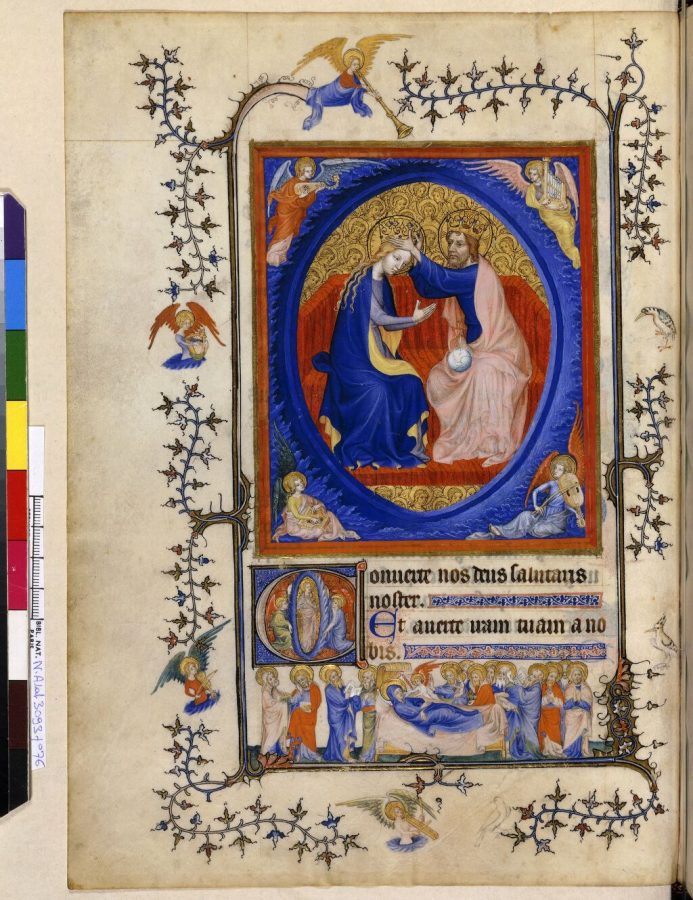
On relief number 5 of the north wall of the choir, within a richly decorated frame of leaf motifs, the scene of the Coronation of the Virgin is carved. Mary, wearing a veil and crown, is seated on a bench beside Christ. Although time has damaged the figures — the heads of both and the right hand of Jesus have been lost — the solemnity of the gesture can be sensed: Christ rests his left hand on what appears to be a globe, a symbol […]

Mural and Architectural Decoration
A Hybrid Man Operating a Bellows
Date:1320-1330
Location:New York, Morgan Library and Museum, M.754, f. 88r

A Hybrid Man Operating a Bellows

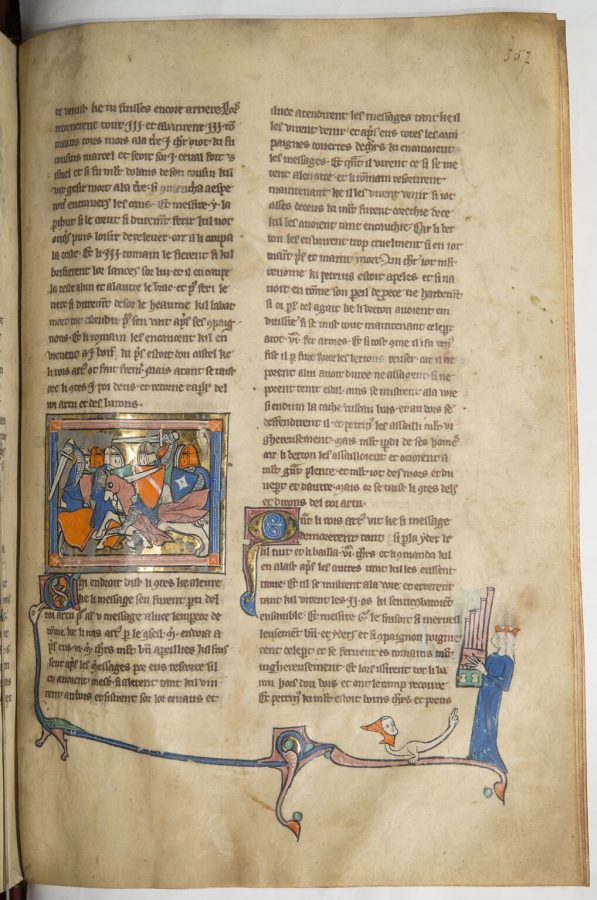
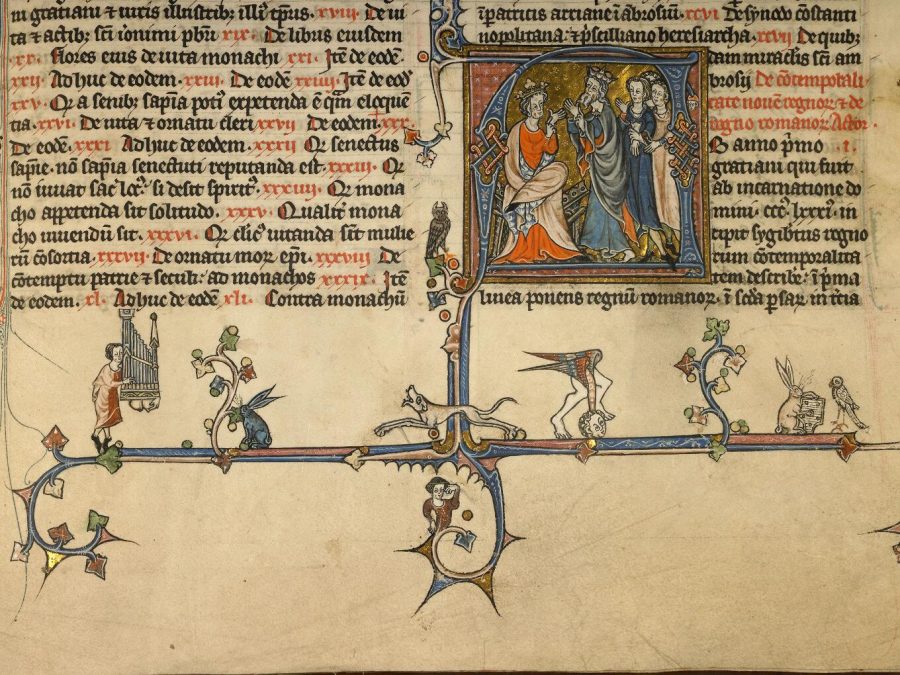
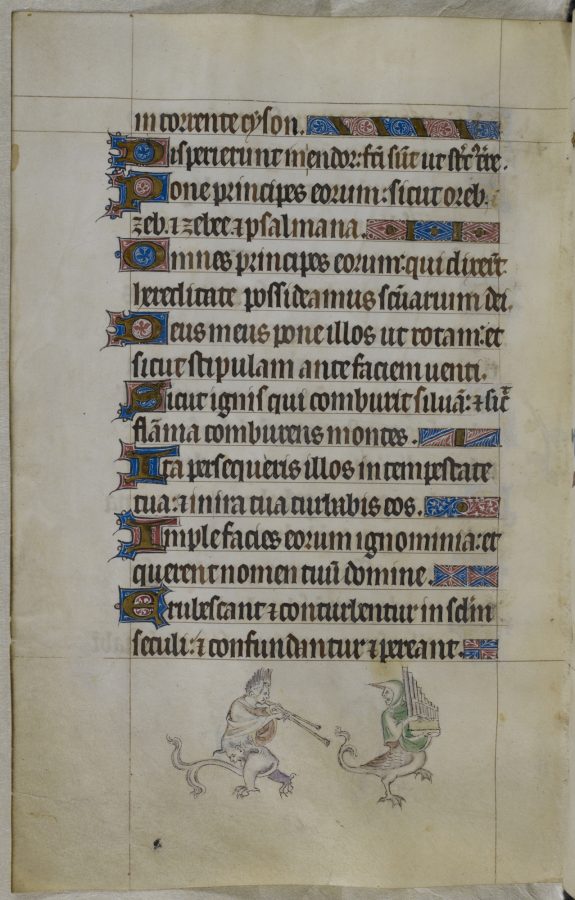
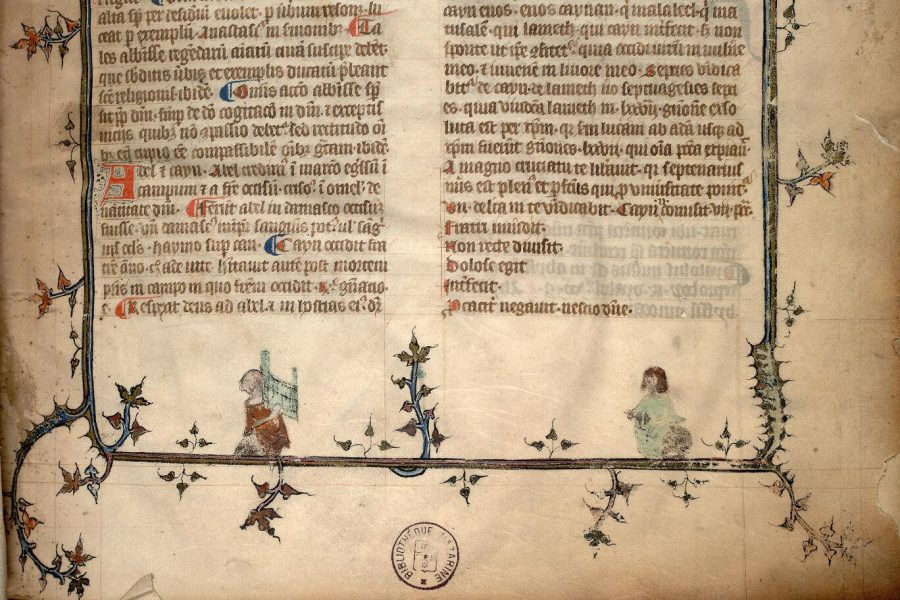
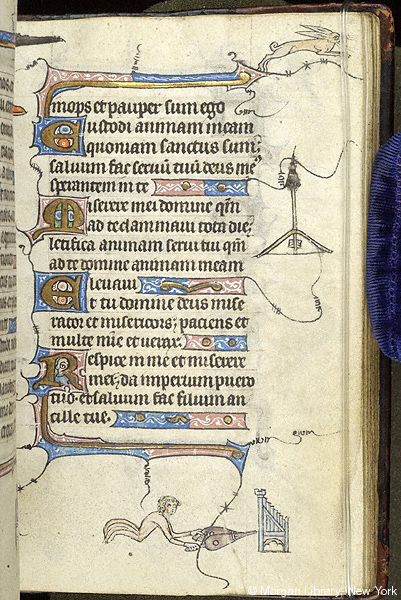
Jerome’s Psalter opens with four decorated initial letters (E, M, E and R) enclosing within them figures of hybrid men. The page is framed by horizontal borders in the upper and lower margins, populated by curious creatures and narrative scenes. In the upper section a fantastical animal with a beak and a rabbit can be distinguished. The latter is the target of a bow and arrow drawn in the right margin and aimed upward. The lower border is animated by a hybrid man intent on […]

Graphics and Drawing on Paper
The Consecration of the Church
Date:1325-1349
Location:Switzerland, Aarau, Aargau, Aargauer Kantonsbibliothek, Wett., II, f. 177v

The Consecration of the Church

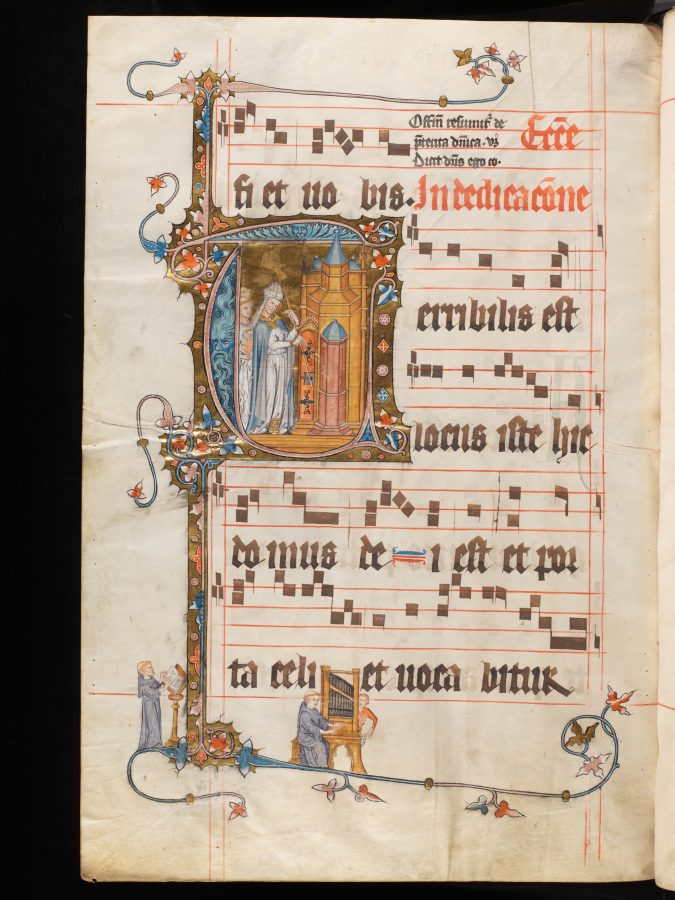
Within an initial letter “T,” enriched with leaf motifs and small human and animal faces, the solemn scene of the Consecration of the Church is depicted. A bishop, wearing the mitre and liturgical vestments, symbolically strikes the door of the sacred building with his crozier; beside him, a tonsured deacon holds a book closed with two straps. The entire action stands out against a precious golden background. The decoration continues in the lower margin, where a scene of monastic life unfolds: two tonsured monks are […]

Graphics and Drawing on Paper
The Manuscript of Cividale del Friuli (Psalter of Saint Elizabeth)
Date:first third of the 13th century
Location:Archaeological Museum of Cividale del Friuli

The Manuscript of Cividale del Friuli (Psalter of Saint Elizabeth)

Various instrumentalists are once again gathered around King David in this document generally dated to the first third of the thirteenth century: a cornetto player, a viol player, a cymbal player seated and holding a small hammer in both hands, and an organist can be distinguished.The organist, dressed in a long robe, is seated on an ornate seat. With his left hand toward the instrument he grasps one key per hand in the evident act of pulling or pushing it back; due to a perspectival […]

Graphics and Drawing on Paper
The Statues of the Chamber of Beauties
Date:1330 ca.
Location:Bibliothèque Nationale de France, Ms. français 60

The Statues of the Chamber of Beauties

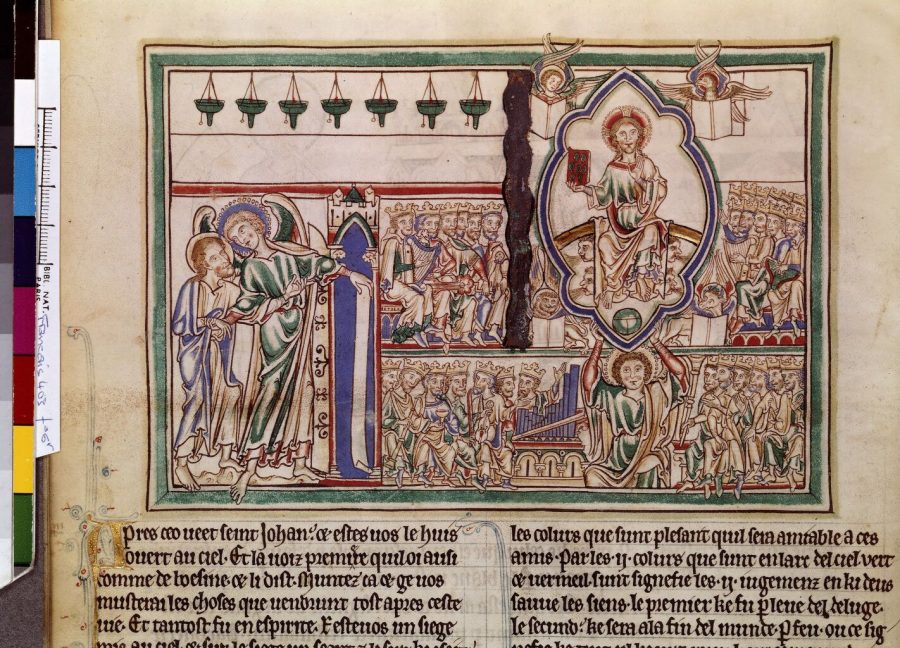
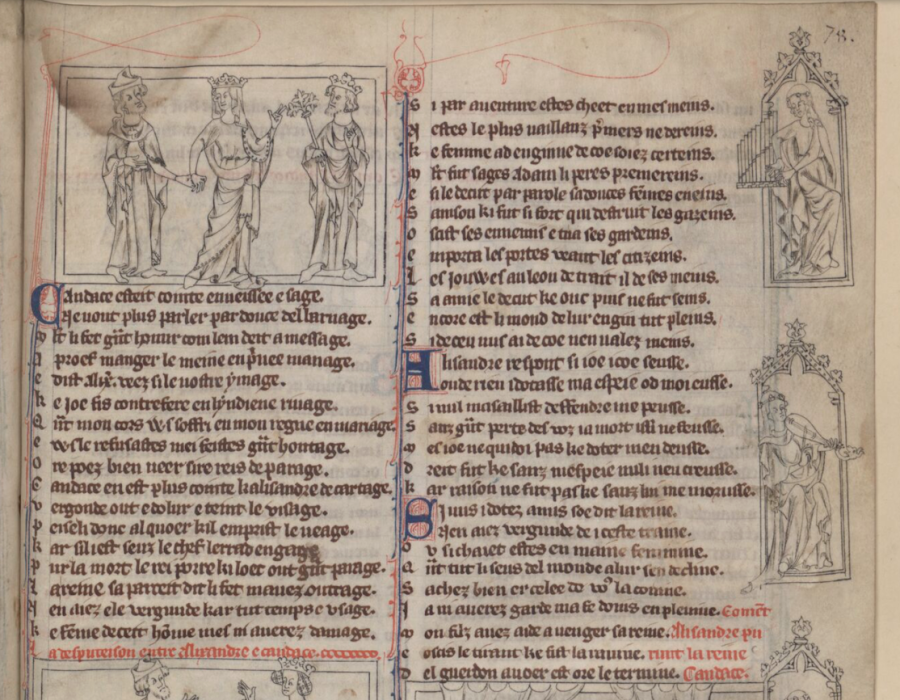
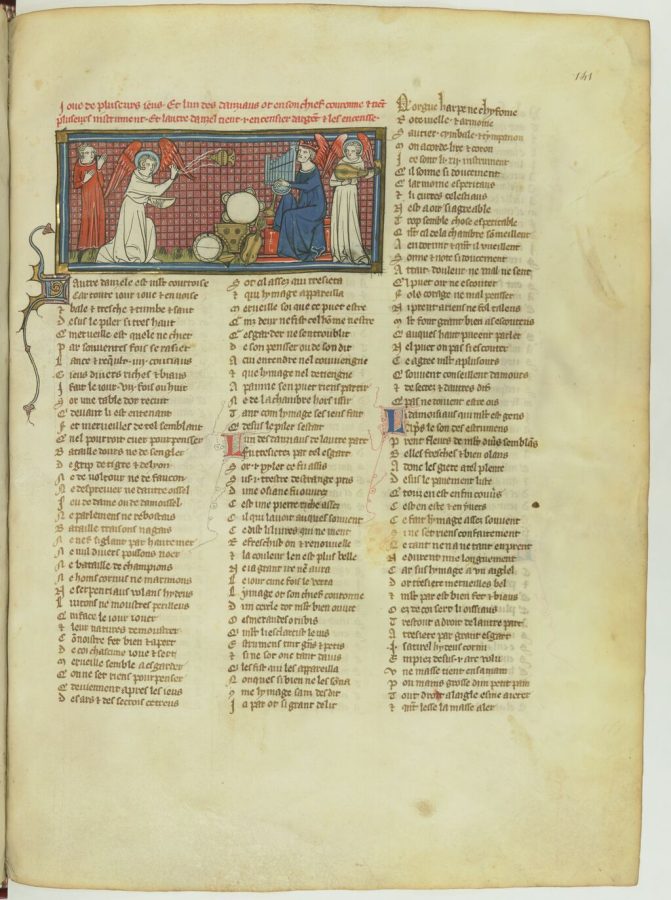
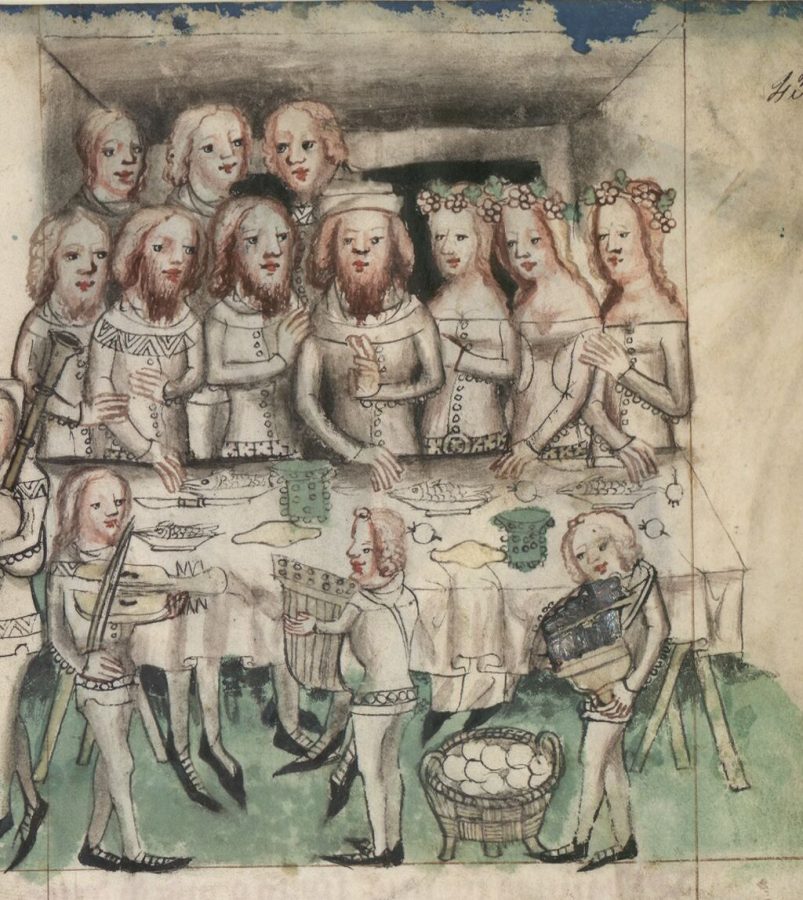
In this manuscript the statues of the Chamber of Beauties are depicted, from the Roman de Troie by Benoît de Sainte-Maure: the illuminator produced the miniature following the text’s indications closely. The author interpreted literally the rubric describing four automata in the likeness of young men and women. However, a curious linguistic misunderstanding occurred: the archaic terms for youths (danziaus and danziel) were confused with dangel, leading to the depiction of angels rather than human figures. According to the manuscript, these animated statues perform specific […]

Graphics and Drawing on Paper
Coronation of the Virgin by Maso di Banco
Date:1330
Location:Szépművészeti Múzeum, Budapest, Hungary

Coronation of the Virgin by Maso di Banco

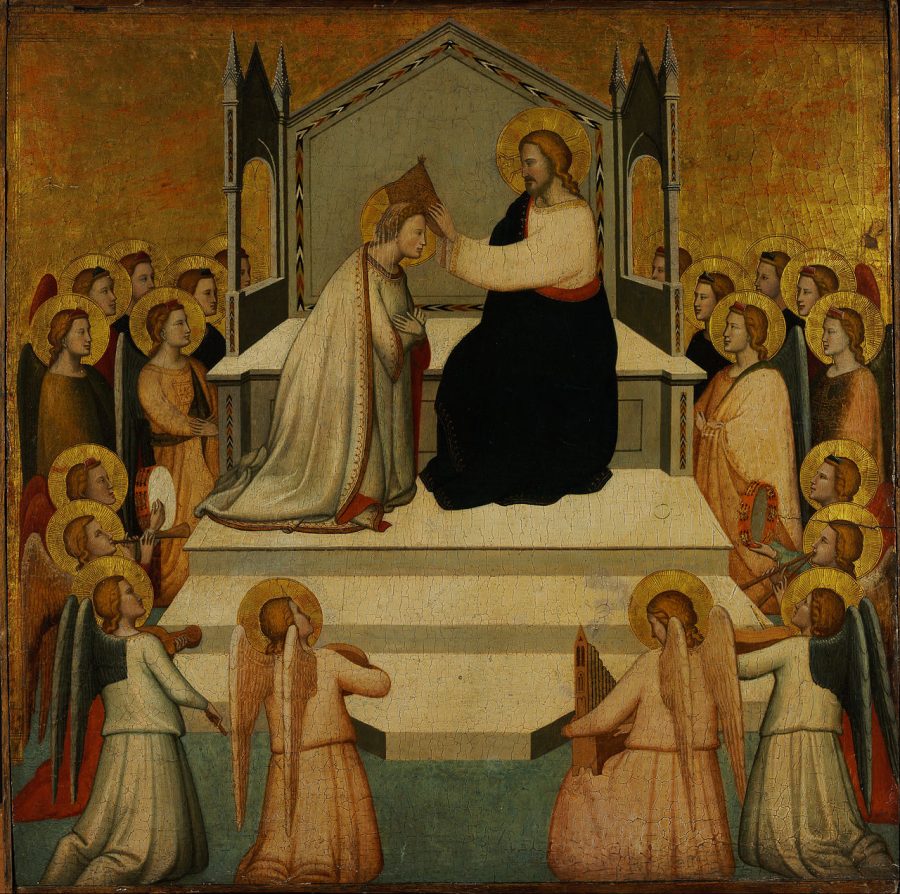
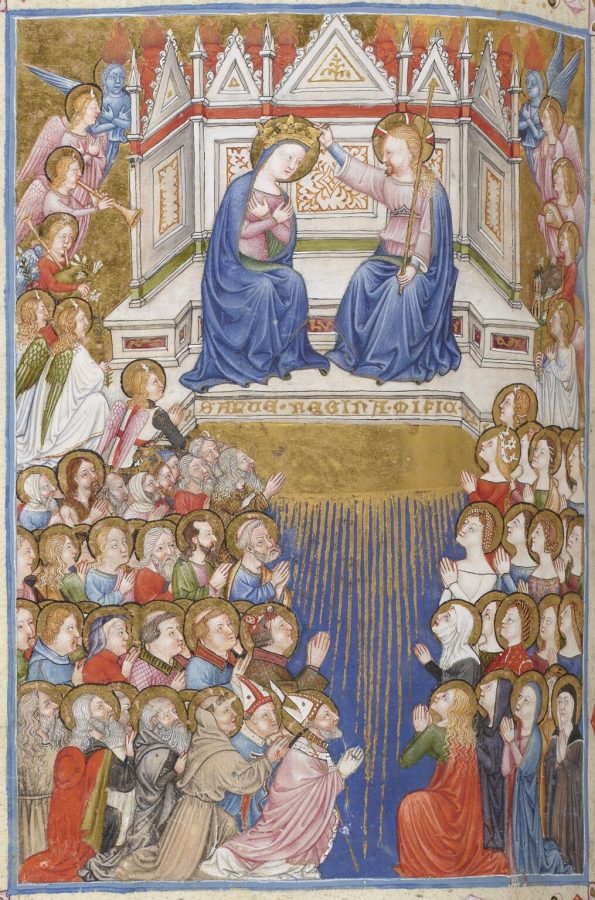
At the centre of the scene, the Virgin Mary is depicted kneeling in a gesture of humility, veiled and with her hands crossed on her chest. Before her sits Christ, wearing a conical crown and seated on a majestic throne built on several levels like a small building. Both figures are surrounded by angels, some of whom are kneeling and form a true celestial orchestra. Among the musical instruments the angels are playing, two tambourines, two viols, a trumpet, a flute and an organ can […]

Painting on Movable Support
Jubal at the Basilica of Santa Maria del Fiore, Florence
Date:1334-1336
Location:Museo dell'Opera del Duomo, Florence, Tuscany, Italy

Jubal at the Basilica of Santa Maria del Fiore, Florence

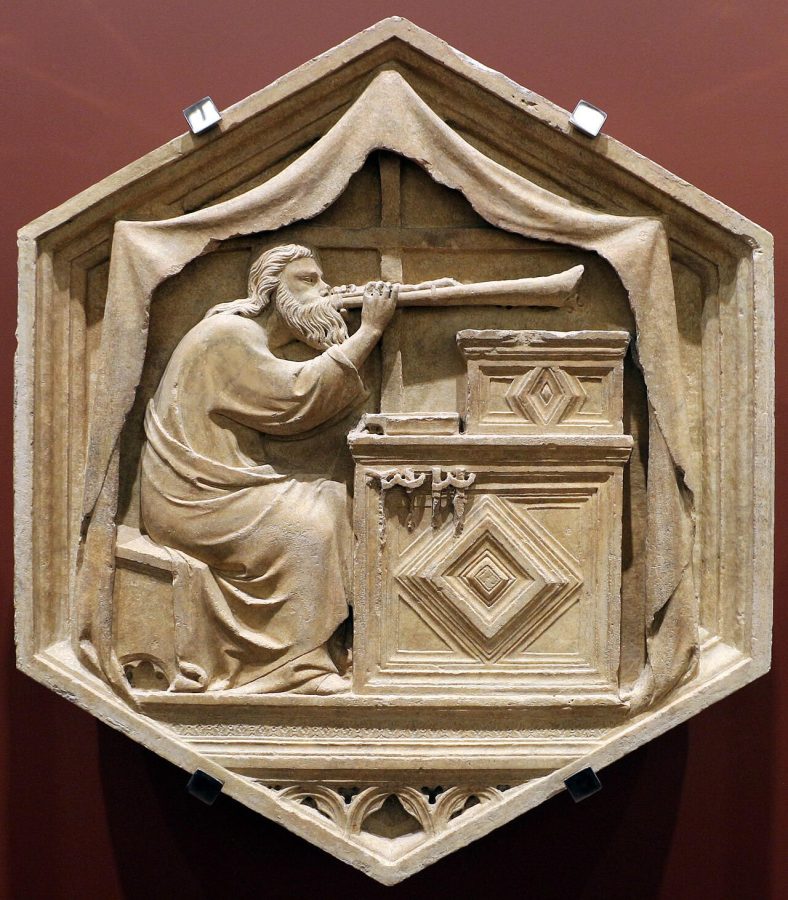
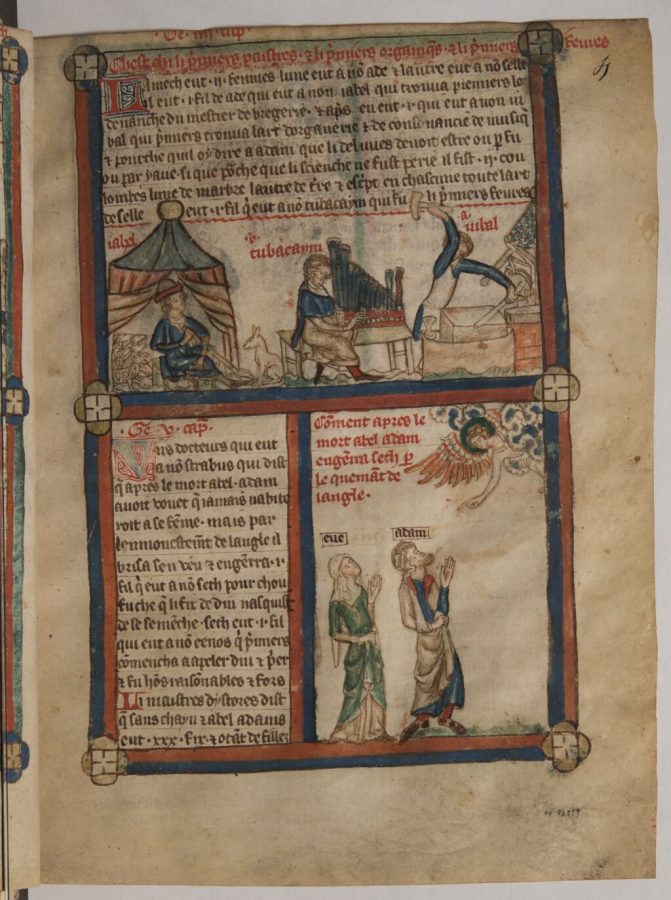
On the west side of the Campanile, in the third decorative zone, relief number 5 is dedicated to the figure of Jubal, celebrated by tradition as the “father of music.” The scene depicts him seated on a bench inside a tent, intent on playing the trumpet in front of an organ. This depiction underlines his legendary role as the inventor of musical instruments, uniting in a single image the power of brass and the complexity of the organ.

Mural and Architectural Decoration
Coronation of the Virgin
Date:14th century
Location:Lewes Castle and Museum of Sussex Archaeology, Lewes, East Sussex, United Kingdom

Coronation of the Virgin

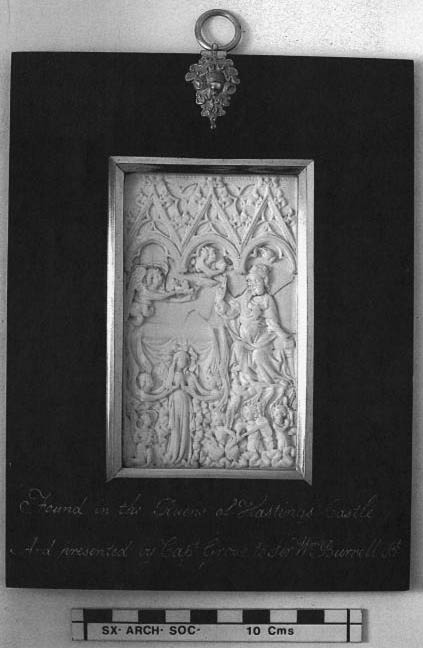
This ivory plaquette, probably part of a wax writing tablet, presents a complex depiction of the Assumption and Coronation of the Virgin, framed by three arches with pointed trefoils in the tympana and spandrels. At the centre of the scene, Christ appears crowned and seated on a draped throne. Below him, the composition is peopled with celestial figures: two half-figures of angels, one swinging a censer and holding a boat, while the other crowns Mary. The Virgin is depicted within a mandorla of clouds supported […]

Plastic and Sculptural Arts
Coronation of the Virgin with Three Musical Angels
Date:1355
Location:Thyssen-Bornemisza Museum, Madrid, Community of Madrid, Spain

Coronation of the Virgin with Three Musical Angels

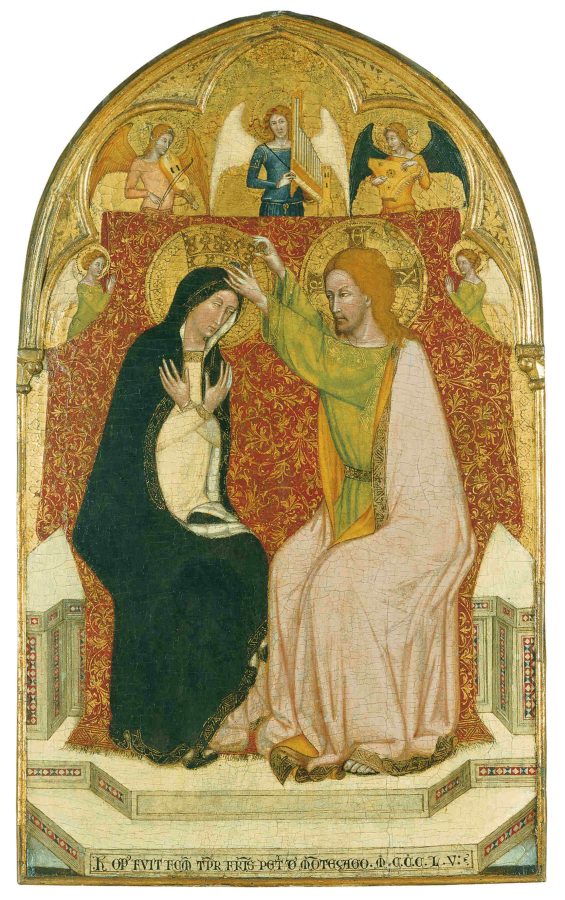
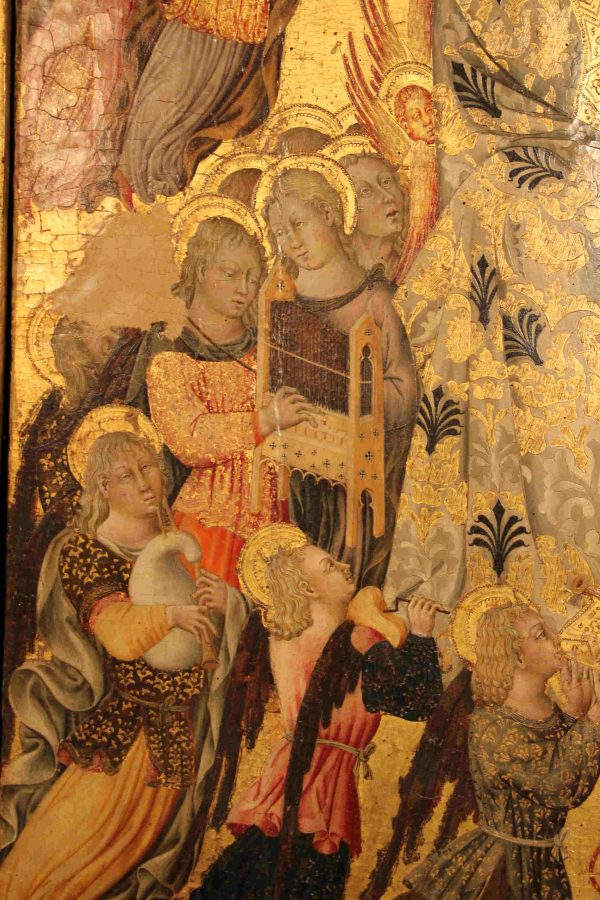
In this Coronation scene, Christ and the Virgin Mary are seated together on a single throne covered with a precious drape. Christ, whose halo is decorated with a cross and the inscription “XPE” (Christ), is caught in the moment of placing the crown on his Mother’s head with both hands. Mary is depicted veiled and with her hands crossed on her chest in a gesture of acceptance. Accompanying this sacred moment are five angels, three of whom are playing various instruments of the period: a […]

Painting on Movable Support
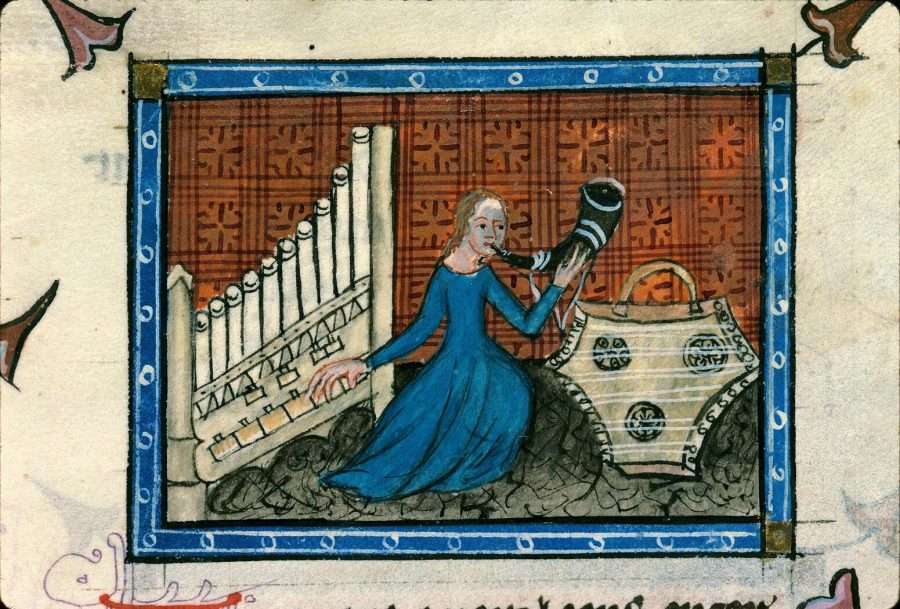
A miniature of a woman playing the organ
Date:1370-1380
Location:New York, Morgan Library and Museum, M.88, f. 23

A miniature of a woman playing the organ

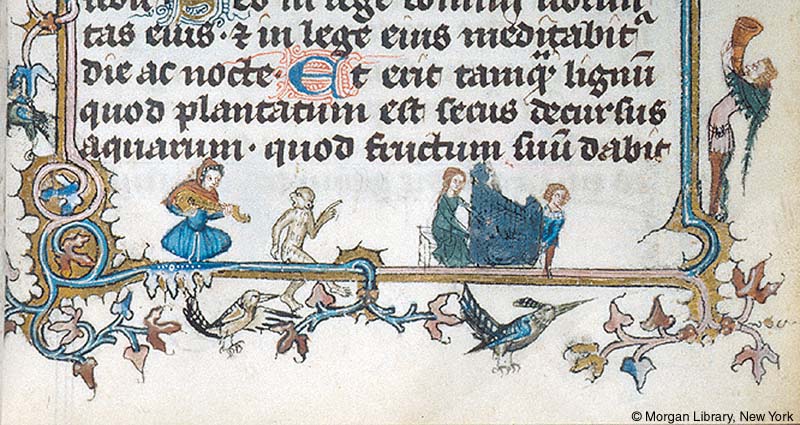
At the opening of Psalm 1, the initial letter “B” is decorated with leaf motifs and encloses within it the figure of King David. The sovereign, wearing his crown, is seated cross-legged on a bench playing the harp, set against a background decorated with a lattice pattern. The margins of the page offer a rich variety of animated scenes. On the lower border, along a bar decorated with leaves, a hooded man plays a small guitar, while a monkey points to a curious scene: a […]

Graphics and Drawing on Paper
Adoration of the Magi at Lincoln Cathedral
Date:1370-1380
Location:Lincoln Cathedral, Lincoln, Lincolnshire, England, United Kingdom

Adoration of the Magi at Lincoln Cathedral

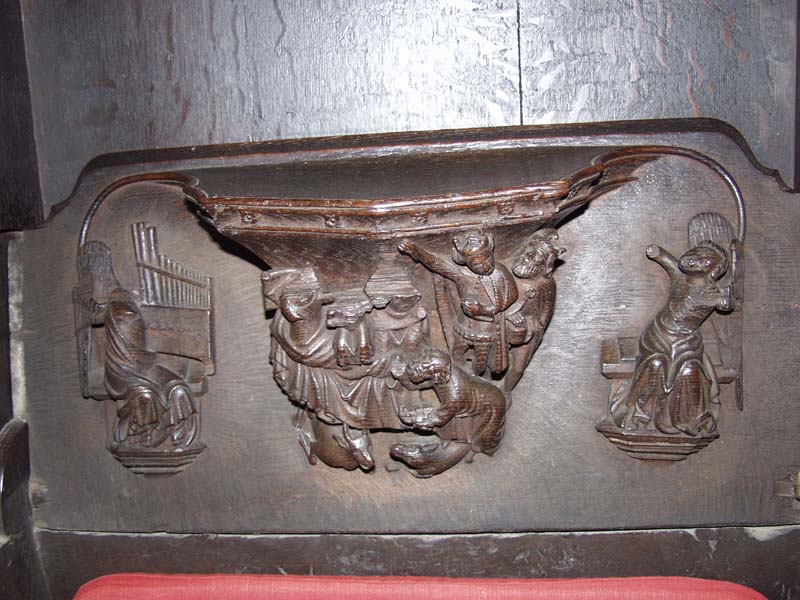
Located on the south side of the choir, on the upper level of the twenty-third stall, this decoration on the “misericord” (the hinged seat support) depicts the Adoration of the Magi. At the centre, the Virgin Mary is lying on a bed covered with a drape, with the ox and donkey crouching before her. Mary holds the infant Jesus in her arms, while the three Wise Men present themselves before her with their gifts: one is kneeling in a gesture of respect, while the other […]

Plastic and Sculptural Arts
An Angel with a Portative Organ from Lincoln Cathedral
Date:1370-1380
Location:Lincoln Cathedral, Lincolnshire, England, United Kingdom

An Angel with a Portative Organ from Lincoln Cathedral

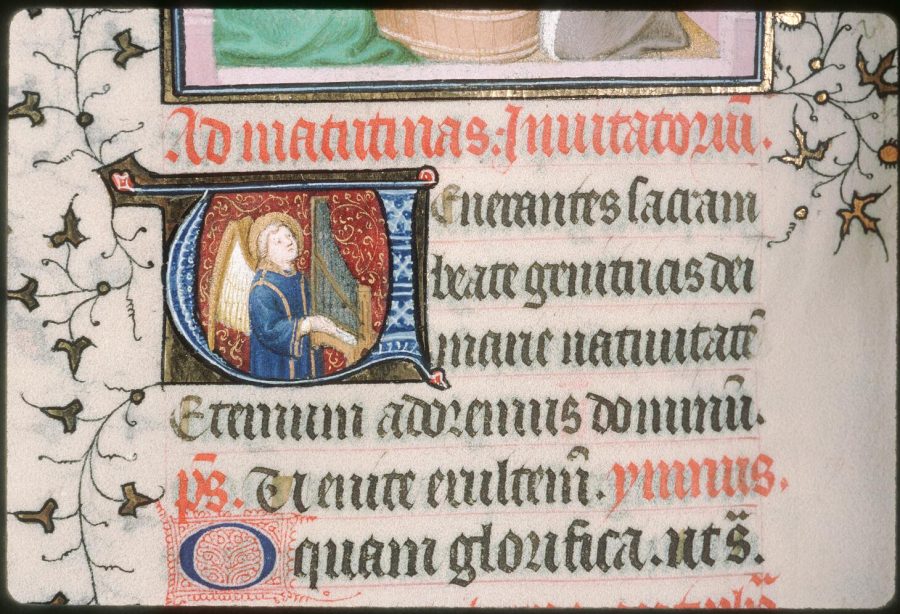
Along the south side, the front panels of the desks numbered four to six present a decorative apparatus characterised by elegant foliage motifs, terminating at the ends with a poppy flower. The decoration of the panels, carried out in modern times following the original models, shows a series of isolated figures: in the fourth panel an angel appears playing the lute, in the fifth a king holding a sceptre, and finally in the sixth another angel engaged in playing a small portable organ.

Plastic and Sculptural Arts
Madonna and Child with Six Angels
Date:1370-1375
Location:Museum of Fine Arts, Budapest, Hungary

Madonna and Child with Six Angels

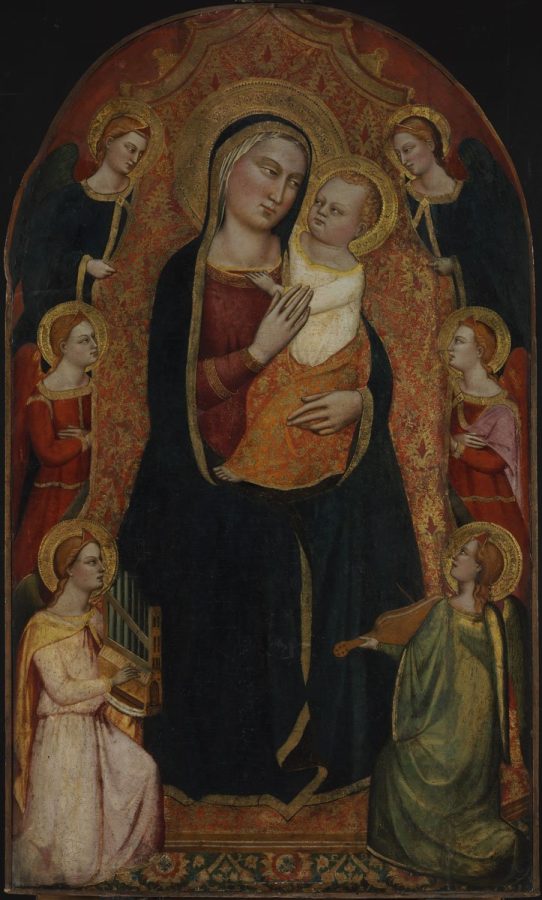
The work, a typical example of mid-fourteenth-century Florentine late-Gothic painting, depicts the Virgin enthroned with the Child surrounded by a solemn court of six angels. While four of them are caught in an attitude of adoration at the sides of the throne, the two in the foreground celebrate the divine through music: one is playing a portable organ and the other a vielle.

Painting on Movable Support
A Fresco with Musical Angels
Date:second half of the 14th century
Location:Schnütgen Museum, Cologne, North Rhine-Westphalia, Germany

A Fresco with Musical Angels

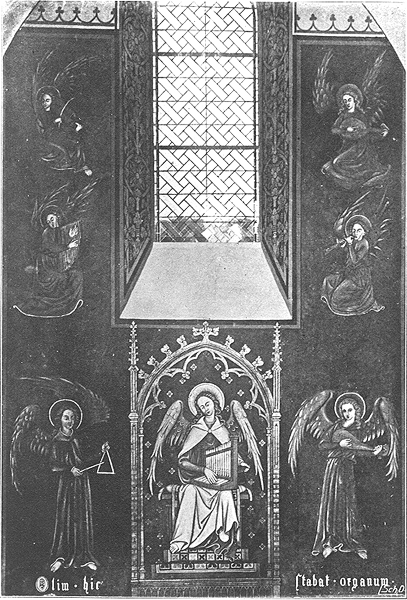
Along the north wall of the nave, the scene shows a group of six angels gathered around a central companion. The latter, characterised by a finely decorated halo, is seated on a majestic throne resembling a small architectural structure, complete with a footrest, while intent on playing the organ. On either side, the other six angels (four of whom are kneeling) form a celestial orchestra playing various instruments: a viol, a harp, a triangle, a flute and two lutes. The work is completed by an […]

Mural and Architectural Decoration
A Miniature of Saint Cecilia in Prayer
Date:second half of the 14th century
Location:Israel, Jerusalem, Studium Biblicum Franciscanum Museum, Manuscript 7 (H), fol. 233r

A Miniature of Saint Cecilia in Prayer

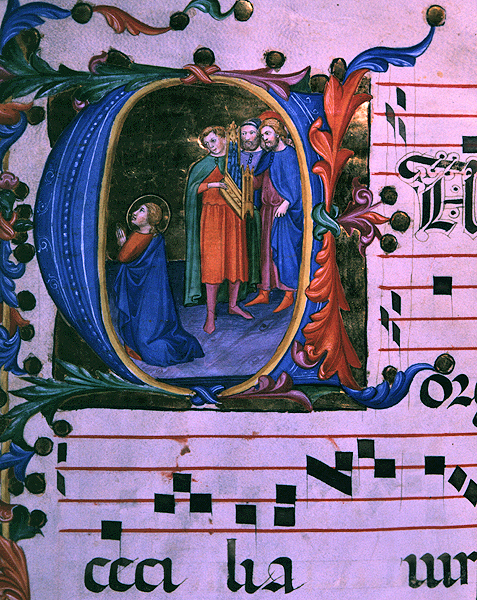
Inside a decorated initial letter “C” with leaf motifs, Saint Cecilia is depicted in a moment of intense prayer. The Saint, with her halo, is kneeling with her joined hands raised upward. Behind her stand three men, one of whom holds what appears to be a small portable organ, the instrument that would become the Saint’s most well-known symbol. The decoration extends from the letter to the margins of the page, where a curious figure appears: a naked man bearing a sword and shield, creating […]

Graphics and Drawing on Paper
Sculptural Tondo with Nine Musical Angels
Date:1380-1399
Location:Blair Collection, Chicago, Illinois, United States

Sculptural Tondo with Nine Musical Angels

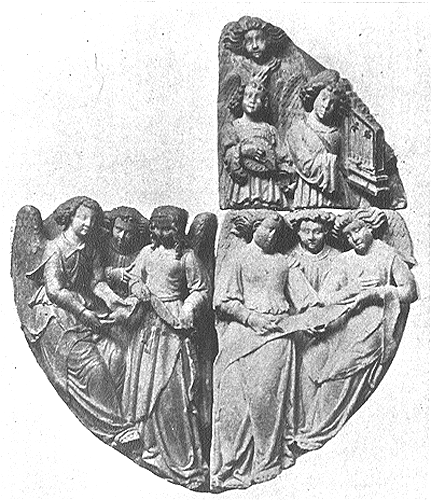
This sculptural relief, originally conceived as a large tondo composed of four quadrants, presents a celestial choir of nine angels. Although the upper-left quadrant has been lost, the surviving composition shows the divine figures engaged in various musical and celebratory activities: two of them are playing a lute and a portable organ respectively, while a third angel is caught in the act of singing. Some members of the group hold parchment scrolls in their hands, probably bearing sacred texts or musical scores, thus completing the […]

Plastic and Sculptural Arts
Resurrection of the Virgin by Giovanni di Paolo
Date:1385
Location:Palazzo Corboli Museum, Asciano, Siena

Resurrection of the Virgin by Giovanni di Paolo

The accompanying label is somewhat ambiguous, which may suggest that the work was produced by two hands. In reality, the triptych currently on display is the result of a heterogeneous assembly, carried out around 1883, made up of several panels from two polyptychs from Asciano: an Assumption painted by Giovanni di Paolo for the church of Sant’Agata, and two lateral panels (Saint Augustine and Saint Michael) painted by Matteo di Giovanni for the church of Sant’Agostino.The Polyptych of Asciano, painted by Matteo di Giovanni, was […]

Painting on Movable Support
Musical angels at the organ and the harp
Date:1407
Location:Museum Boijmans Van Beuningen, Rotterdam (Netherlands)

Musical angels at the organ and the harp

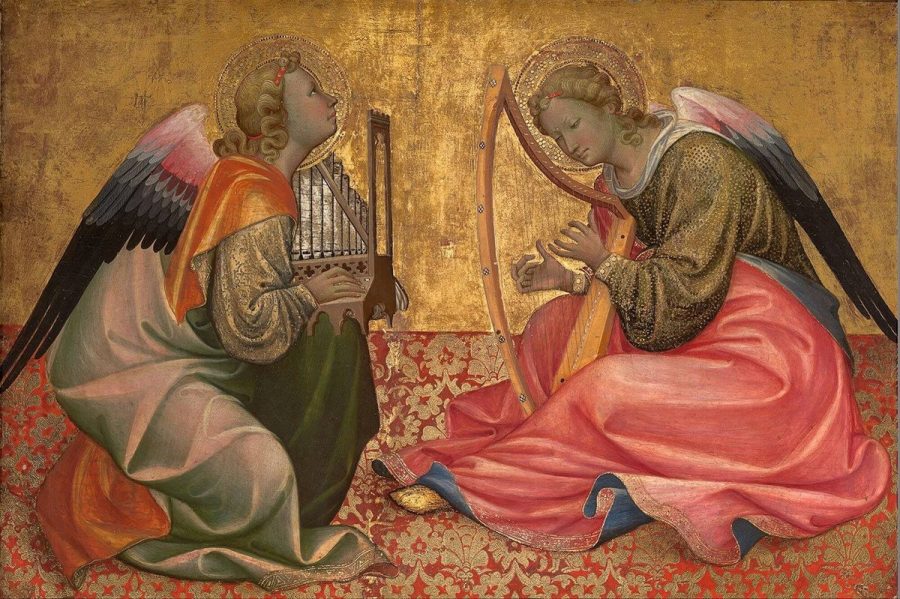
This fragment, now preserved at the Museum Boijmans Van Beuningen in Rotterdam, formed part of the central panel of the altarpiece made for Angelo Acciaiuoli and originally placed in the Certosa del Galluzzo, near Florence. The scene depicts musical angels playing an organ and a harp, as part of a pictorial complex of which other fragments survive in Dresden and Florentine private collections. The work bears witness to the high quality of the patronage associated with the Acciaiuoli family and the original decorative splendour of […]

Painting on Movable Support
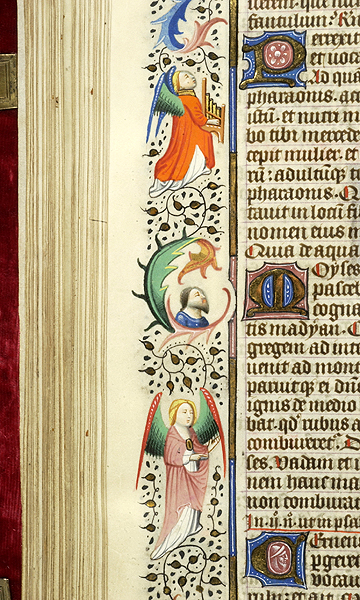
An Angel on the Page Margin Playing an Organ
Date:1440
Location:New York, Morgan Library and Museum, M.87, f. 152v

An Angel on the Page Margin Playing an Organ

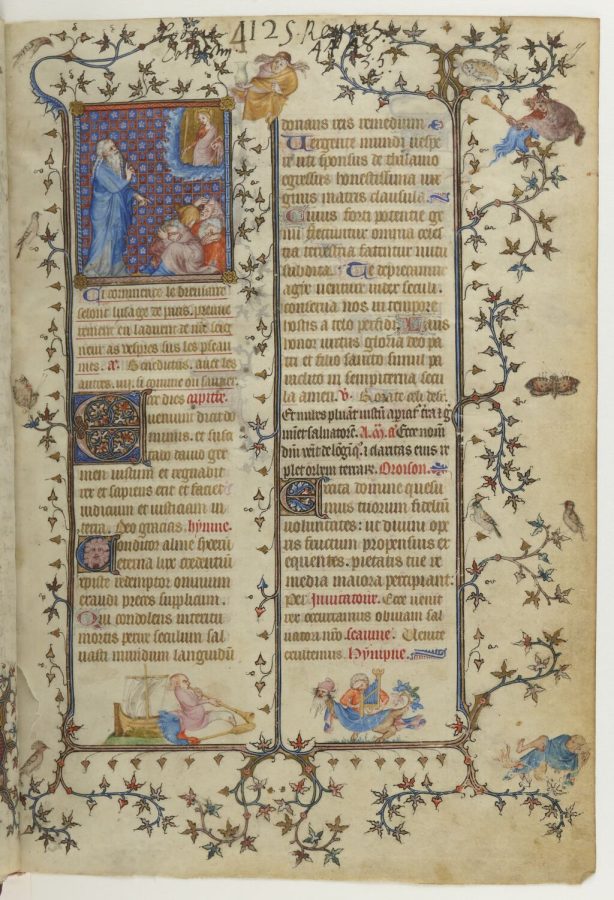
The initial letters “C” and “P,” marking the different readings for Sexagesima Sunday, contain within them small portraits of men with hats. The margins of the page are finely decorated on three sides with foliage and flower scrolls, populated by various figures: at the top, an angel emerges halfway from a cloud playing a trumpet; on the left, among the foliage, the bust of a man appears flanked by two angels, one of whom is kneeling and playing a small portable organ, while the other […]

Graphics and Drawing on Paper
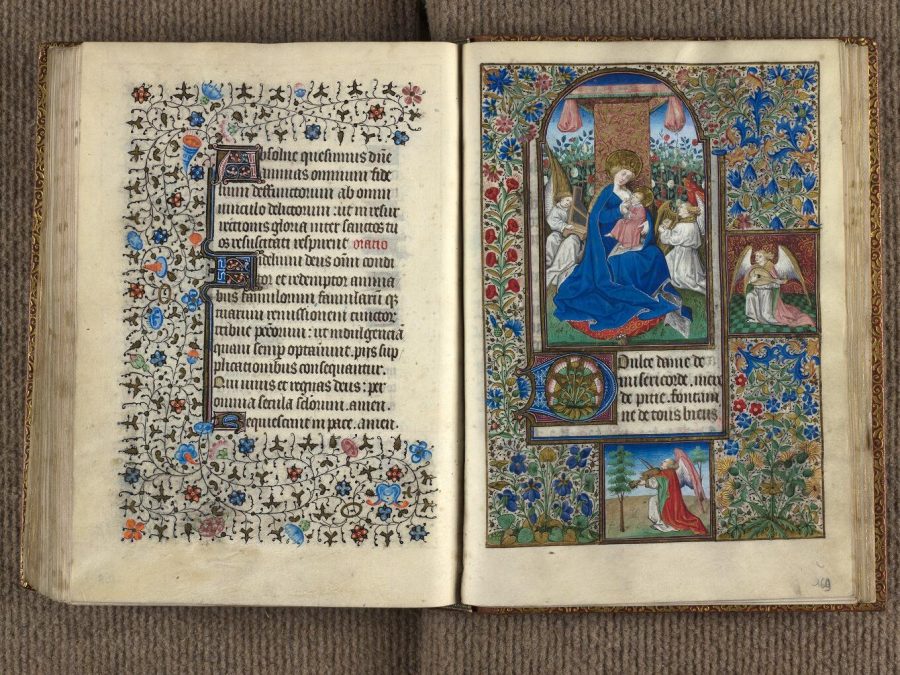
An Angel with a Portative Organ
Date:1455
Location:New York, Morgan Library and Museum, M.221, f. 14r

An Angel with a Portative Organ

Along the margins of this page, which contains the liturgical passage between the end of None and the beginning of Vespers for the Christmas Vigil, a rich decorative apparatus of flower and leaf motifs unfolds. In the right margin a mermaid with a scarf appears, depicted with her head turned back in a dynamic pose. The lower border is occupied by the figure of an angel wrapped in a long blue robe: the angel is partially kneeling and stretches out his left hand to play […]

Graphics and Drawing on Paper
Miniature in the Form of a Medallion with Two Musical Angels
Date:1470
Location:New York, Morgan Library and Museum, M.285, f. 28r

Miniature in the Form of a Medallion with Two Musical Angels

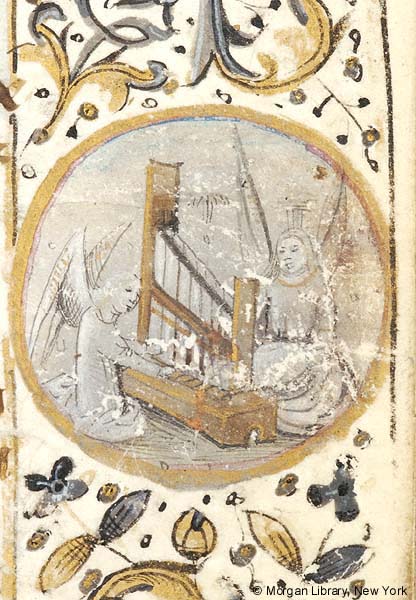
On the right margin of this illuminated page, within an elegant circular medallion, two angels are depicted seated on the ground in a moment of musical contemplation; one of them is caught in the act of playing a small portable organ. The entire marginal decoration develops through refined floral motifs and vine-tendril volutes, which harmoniously frame the sacred text. The latter contains the opening verse of Lauds, taken from the Office of the Hours of the Virgin.

Graphics and Drawing on Paper
The Lady and the Unicorn (Hearing)
Date:1484-1500 ca.
Location:Musée de Cluny – Musée national du Moyen Âge, Paris

The Lady and the Unicorn (Hearing)

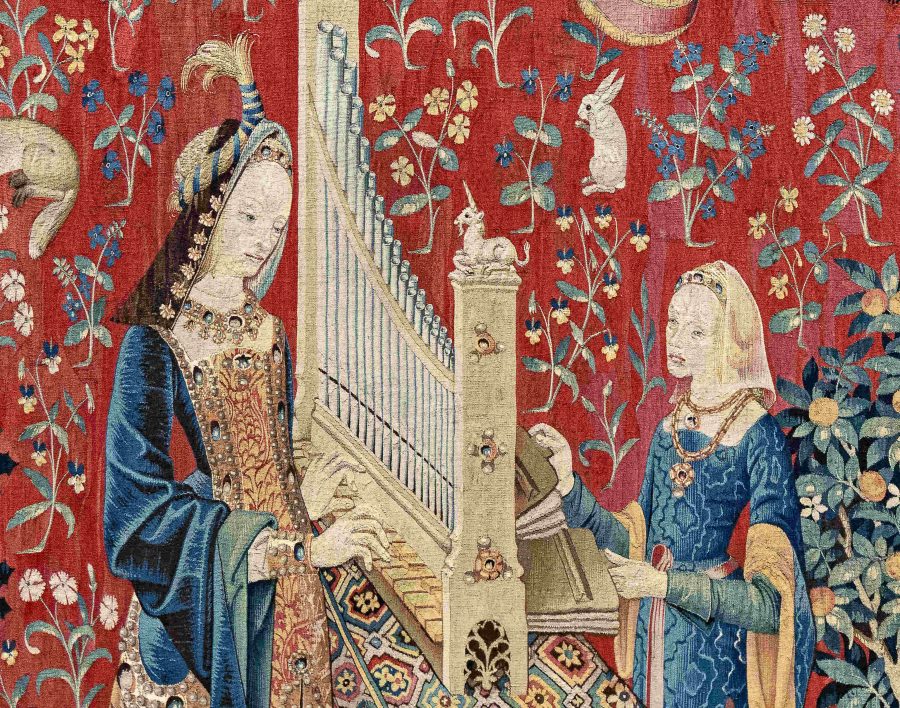
The Lady and the Unicorn is a cycle of Flemish tapestries from the end of the fifteenth century. It constitutes one of the most important works of tapestry-weaving in the European Middle Ages. It is composed of six panels, all with a red background, with at the centre the lady with the unicorn and the lion and around them other small animals, trees and flowers. The banners and shields bear the emblem of Jean Le Viste. Five panels are dedicated to the senses:– taste: the […]

Applied and Decorative Arts
Angel playing the organ
Date:1520-1530
Location:Musée des Arts Décoratifs, Paris

Angel playing the organ

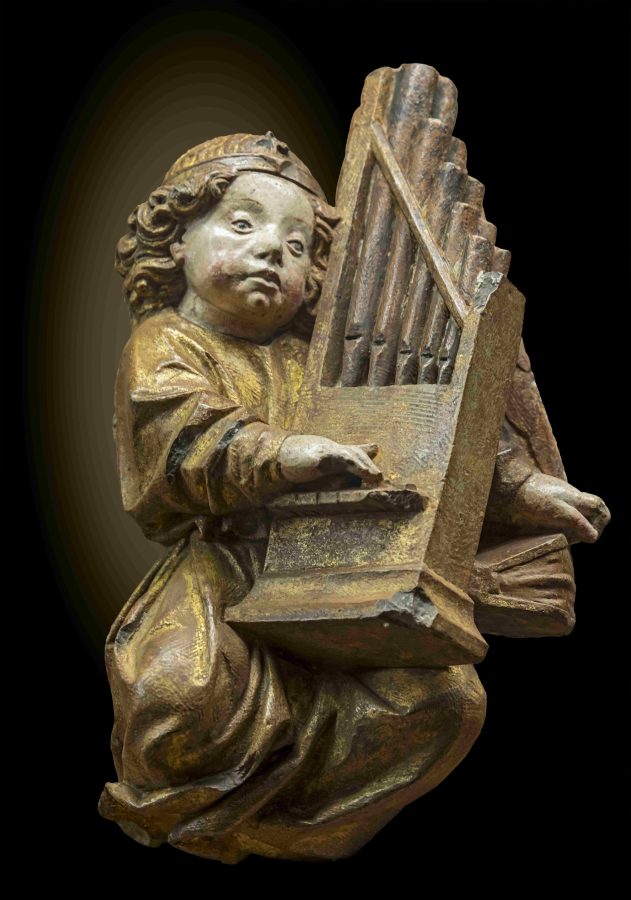
This statuette consists of a principal piece of wood (lime?) with assembled secondary elements, depicting an angel playing a small portative organ.– Traces of fixing in the workbench vice not detected: on the head, a posterior filling; under the base, not accessible.– Assembled elements: right wing (missing) fixed on the right side in a rectangular cavity; on the reverse, traces of nails (three cavities) for the (original or later?) fixing of the missing left wing.– Details carved on the wood surface: tremolo work to evoke […]

Plastic and Sculptural Arts
Organ from the Winghe Manuscript
Date:Last quarter of the 16th century
Location:Church of Santa Maria de Navicella (Via della Navicella, Rome)

Organ from the Winghe Manuscript

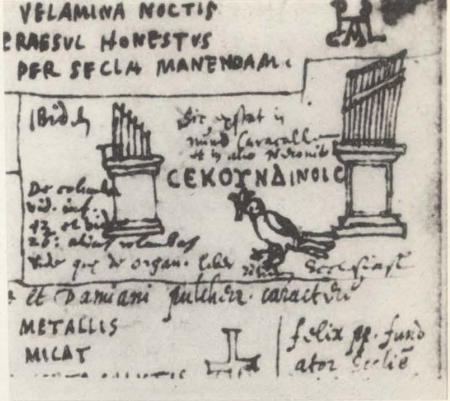
A young man from Louvain, Philippe de Winghe, travelling in the last quarter of the sixteenth century, copied a number of inscriptions in Rome and the principal cities of Italy. The manuscript of these notes, never published, comprises around 300 pages and the inscriptions appear to have been recorded with great faithfulness. On the recto of folio 22 are inscriptions copied, it seems, “in musino S. Maria de Navicolla” (sic). At the top right two drawings of hydraulic organs can be seen. The one on […]

Graphics and Drawing on Paper

End of results

No results found

organarium

repository of the ancient and medieval organ

Retracing music and arts networks
enhancing education and
promoting cultural heritage preservation

Contact

Project e-mail
jerus-it-arts@fadbrera.edu.it.it

Marco Negroni
Brera Academy of Fine Arts
marconegroni@fadbrera.edu.it

Repository gitHub

Partners
CC 2026 Organarium / CUP project n. E33C24000160006