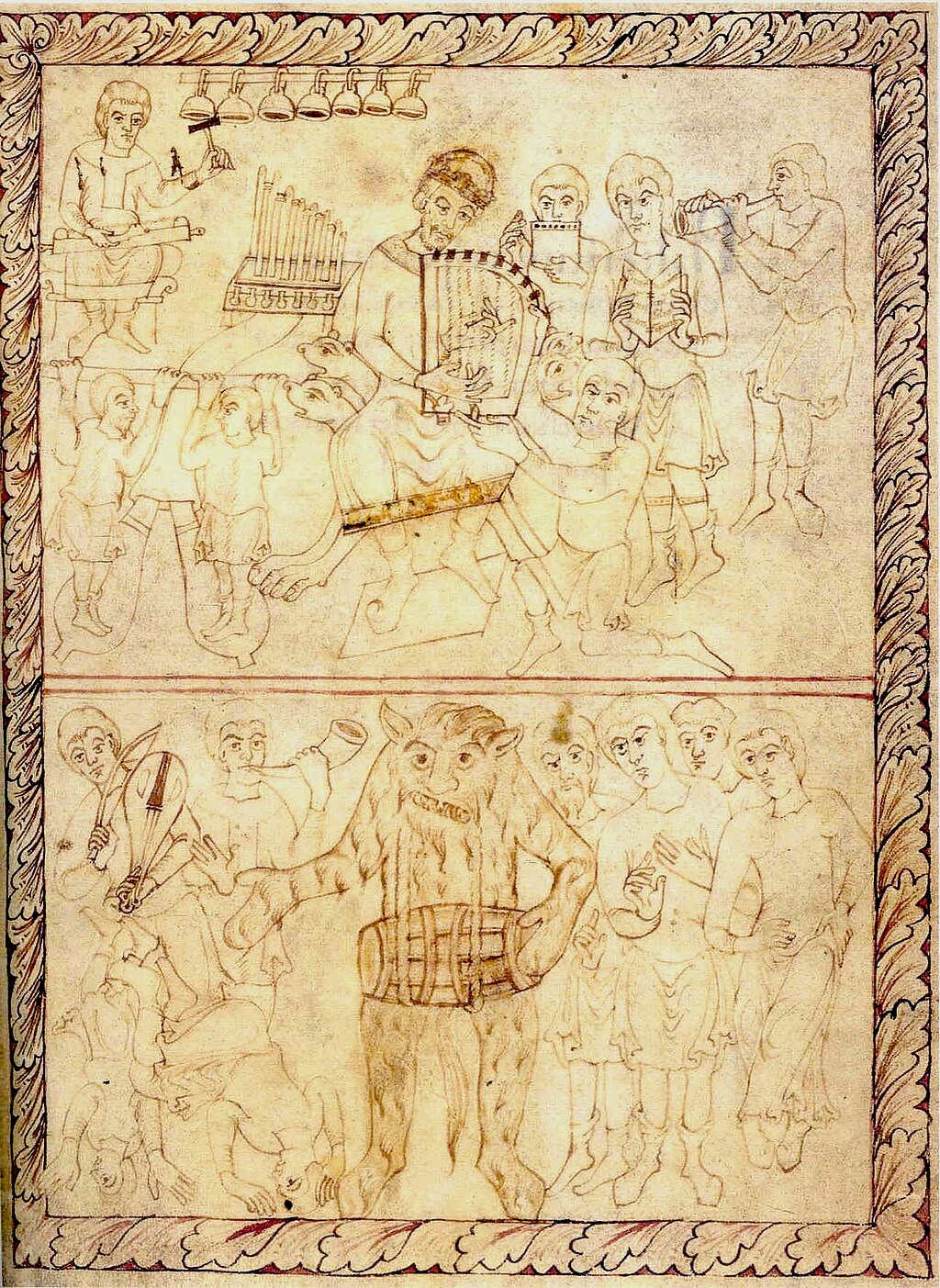
The frontispiece page of the Psalter of Saint-Rémi de Reims is organised in two registers of different sizes, the larger of which occupies the upper part of the image. These two registers are arranged according to a system of symmetry. David, placed at the centre of the upper register, is answered by a bear figure or a mask — the ambiguity is undoubtedly deliberate — striking a drum. In Christian exegesis, which relies largely on analogies, instruments do not intrinsically possess positive or negative symbolic qualities; it is their formal and acoustic characteristics, the techniques they require to be played, as well as their similarities and differences from each other, that determine their symbolic function in literary sources and images. In the Psalter of Saint-Rémi, while the harp is light, lifted within arm’s reach by the servant kneeling by the king, the drum proves massive and weighs fully on the strap hanging it around the mask’s neck. Against David’s agile and nimble fingers, a massive, roughly anthropomorphic paw is set in opposition: if the king can modulate sounds on his harp, the bestial figure cannot do the same on its drum. Music, as a set of informed sounds, and noise, as a set of audible but indeterminate forms, are here proposed as two antinomic poles of sonic emission.
The Cambridge Psalter
St John’s College Cambridge
Date:
13th century
Location:
St. John’s College, Cambridge
Author:
Anonymous (13th-century illuminator, French Gothic style)
Technique and materials:
Illumination on parchment with colored pigments and gold
Dimensions:
Not documented
Provenance:
Liturgical tradition of the Abbey of Saint-Rémi, Reims
Sources: