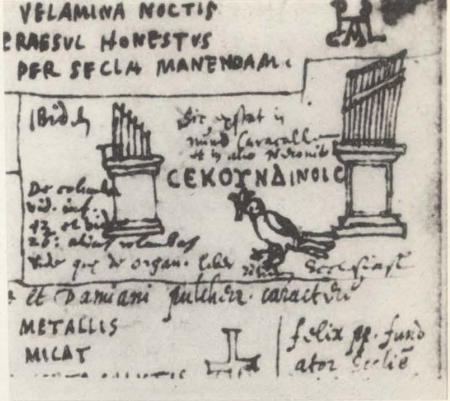
A young man from Louvain, Philippe de Winghe, travelling in the last quarter of the sixteenth century, copied a number of inscriptions in Rome and the principal cities of Italy. The manuscript of these notes, never published, comprises around 300 pages and the inscriptions appear to have been recorded with great faithfulness. On the recto of folio 22 are inscriptions copied, it seems, “in musino S. Maria de Navicolla” (sic). At the top right two drawings of hydraulic organs can be seen. The one on the left is merely a point of comparison, since Winghe wrote beside it “sic extat in nummo Caracallae et in alio Neronis,” alluding to two of the contorniate medallions already studied above. On the right is the one that appeared on the inscription.
The rectangular water cistern is decorated with a moulding along its circumference and rests on a double-stepped base. The wind chest consists of two superimposed sections and supports ten pipes of decreasing size from right to left, in turn held by an oblique transverse bar; near their feet a line parallel to the wind chest can be seen, apparently formed by their mouths. Neither pumps nor levers are present. At the bottom left of the organ a dove is drawn holding an olive branch in its beak, above which the following inscription can be read: “CEKOYN INOIC SECUND(UM) INOIC,” whose meaning escapes us: it may perhaps be related to the Gallo-Roman family of the Secundini.
This is probably the tomb of a Christian organist.