
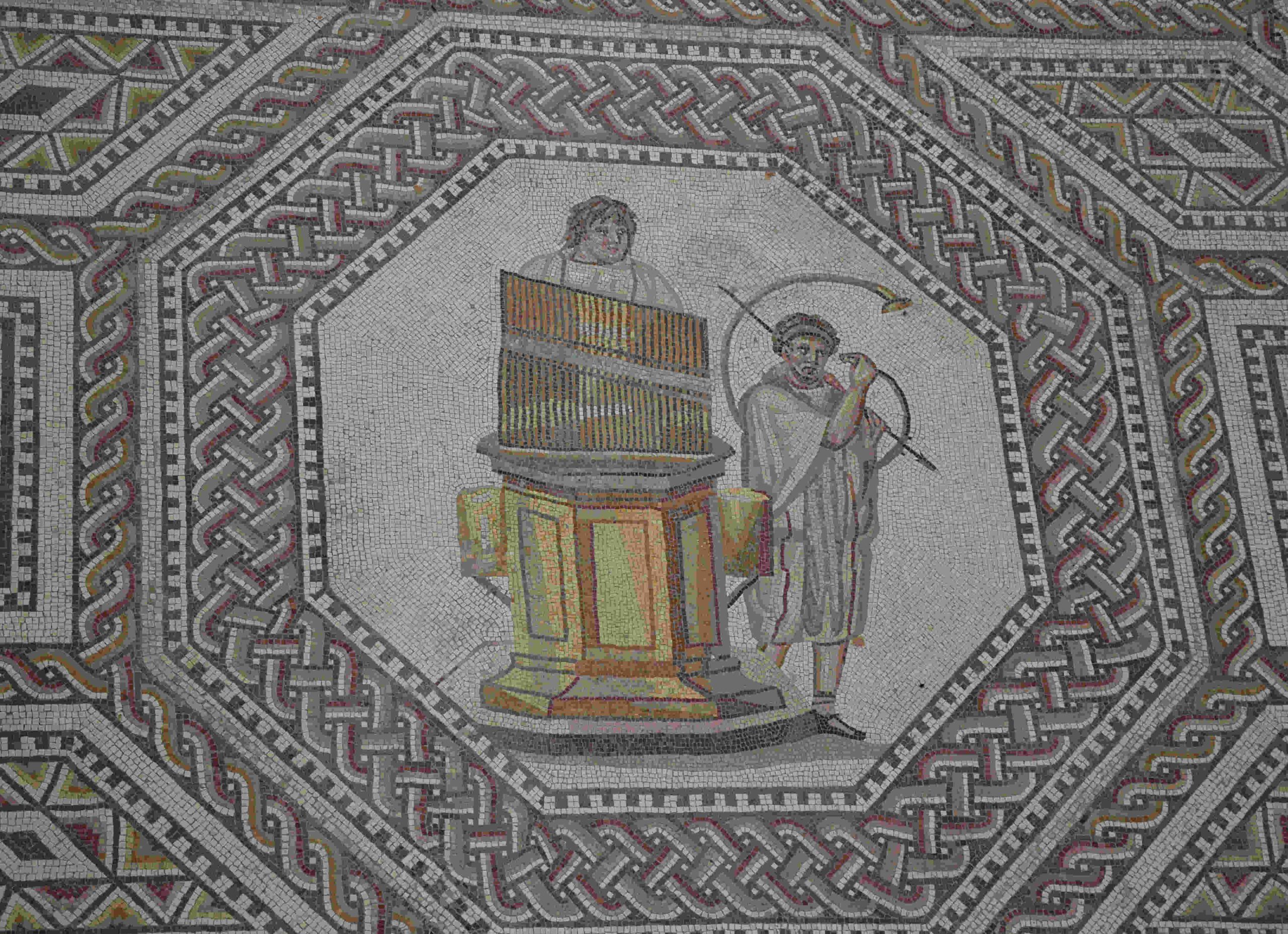
In 1852 the remains of a rich Roman dwelling, generally dated to the Hadrianic period, were discovered at Nennig, a small village in the Saar situated 40 kilometres from Trier, not far from the right bank of the Moselle. The floor of one of the rooms is adorned with a magnificent mosaic in very good condition. It comprises nine medallions, seven octagonal and two square, separated by geometric motifs and depicting various amphitheatre scenes: gladiatorial combat and venatio. One of the medallions shows an orchestra made up of a hydraulic organ and a horn.
The organ conforms to Vitruvius’s description and has two lateral pumps. The plinth, hexagonal, is placed on a small predella of identical shape whose perspective is well rendered in the drawing. The water cistern, hexagonal, is decorated with rectangular moulded panels. It bears on each side and on its upper half a large cylinder supported by an oblique bracket.
Towards the upper part of the cistern is a kind of table, also hexagonal and decorated with mouldings: this is the wind chest on which the pipes are planted. These, twenty-seven or twenty-eight in number, appear very closely spaced and of small diameter. Their progression is not very pronounced, the smallest being approximately three-quarters the size of the largest.
The organist stands behind the instrument, with his head and torso emerging above the pipes. The physiognomy is pleasant: a beardless, young, relaxed face radiating health; abundant hair with a few locks on the forehead. The eyes, a fine black, are turned attentively to the left. The broad shoulders are draped in a wide garment reaching up to the neck. To the left of the organist stands the cornicen, who wears a wide light-coloured cloak and sandals. His expression is more serious; he wears a beard and his forehead is bound with a fillet holding back his hair. His face and eyes are also turned to the left. He holds in his hands the cornu, a large horn whose mouthpiece is held a little distance from his mouth. Without any doubt he and his companion are watching the combat, waiting for the signal to begin playing. The colours, whose role here is probably more decorative than descriptive, consist mainly of blue and ochre. In light blue appear the wind chest and the oblique bar of the pipes; in light ochre are the cylinders, the mouldings of the cistern and the pipes as a whole; the cistern is in a light bistre.
One of the merits of this depiction is to demonstrate that the hydraulic organ was not solely a solo instrument, but that it readily played in concert with the horn. It is likely that the combination of these two characteristic timbres produced a grand and martial music, well suited to the violence of gladiatorial combat.










.jpg)