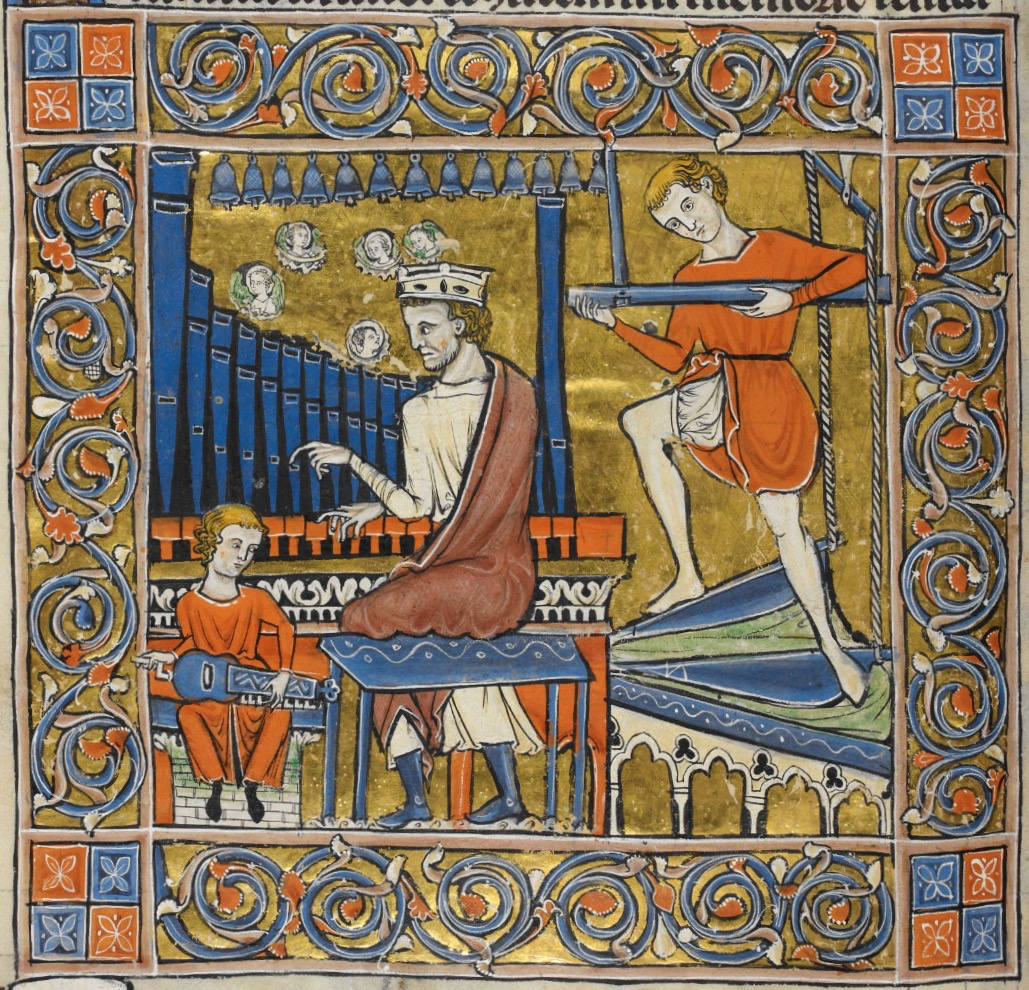
Towards the end of Psalm 96 in the Rutland Psalter, this miniature is found in which King David plays a pipe organ, assisted by a figure operating the bellows and striking a row of bells.
The decoration in this volume is the work of four master artists and their assistants (see Morgan, “The Artists of the Rutland Psalter,” 1987). The thirteenth-century illuminators were rather more figurative and many details are lacking, such as the strings. However, the overall size and shape of the instrument can be determined with a reasonable degree of precision.
It is clearly an organistrum, with three pegs, therefore three strings. It has a single row of keys, so it is diatonic, which is what one would expect for this period. There is no wheel cover, but the wheel slot is decorated with a simple painted border. Eight keys are shown, but they are not in the right positions to create a meaningful scale.
The simple crank, without a knob, is also shown in paintings by Hieronymus Bosch. It may seem awkward, but in practice it works very well indeed. For players who want something more familiar, a conventional handle can be substituted, which makes the instrument more compact. It is supplied with two straps, so it can be played standing if necessary.
It is finished with a distinctive blue wood stain, which roughly matches the colour in the psalter illustration.
The Rutland Psalter
Date:
1260
Location:
British Museum, London
Author:
Anonymous (executed by four artists and their workshop)
Technique and materials:
Illumination on parchment
Dimensions:
285 × 205 mm (text space: 185 × 135 mm)
Provenance:
England (?)
Sources: