Wilhelm Ludowici published between 1901 and 1904 the image of a small terracotta vessel on which an organ can be seen. Of graceful form, with an ovoid belly and a narrow neck, this vessel, from Rheinzabern, is currently exhibited at the Museum of Speyer. On its sides a gladiatorial combat is depicted. Two men are facing each other: a retiarius armed with net and trident charges his opponent; a secutor, who awaits him, holds a threatening dagger. Beside them a third figure plays the organ entirely absorbed in watching them attentively. The instrument is very stylised yet can be recognised as a hydraulic organ. The water cistern is depicted as a kind of square box decorated with simple geometric designs; on each side the pumps are symbolised by small oval figures. No wind chest is visible: the pipes appear to be planted directly in the cistern and are, judging by what can be seen, ten in number, with the treble pipes to the right of the organist. Above them the head and upper bust of the player are drawn. She has long curly hair and a necklace around her neck. From the face she would appear to be a woman.
The Vase of Rheinzabern
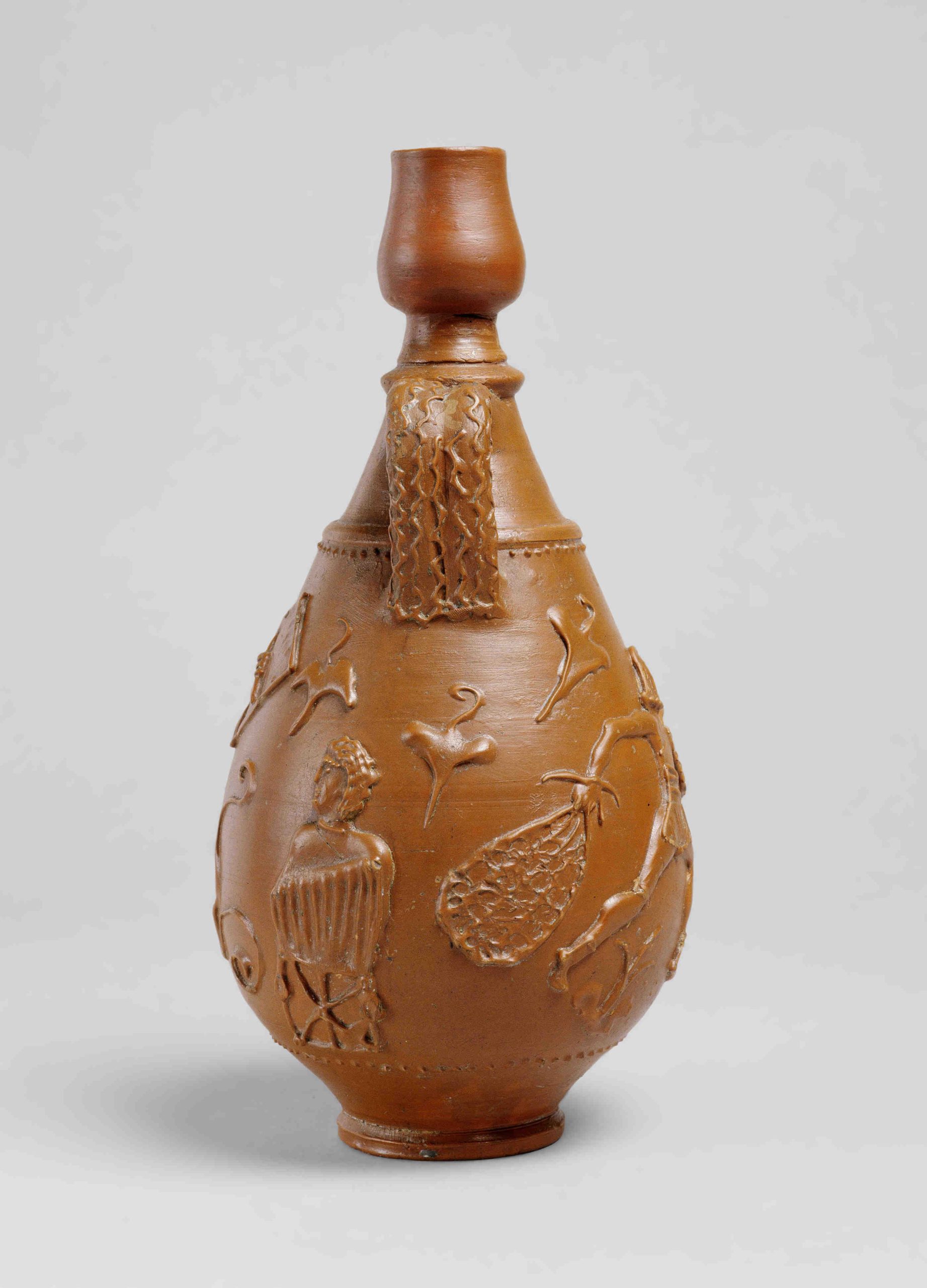
Historical Museum of the Palatinate, Speyer; photographer: Peter Haag-Kirchner
Date:
3rd century AD
Location:
Historical Museum of the Palatinate, Speyer, Germany
Author:
Anonymous
Technique and materials:
Terracotta
Dimensions:
13 x 6,5 cm
Provenance:
Rheinzabern, Germany
Sources:
The Hellenistic-Medieval Organ by Jean Perrot