A scene of the same kind is depicted on this glass vessel found in 1870 at Thorslunde, near Roskilde, and now preserved at the Nationalmuseet in Copenhagen. Unfortunately it was found mutilated, lacking certain fragments. The vessel is decorated with polychrome ornaments of rough design, depicting a gladiatorial combat. Three combatants can be distinguished in full action and a hydraulic organ with its organist. The instrument has a wide base above which the water cistern rests. This, wider than it is tall, shows on its front face the drawing of a checked-belly vessel whose symbolism escapes us. Two lateral pumps are present placed between the plinth and the wind chest; slightly below mid-height two parallel horizontal lines can be seen, perhaps indicating the boundary between piston and cylinder. The wind chest is wide and very tall; unlike the plinth it is not horizontal but slightly oblique, undoubtedly to convey a sense of perspective, and is decorated with a checked pattern. Fourteen pipes of equally wide diameter can be distinguished. Above the pipes the head of the organist appears, very indistinctly. The colours here are purely decorative: the plinth, cistern, pumps and pipes are in ochre, the wind chest is green. The meaning of this decorated vessel becomes clear when one learns that it was originally placed beside a skeleton with other funerary objects: its purpose was probably to make the gods favourable to a gladiator killed in combat or to a munus supporter.
The Vase of Copenhagen
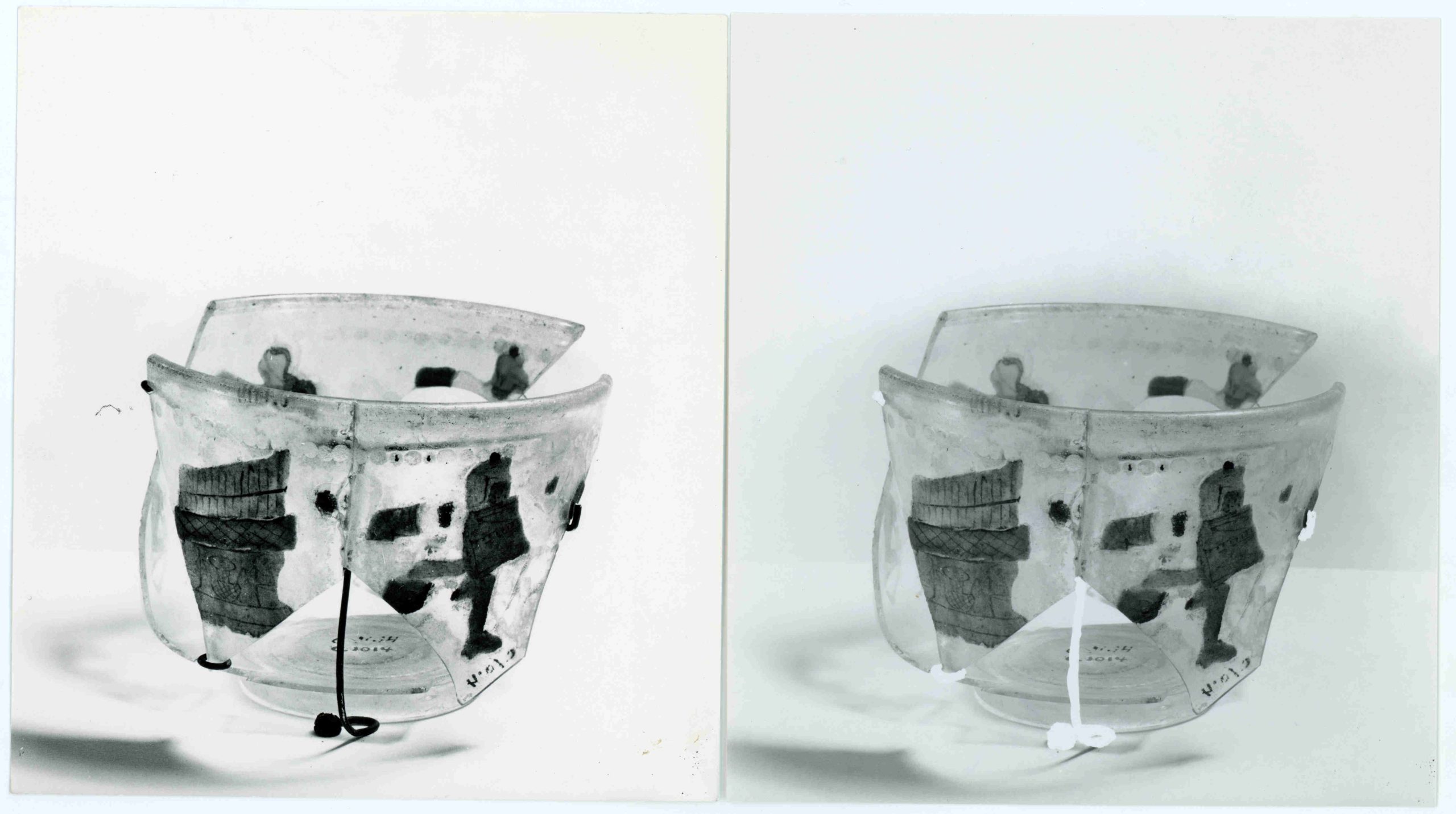
Nationalmuseet, Danmark
Date:
3rd century AD
Location:
Nationalmuseet, Copenhagen, Denmark
Author:
Anonymous
Technique and materials:
Glass decorated with polychrome ornaments of rough design (decorative colours: ochre for base, cistern, pumps and pipes; green for the wind chest)
Dimensions:
Height 7 cm (mutilated fragment)
Provenance:
Found in 1870 at Thorslunde, near Roskilde (Denmark)
Sources:
The Hellenistic-Medieval Organ by Jean Perrot