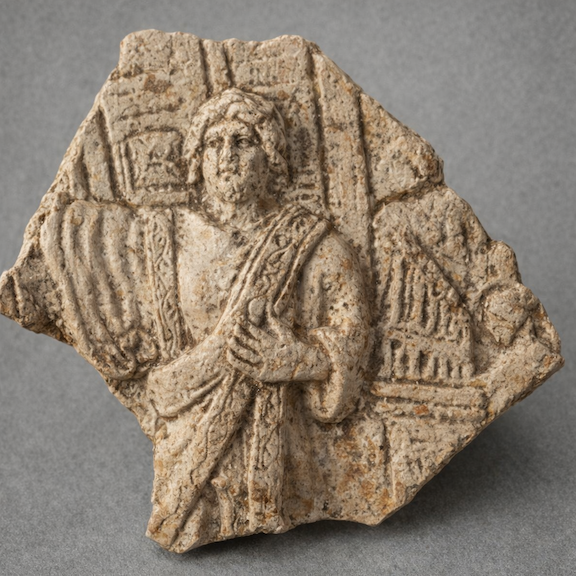
This small ceramic fragment is said to come from the Villa Ludovisi and to have been found in the final years of the last century (i.e., the nineteenth century).
In the foreground a thick-haired man appears to be declaiming or greeting, his right arm outstretched, his left hand resting on the fold of a rich toga picta. Behind him a large decorated two-leaved door can be seen, perhaps that of a temple or theatre. To his left but on a distinctly more recessed plane an organ is depicted: it is a hydraulic organ, with a water cistern decorated with scrolls. There was certainly a pump on the right but, unfortunately, the ceramic is broken at that point. The bellows operator is clearly visible however: he is a boy, and appears to be blowing with his right hand while leaning his left elbow on the wind chest. The latter appears to consist of two parallel parts, one lower containing the mechanism, the other upper corresponding to the top board supporting the pipes held by the transverse bar, seven in all. He too appears quite curly-haired: entirely absorbed in playing, he watches attentively the gestures of the main figure. Most authors identify this figure as a singer. This is possible, but his mouth appears closed. Is he not rather an actor taking his applause in front of the entrance of a theatre?