This very graceful glass depicts a Bacchic procession, in which various musical instruments can be seen: cymbals struck by a dancer, a syrinx held by another; a lituus and, in all probability, a small pneumatic organ placed on the ground. This has approximately twenty-five pipes held by a wide transverse bar and placed on a very flat wind chest. The whole ensemble greatly resembles the sounding section of the British Museum gem. Neither a water cistern nor pumps are present, while the air supply is undoubtedly provided by bellows. The instrument is also fitted with a strap for carrying it over the shoulder. This is a real organ and not a Pan flute. One might certainly object that the number of pipes is unusually high, although the Nennig instrument similarly had many pipes, as already noted: it is therefore considered that in both cases the draughtsman’s intention was not to render the precise details but the general outline. This is a hypothesis, but if it were correct, one must conclude that this is the first known portative organ.
The Glass of the Naples Museum
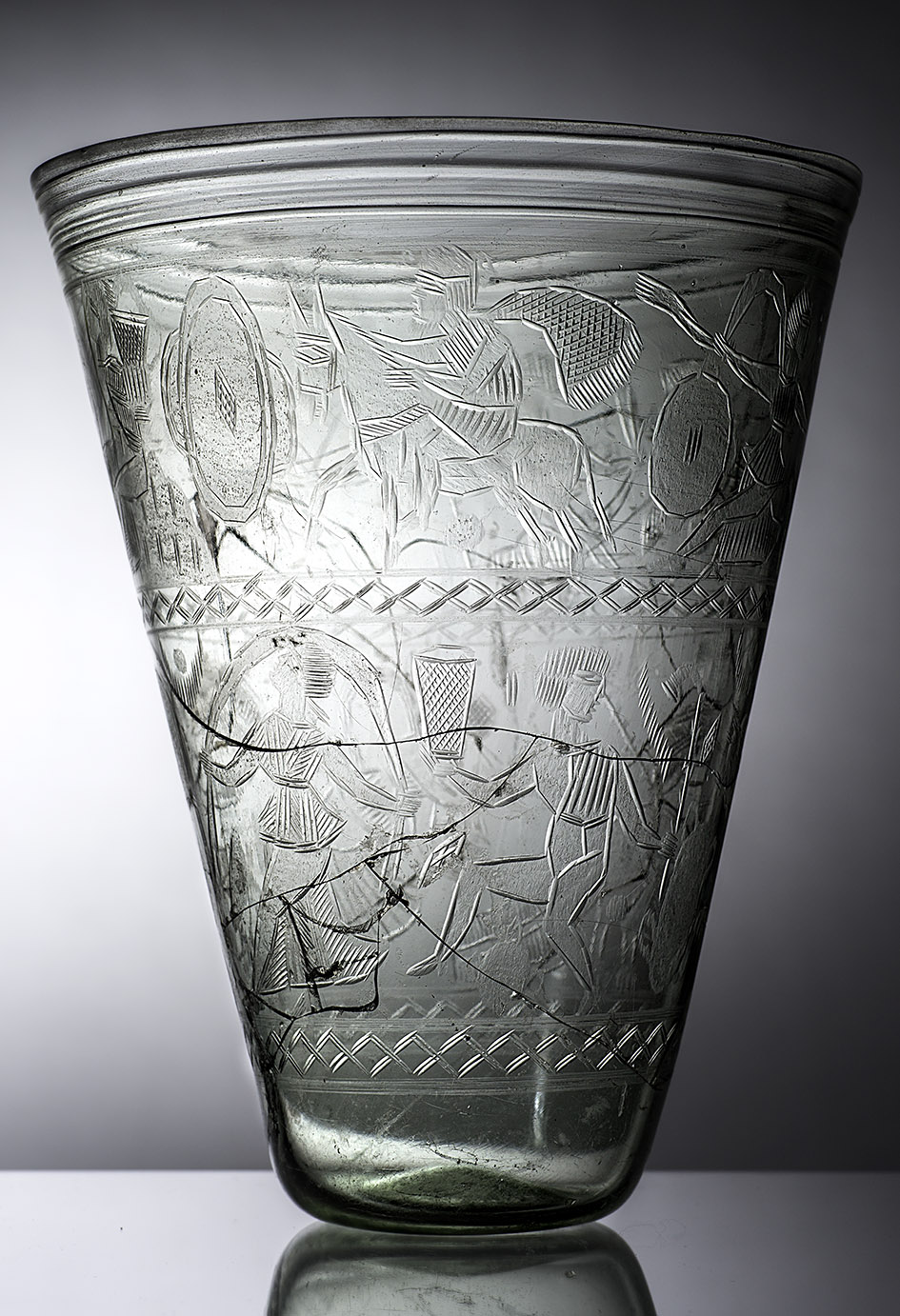
Photo by Luigi Spina. By permission of the Italian Ministry of Culture – Museo Archeologico Nazionale di Napoli
Date:
between 3rd and 4th century
Location:
National Archaeological Museum of Naples
Author:
Anonymous
Technique and materials:
Glass
Dimensions:
Not documented for the glass; depicted organ: width approx. 70 cm, lowest pipe 75 cm, highest pipe 30 cm
Provenance:
Not documented
Sources:
The Hellenistic-Medieval Organ by Jean Perrot