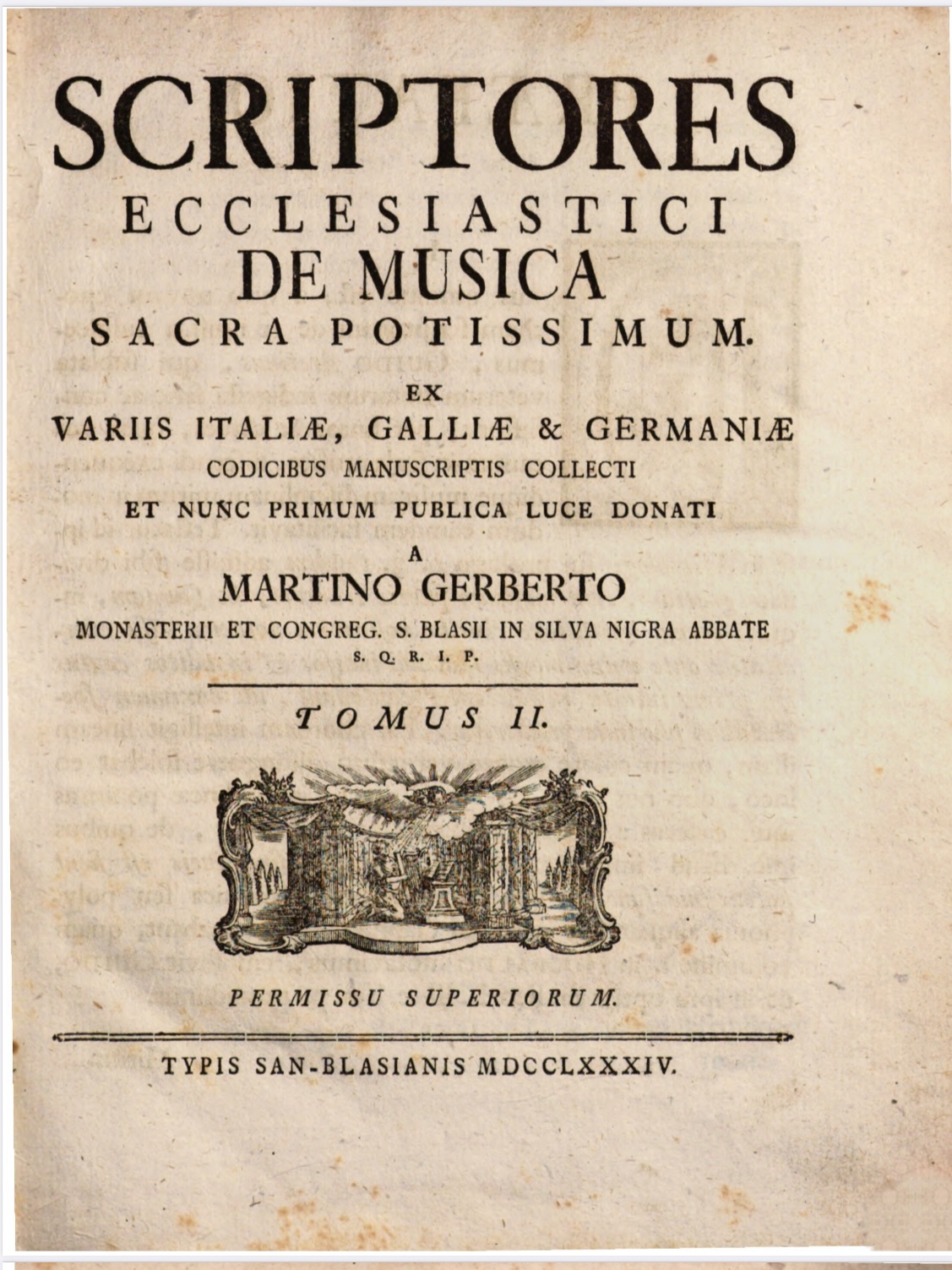
These passages from Aribo’s Musica deal with the measurement of organ pipes and the proportional ratios employed in medieval music theory. The text describes various methods for calculating pipes according to the consonances of the musical system, focusing on the relationship between length, diameter and musical intervals, as well as including directions on the arrangement of notes and the material construction of metal pipes.
On the simple measure of cymbals according to the sesquitertia and sesquialtera proportions, in increase and decrease, and on the reason why the measure of the monochord and that of cymbals behave in the same way.
Both in increase and in decrease, the measure of the monochord and that of cymbals are believed to behave in the same way, since in both cases sound is produced by a percussion: the vibration of the string and that of the cymbal set the free air in motion, not enclosed by any containment. Different, however, is the measure of pipes, probably because of the air that in them is compressed, which, being unable to expand freely on account of the walls of the pipe, requires not only an increase in length but also in thickness; for this reason, in determining the tone, not only the length of the pipe is considered, but also a part of its thickness, that is one eighth of the diameter, as will be clarified below; but let us return to the cymbals.
Concerning the ancient measure of pipes
it is sufficient to describe that of two orders, that is of sixteen pipes, according to which anyone can build as many orders as desired: first of all let the first pipe be established with a length and width determined by the opening of the circle, meaning by diameter not the circumference but the line that divides the circle into two halves; once this measure is taken with the compasses, immediately after building the first pipe, two equal lines are drawn on its top, one of which is to be divided into eight parts, the other into two, three and four equal parts, and from this point onward the entire system of measurement becomes very simple; to obtain the second pipe, subtract from the length of the first one eighth of the diameter, then divide the remaining space up to the lip into eight parts and, having eliminated the ninth at the top, the second is obtained; for the third, subtract from the second one eighth of the diameter, divide the remaining space into nine parts and, discarding the ninth, the third is obtained; for the fourth, remove from the length of the first one third part of the diameter and, having eliminated one fourth part, the fourth is obtained adding a complete diatessaron; for the fifth, subtract half the diameter of the first pipe, divide the remaining space into three parts and, having eliminated the third, the fifth is obtained adding the diapente; for the sixth, proceed in the same way starting from the second pipe, subtracting half the diameter, dividing the remaining space into three parts and removing one, thus obtaining the sixth; finally, to obtain the synemmenon, subtract from the fourth pipe one third part of the diameter; therefore subtract one part and divide the remaining space up to the lip into four parts, and, having eliminated the fourth, the synemmenon is obtained. The seventh will be found by subtracting from the third half the diameter and dividing the residue into three parts, then discarding the third at the top, thus obtaining the final seventh. Once the pipes are arranged in this way, the subsequent ones can also be easily ordered: the eighth from the first, the ninth from the second, the tenth from the third, the eleventh from the fourth, the twelfth from the fifth, the thirteenth from the sixth, the lower synemmenon from the upper one and the fourteenth again from the sixth, proceeding in such a way that to each of the upper pipes the entire diameter is added and the remaining space up to the lip is divided into two parts, eliminating the upper one and taking the lower one, that is the one closer to the lip, as the eighth.
New measure of organ pipes in descending order
The venerable lord William, once a monk of Saint Emmeram in Regensburg and now abbot elsewhere, devised a new measure of pipes by transforming the ascending extension of the previous system into a descending one, and communicated it to me; for he, first among musicians, a kind of modern Orpheus and Pythagoras, showed great kindness toward me. This is his arrangement: the length of the first pipe, according to what William established, is determined up to the lip, while the thickness, equal for all, is defined by a circle. The length of the first pipe is therefore to be divided into eight parts and one eighth plus one eighth of the diameter is to be added to it, thus obtaining the second; also the length of the second is to be divided into eight parts and, adding one eighth together with one eighth of the diameter, the third is obtained; the first is then divided into three parts and, adding one third together with one third of the diameter, a perfect diatessaron is obtained in the fourth, from which the minor order begins. The third pipe is also to be divided into eight parts and, adding one eighth together with one eighth of the diameter, the synemmenon is obtained; the first is then divided in two and, adding half the diameter, the fifth is obtained; the second is divided in two and, adding one half together with half the diameter, the sixth is obtained; the third is divided in the same way into two parts and, adding one half together with half the diameter, the seventh is obtained. The eighth from the first is found by doubling the first and also adding the entire diameter; in the same way as the eighth is obtained from the first, all subsequent ones can easily be derived, provided the entire diameter is added to each.
Measure of pipes according to the “aribuncoline” method, neither entirely ascending nor entirely descending, according to the sesquitertia and sesquialtera proportions.
We, however, proceeding in both directions, sometimes increasing and subtracting, sometimes diminishing and adding, do not lean entirely toward either, since we do not wish to determine the tone through subdivisions into eight or nine parts; and not without reason, for the more rapid a measure, the more true it also is. It is indeed evident to all that determining a fourth, a third or a half of a space by means of its eighth or ninth part occurs more certainly and more quickly. For this reason we have decided to use the sesquitertia and sesquialtera proportions both ascending and descending. The third part of the first pipe, added to the third part of the diameter, produces the fourth; in the same way half of the first, joined with half of the diameter, generates the fifth. The fifth, deprived of one of its fourth parts together with one third of the diameter, provides the measure of the second; the second, considering its half and the diameter, gives the sixth; the sixth, deprived of one of its fourth parts and one third of the diameter, produces the third; half of the third, joined with half of the diameter, is the generator of the seventh; and by removing from the seventh one of its fourth parts together with one third of the diameter, what remains provides the length of the pipe that corresponds to the synemmenon. At this point we can abandon every concern, because we have now reached a safe harbour: by doubling the first and adding the entire diameter the eighth is obtained, from the second the ninth, from the third the tenth, from the fourth the eleventh, from the synemmenon another synemmenon, from the fifth the twelfth, from the sixth the thirteenth and from the seventh the fourteenth; for so many are the pipes of the organ which, according to the experience of lord William, it was thought fit to use, who to the two orders, that is the fourteen pipes, added three more to complete a tetrachord, so that an adequate acuteness might correspond to the smallest and a proportionate gravity to the largest.
Measure of the organic disposition.
From A let a diatessaron be raised to D; from A then draw a diapente upward to E; then descend from E a diatessaron to B; again, from B ascend to F with a diapente; from F descend a diatessaron to C; from C ascend to G with a diapente; from D a diatessaron must finally be raised to the synemmenon.
How pipes must be correctly constructed.
Just as the pipes all have the same thickness, so too the sheets from which they are constructed must have the same width; we have already traced, according to the teaching of lord William, the circle that defines the thickness, but we must now carefully consider what width derives from it. Macrobius, in his commentary on the Dream of Scipio, states that the diameter of every circle, multiplied by three and increased by one seventh of itself, provides the measure of the circumference; following therefore his authority, we multiply the diameter of the circle and add one seventh part of the diameter itself, and according to the length of the line thus obtained we determine the width of the sheets from which all the pipes are made. These sheets must be thinned at the lateral edges, so that when they are bent by the craftsman’s hand, the ends do not overlap, but touch only with a perfectly close joint; to cover this joint, small covering sheets — thin as wisps and of the right width — are soldered together with tin or with another material that guarantees greater holding and durability over time. After the length of each pipe has been determined on the still-open sheet by means of points fixed at the sides, a transverse line is to be drawn from point to point: this line will constitute the limit of the hole and opening of the pipe, and the mouth must be cut above it so that it opens to half the width of the pipe. On this same line the sounding lip is to be firmly fixed, from which the lower edge of the opening must be at a distance equal to the thickness of a small sheet.