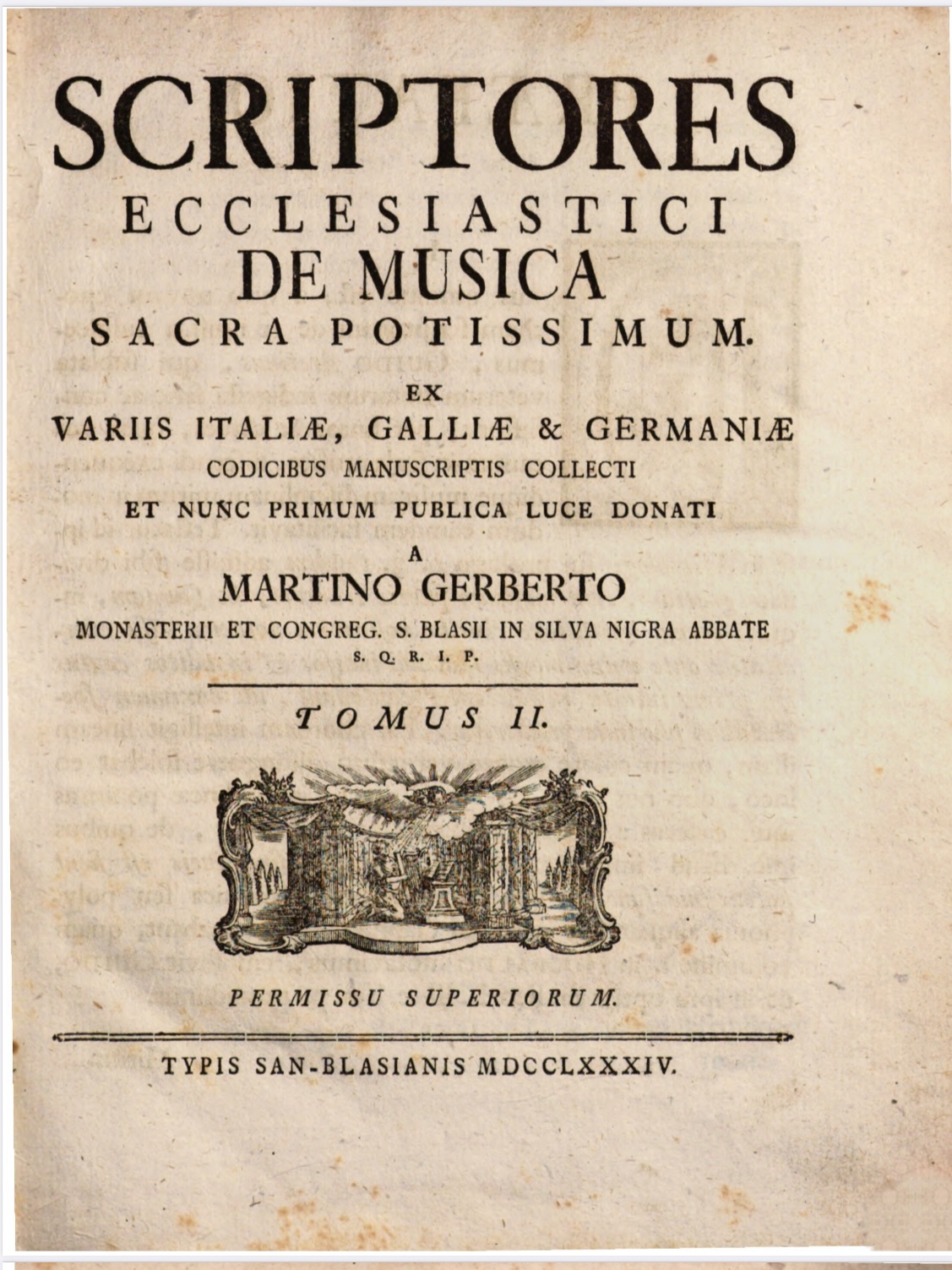
These introductory texts to the treatise De mensura fistularum in organis, attributed to Eberhard of Freising and transmitted in several medieval manuscripts, illustrate the theoretical and practical principles used in the measurement of organ pipes. The passages describe the ratios between length, diameter and musical consonances, presenting different methods for calculating pipes, the organisation of organ ranks and courses, and directions for the casting of nolae, that is, small organ bells.
Prefatory note
To the short treatise by Eberhard of Freising on the measure of pipes, together with the rules for casting the nolae — that is, the small organ bells — which we publish from a Tegernsee codex of the twelfth or thirteenth century, we add from a manuscript of Saint Blasius, of the same date and subject, two brief anonymous writings on the measure of pipes in organs. The second of these is found among the works of Guido of Arezzo in an Admont manuscript, with which we have compared and supplemented our text. From an Ottobeuren manuscript, of approximately the same date, comes moreover a measure of the organistrum.
Before setting out the measure of pipes, we wish to premise some things, so that what follows may be more easily intelligible. A doubt may indeed arise, especially in those less expert in music, as to why the measure of pipes extends to two or three orders; so that some dispositions comprise fourteen, others twenty-one pipes of different length, without including the synemmenon of each order. This occurs although the organic rule, just as it is founded on seven strings, is also naturally founded on seven pipes, on account of the seven distinctions of sounds, from the parypate hypaton to the paramesa, with only the synemmenon placed as an eighth between mese and paramesa.
To prevent even the simplest from losing their way in this question, it must be known that the measure actually deals with as many pipes as there are ranks of pipes that musicians are accustomed to add to the organic instrument in order to practise the art of organum. Eight ranks being disposed according to the seven distinctions of sounds mentioned above, and an eighth synemmenon added for sweetness and ornament, to each of them their respective lower doublings are also added, so that the entire structure of the organ turns out to be composed of eight natural ranks, each of which resounds twice at the octave.
We, however, will limit ourselves to setting out the measure of two orders, that is of sixteen pipes, according to which each one will be able to add as many orders as desired.
Establish the first pipe with such a length and width as good judgment and balance suggest. The length of the pipe is measured from its plectrum to the top, while the width is the capacity of the inner cavity, which at the upper part opens in the form of a circle. This circle is not measured along the circumference, but through the centre, from one edge to the other: this measure is called the diameter.
The width of this diameter, measured with the compasses, must be immediately transferred, after building the first pipe, to its top with two equal lines: one of which is to be divided into eight parts, the other. Divide (the measure) into two, three and four equal parts: after this, the entire system of measurement will be very simple for you.
To obtain the second pipe from the first, subtract from the length of the first one eighth of its diameter; divide the remaining space up to the plectrum into nine parts and, discarding the ninth at the upper part, you will obtain the second.
To find the third, remove from the length of the second pipe two eighths of the diameter, or better one single eighth of the diameter; then divide the rest up to the plectrum into nine parts and, having eliminated the ninth upper part, you will have the third.
To obtain the fourth, subtract from the length of the first pipe one third of the diameter; divide the rest up to the plectrum into four parts and, having removed the fourth upper part, you will have the fourth, completing the interval of a fourth (diatessaron).
To find the fifth, subtract from the length of the first pipe half the diameter; divide the rest into three parts and, having removed the third upper part, you obtain the fifth, that is the interval of a fifth (diapente).
For the sixth, subtract in the same way half the diameter from the second pipe; divide the rest into three parts and, leaving the third upper part, you obtain the sixth, completing a major interval of the song.
To determine the synemmenon, subtract from the length of the fourth pipe half the diameter, or better one third; divide the rest into four parts and, having eliminated the fourth, you obtain the synemmenon.
To obtain the seventh, remove from the length of the third pipe half the diameter; divide the rest into three parts and, having disregarded the third upper part, you complete the seventh in the entire natural structure.
Things having been thus disposed: the eighth from the first, the ninth from the second, the tenth from the third, the eleventh from the fourth, the twelfth from the fifth, the thirteenth from the sixth, the lower synemmenon from the upper one, the fourteenth from the seventh — you will be able to order them very easily, taking for each upper pipe the entire diameter at the top and dividing the rest up to the plectrum into two parts; having eliminated the upper part, take the lower one, that is the one near the plectrum, as the eighth.
Another method
Given the length of the first (that is the smallest) pipe, it is preferable that the diameter of the bore should be one eighth of the length. Every time a tone is to be obtained, the larger pipe must contain the smaller one plus the entire diameter and one eighth of the diameter; for the fourth (diatessaron), the larger must contain the smaller plus one third of its length and one third of the diameter; for the fifth (diapente), the larger must contain the smaller plus half its length and half the diameter; for the octave (diapason), the larger must be twice the smaller plus the entire diameter.
Another method
In measuring the pipes of organs, introducing a new method, we proceed from the smallest measure to the largest. And although this method has hitherto been unknown and unheard of, it is nevertheless received the more favourably by the more experienced organists, the more it follows a natural order and a proportional rule. Since indeed almost all craftsmen of this art have hitherto adopted the practice of establishing two or three complete orders of pipes, it must be known that those who establish two orders suffer a certain loss; those, however, who place three exceed the right measure. For when two distinctions of sound are established, adequate gravity in the larger pipes or greater acuteness in the smaller may be obtained, or both. But when there are three, either the smaller pipes exceed the right acuteness, or the larger ones exceed in gravity: if they exceed in the acute they are dissonant, if in gravity they cannot be set in vibration. Therefore, rejecting both solutions, we do not wish either to extend our measure to three orders or to limit it to two alone.
We therefore establish two orders, a minor and a major, to which we add three more sounds, to construct a tetrachord starting from the third order, that is the smallest. But first some necessary elements must be prepared: an adequate length of the smallest pipe from the plectrum, and a suitable width. The width must indeed be the same for all; and of it the diameter is considered, and of the diameter three parts: the eighth, the third and the half.
We therefore wish that the minimum length and the width of all should be of this kind.

For if they are arranged as stated, by means of the diameter the diatessaron (fourth) is obtained, which, as indicated, is determined with precision according to length and width; in this way none of the modes described above is exceeded, even the graver pipes can sound, and all, as we have already verified in our examples, are perfectly consonant and can be proportionally measured in the following way.
The first pipe is divided into eight parts, and one eighth of its length together with one eighth of the diameter is added to it: thus the second is obtained. In the same way the second is divided into eight, and adding one eighth of the length and of the diameter the third is obtained. The third is also divided into eight and, adding one eighth and one third, the fourth is completed as stated.
Here the minor order also begins. The third pipe is then divided into six parts, adding one eighth of the diameter; having eliminated the sixth upper part, the synemmenon at the fifth degree is obtained. The first is divided in two and, adding half the length and half the diameter, the fifth is obtained. The second is divided in the same way and the sixth is obtained. The third is divided into two equal parts and, adding half the diameter, the seventh is obtained.
The eighth is found thus: the first is doubled and the entire diameter is added. And just as the eighth is obtained from the first, in the same way all subsequent ones are found with great ease and with the minimum number of operations: from the second the ninth, from the third the tenth, from the fourth the eleventh, from the synemmenon another synemmenon, from the fifth the twelfth, from the sixth the thirteenth, from the seventh the fourteenth, from the eighth the fifteenth, from the ninth the sixteenth, from the tenth the seventeenth, which represents the limit.
If this subdivision, verified by the ancient method, is carefully checked, a certain and perfect measure is obtained, eliminating only the superfluous eighth of the diameter that the ancients added in determining the third pipe, provided the necessary precision of the measurer is applied.

Rule for casting the nolae, that is small organ bells.
If you wish to make small bells (nolae), take any weight and call it A; then take all of A and add one eighth of it, and you obtain B: you will thus have a tone. Then take B and add its eighth part, obtaining C: again you have a tone. Then take all of A and add one third of its quantity, obtaining D: you have thus completed a fourth (diatessaron), composed of two tones and a semitone.
Subsequently take the whole of D and add its eighth part, or take all of A and add half of it, and you obtain E. Then take E and add its eighth part, obtaining F. Then take F and add its eighth part, obtaining G. Then double A and you will obtain H, or, as some prefer, another A: in this way you obtain the complete octave (diapason), formed by the combination of fourth and fifth.
If, however, you wish to insert the synemmenon, which is regulated by the immediately preceding semitone, take the whole of D and add one third, and you will obtain the synemmenon, which must be placed between F and G in the upper part.
Just as the measure of pipes grows in length from the first to the eighth, in the same way the weight of the small bells grows in thickness from the first to the eighth.