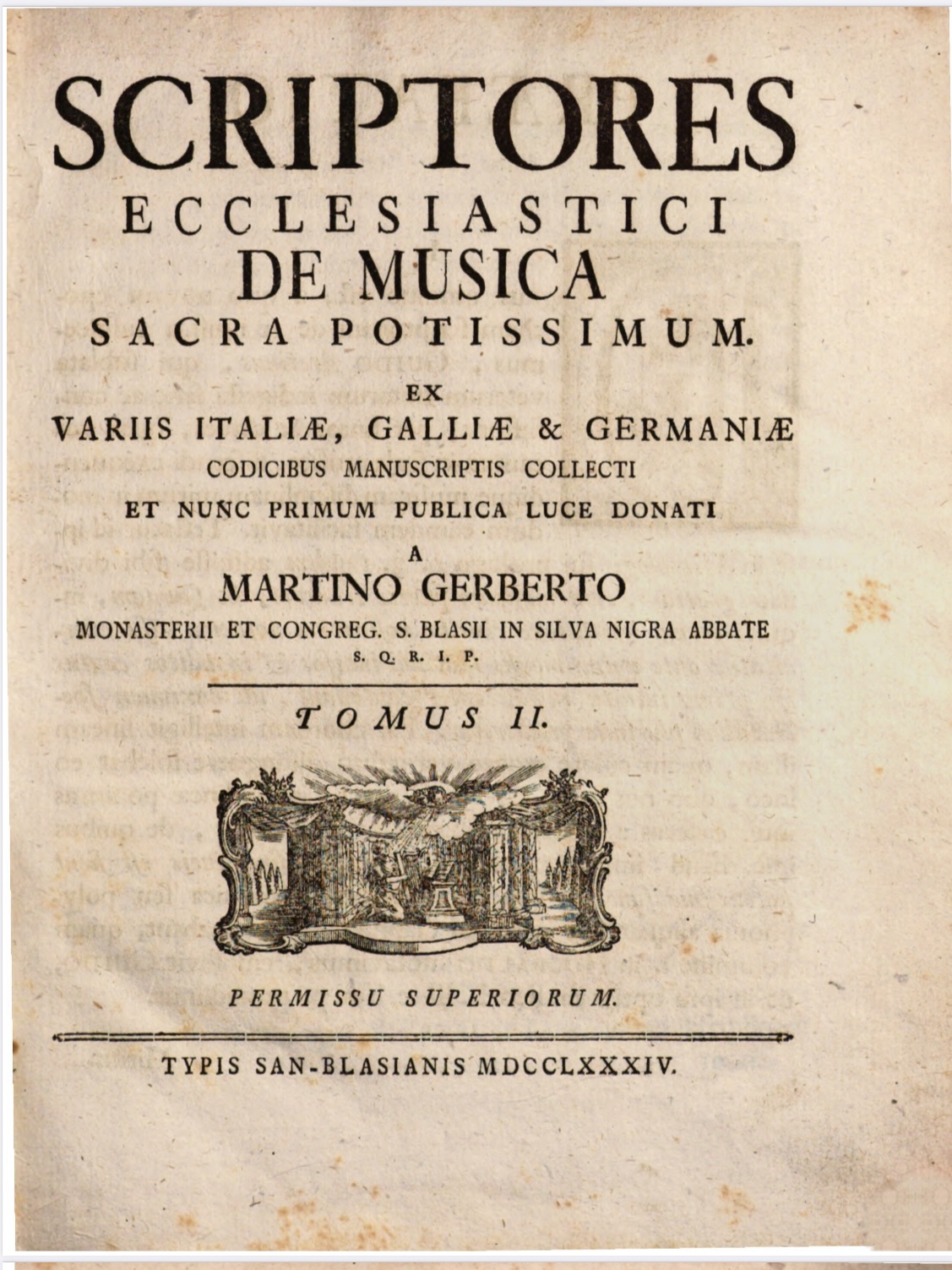
These passages from the De musica by Engelbert of Admont contain theoretical reflections on medieval musical terminology and on the organisation of consonances and tones in musical instruments. The text distinguishes the meaning of the terms organum and instrumentum and refers to the arrangement of keys and voices in organs according to the theoretical system of medieval music.
CHAPTER III — On the three methods of teaching and learning music.
[…] It must however be noted, so as not to fall into terminological misunderstandings or ambiguities, that although organum and instrumentum are often used as synonyms, they properly differ in this: that is called an organum which is set in motion to speak or sing and is activated by nature, such as the members for the generation and emission of the human voice, namely the heart, the lungs, the lips, the tongue, the teeth and the throat. That is properly called an instrumentum, on the other hand, which is set in motion to produce sounds and is activated by art and use, such as the lyre and the flute (fistula), the psaltery, the cithara and the like. […]
CHAPTER XI — On the seven positions of variation of the beginnings and endings of the order of the six voices in the musical hand.
[…]. The usefulness of considering and noting the distinctions between these injections (attacks) and terminations through the positions and letters cited above consists in the fact that, just as the aforesaid voices and their beginnings and endings vary according to seven modes as they pass from one letter and position to another letter and position — as has already been seen — both ascending and descending, so in the same way the beginnings and endings of the consonances also vary. Consequently, the beginnings and endings of the seven musical tones also vary according to the same logic, through intervals of tone and semitone, and of fourth (diatessaron) and fifth (diapente), both ascending and descending in musical song, as will be seen further on. For this reason Aribo states in his Musica that some have not considered an eighth tone, because they observed that it proceeds almost with the same modulation as the first, since it ascends and descends according to the same species of octave (diapason) as the first, as will be said further on. The consideration of these beginnings is moreover useful for establishing in musical instruments (organs) the order and sufficiency of the keys, as well as the starting point from those letters in which the order of voices begins, as from C fa ut in the bass register, from which the arrangement of spaces and lines in books of noted music also takes its start. The rest concerning these voices and their mutations, since it is common and well known to beginners in the study of music, is here omitted: for us it is indeed sufficient to set out in general the causes and reasons of the particular rules. […]