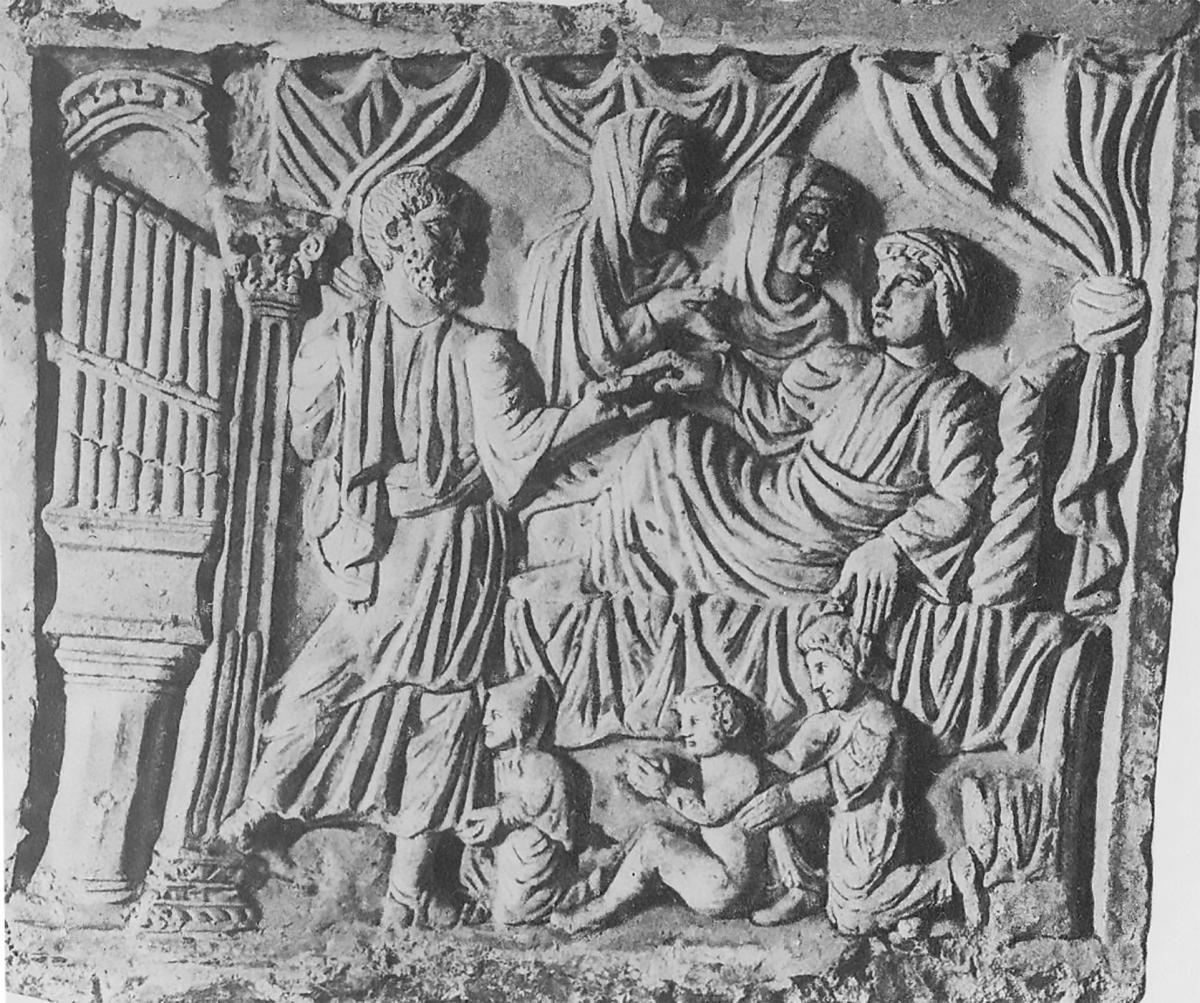
In the crypt of the Basilica of Saint-Maximin (Var) a beautiful marble sarcophagus is preserved dating from the Constantinian period. On one of the lateral faces, unfortunately poorly lit, a bas-relief is visible depicting a well-known Christian scene: the Resurrection of Tabitha, narrated in the Acts of the Apostles (IX, 36–43). The resurrected woman is sitting up on the bed and Peter takes her hand. At the foot of the girl’s bed, behind a column, a hydraulic organ is depicted. The water cistern, grooved, appears to be cylindrical and rests on a small hexagonal plinth. The wind chest, relatively thick, supports eight pipes decreasing from left to right. At their feet the rings described by Vitruvius to secure them to the tabula summa can be clearly seen. These are certainly flue pipes: two wooden oblique blocks with mouths can be clearly distinguished, with the ends of the stoppers closing their upper orifice clearly visible. A grooved transverse bar holds the set of pipes. The keyboard is out of sight, being on the other side of the organ. Nor are the pumps visible, but these are often omitted in drawings. Nevertheless it is not impossible that this is a pneumatic organ of very large format, placed on a table.
The greatest interest of this sculpture lies in the presence of the organ in a Christian burial place. For this circumstance various explanations can be proposed, none of them decisive. Either Tabitha has been depicted with the features of a deceased woman who practised the trade of organist; or it was customary at that time to play the organ at the funerals of believers, or at least to use it to accompany the singing of psalms; or, as suggested by “Father Arbus,” the organ is here a symbol of the joys of the afterlife, but this last hypothesis seems to us barely defensible since the scene depicts precisely a return to earthly life. We are tempted to think that it is an eschatological motif directly inspired by Greco-Roman traditions.