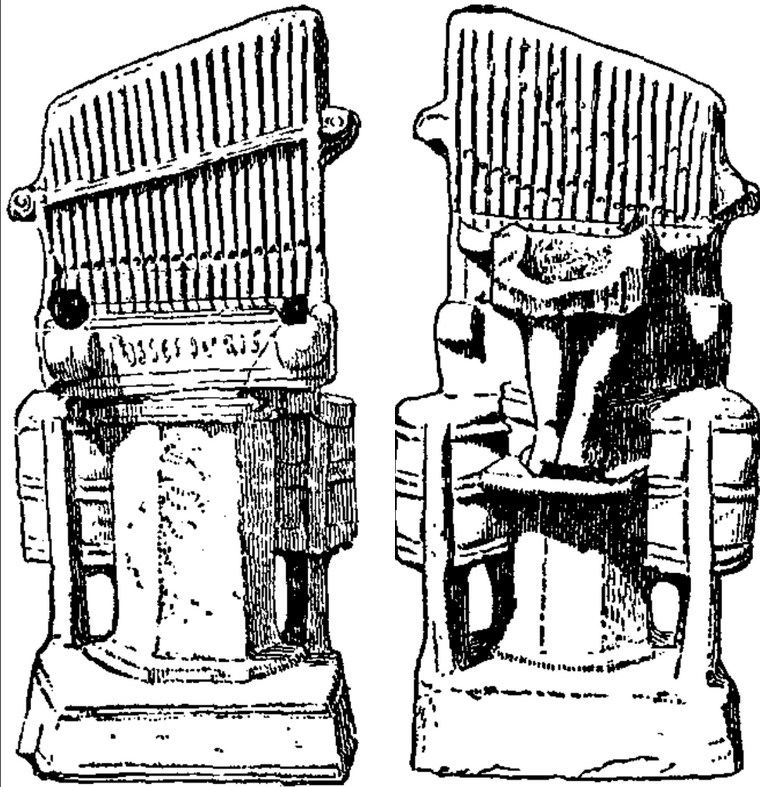
The hydraulic organ represented by this lamp is undoubtedly the most careful and perfect reproduction of the instrument to have come down to us. The inscription “POSSESSORIS,” scratched with a pointed tool, can be compared with a mark I copied from the base of a Roman lamp reading “PVLLAEN POSSESSOR.” It also allows us to date our terracotta to a period close to the second century of our era, since the name “PVLLAENI” is frequently encountered on Roman lamps from the two reference cemeteries dating to that time.
The terracotta shows an elegantly crafted hydraulic organ with its organist, without bellows operators. The workmanship is very careful and one may suppose that the artist reproduced a model he had before his eyes. The organist, whose body is missing above the knees as it was broken off, stands erect on a sort of podium consisting of a simple board placed at the average height of the pumps. The instrument fully conforms to Vitruvius’s description, with a solid square base supporting the water cistern and the uprights “arranged in the form of a ladder” to which the cylinders are fixed. This cistern is hexagonal and furnished with a kind of moulding marking its upper and lower limits, with a height of almost twice its width. On the sides are the pump cylinders, one on each side, approximately half the height of the cistern; each cylinder is held by three circular straps: one at the top, a second at mid-height and the last at the bottom, all fixed to the vertical uprights. The volume of the pumps relative to the overall dimensions of the instrument is significant and presupposes a very considerable consumption of wind. Indeed the wind chest supports three rows of eighteen pipes each: by mistake the sculptor depicted nineteen on the front face of the organ, while the other side shows eighteen, and the keyboard presents the same number of keys.
The first row, on the front face of the instrument, presents pipes of almost equal diameter, held in position by an obliquely placed transverse bar fixed to two vertical uprights on the sides by means of a circular decorative motif. This bar is absent on the other face of the organ.
The pipes have mouths, the latter clearly visible and diamond-shaped, appearing entirely similar to those produced today. Now, establishing eighteen notes at regular intervals as indicated by the rectilinear progression of the pipes, within the range of a major sixth, requires the use of quarter-tones. The ventilation system would therefore have had to provide a sufficiently steady wind to maintain such a precise tuning. Experiment seems to confirm this hypothesis well. In any case, since the statuette was modelled with considerable care, one should not be hasty in concluding that an error of observation on the part of the coroplast was involved.
There are two other series of pipes of different size visible beside the keyboard. One is less than half the height of those in the first rank, allowing for the fact that the keyboard conceals the base of the pipes; the other reaches almost two-thirds of the same. In this way the instrument as configured comprised three ranks.
The keyboard is clearly rendered: it consists of eighteen rectangular keys whose axis corresponds exactly to that of the pipes, a necessary arrangement for a slider-chest. These relatively wide keys are placed on a very low plane in relation to the organist, at the level of mid-thigh. This anomaly, which would have needlessly complicated the instrument’s mechanisms, is easily explained. The figure’s body was in fact not modelled together with the organ but was added and glued with joints that are clearly visible in the clay.