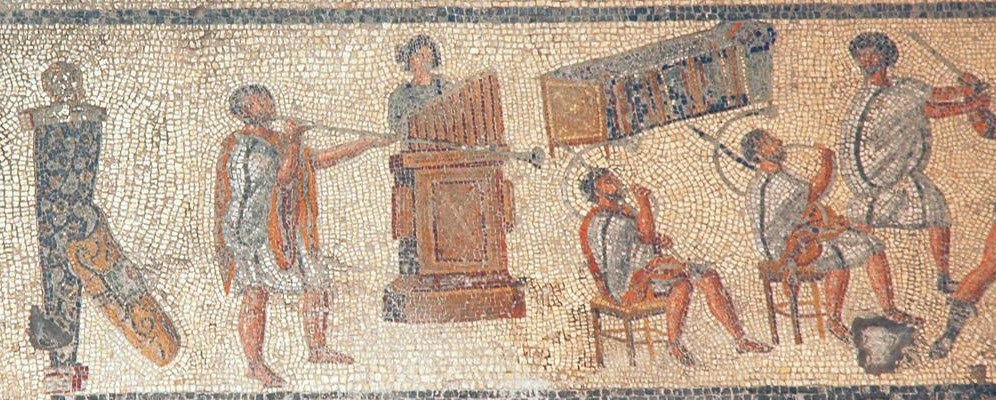
This is a large mosaic of still very vivid colours, adorning part of the remains of an imposing Roman villa built on the seafront at Dar Buk Amméra, not far from the oasis of Zliten. The central part of this mosaic is decorated with fish and geometric motifs; along the entire length of the perimeter a very narrow band shows in detail a great munus animated by two orchestras, each composed of a trumpet, an organ and two horns.
Beside the traditional herma, the tubicen can be seen on the left; elegantly dressed, he blows into a long trumpet that he holds with both hands. The instrument, which measures around a metre and a half in length judging by the figure’s size, has a small conical bell at its end. To the right on the same level the horn players are depicted: also gracefully dressed, they sit on stools and seem fully in action, with the mouthpieces of their instruments pressed to their lips. We note that these horns, like the one in the previous scene, closely resemble the instruments found at Pompeii.
Between the tubicen and the cornicines, on a slightly more recessed plane, a hydraulic organ with its organist is depicted. The organ resembles that of Nennig, with the difference that its water cistern is rectangular rather than hexagonal in section. The front face is decorated with mouldings and geometric designs. This cistern, set on a very narrow plinth, is dark yellow in colour with black and red shading. On each side the pumps can be seen, but neither the connecting rods nor the levers are depicted. The absence of bellows operators in this scene, so rich in details of all kinds, suggests that the organist operates them himself with his feet.
The wind chest, slightly wider than the cistern, supports ten pipes arranged as in our own day, with the treble pipes to the organist’s right. The mosaicist may have wished to depict a reed stop: the pipes, whose upper orifice is clearly visible, have no mouth. The keyboard, hidden behind the pipes, is placed a few centimetres above the wind chest, judging by the position of the organist’s right elbow. The organist is a slender young woman with a fine and determined face; her very dark eyes follow the progress of the combat with close attention. The short-cropped hairstyle gives the figure an extraordinarily modern appearance; the long-sleeved dress is dark green with blue bands.