
The Lady and the Unicorn is a cycle of Flemish tapestries from the end of the fifteenth century. It constitutes one of the most important works of tapestry-weaving in the European Middle Ages. It is composed of six panels, all with a red background, with at the centre the lady with the unicorn and the lion and around them other small animals, trees and flowers. The banners and shields bear the emblem of Jean Le Viste. Five panels are dedicated to the senses:
– taste: the lady is taking a sweet from the dish offered to her by a maidservant. At her feet the little monkey is also eating a sweet. The lion and the unicorn hold banners and wear cloaks bearing the emblem with the three crescents.
– hearing: the lady plays an organ resting on a table, while the maidservant operates the bellows that supply air to the instrument.
– sight: the unicorn gazes at itself in a mirror held by the lady, who is seated with the animal’s forelegs in her lap.
– smell: the lady prepares a garland from the flowers the maidservant brings her on a dish; other flowers, with which the monkey plays, have been gathered in a basket.
– touch: the lady caresses the unicorn’s horn with her left hand and with her right holds a banner.
– À mon seul désir: this last panel, larger than the others, differs in style and is more difficult to interpret. The lady stands before a tent, which bears at the top the inscription À Mon Seul Désir (“to my sole desire”) held open by the unicorn and the lion. In her hands she holds a veil containing the necklace she wore in the other tapestries, and places it in the casket offered to her by the maidservant.
The Lady and the Unicorn (Hearing)
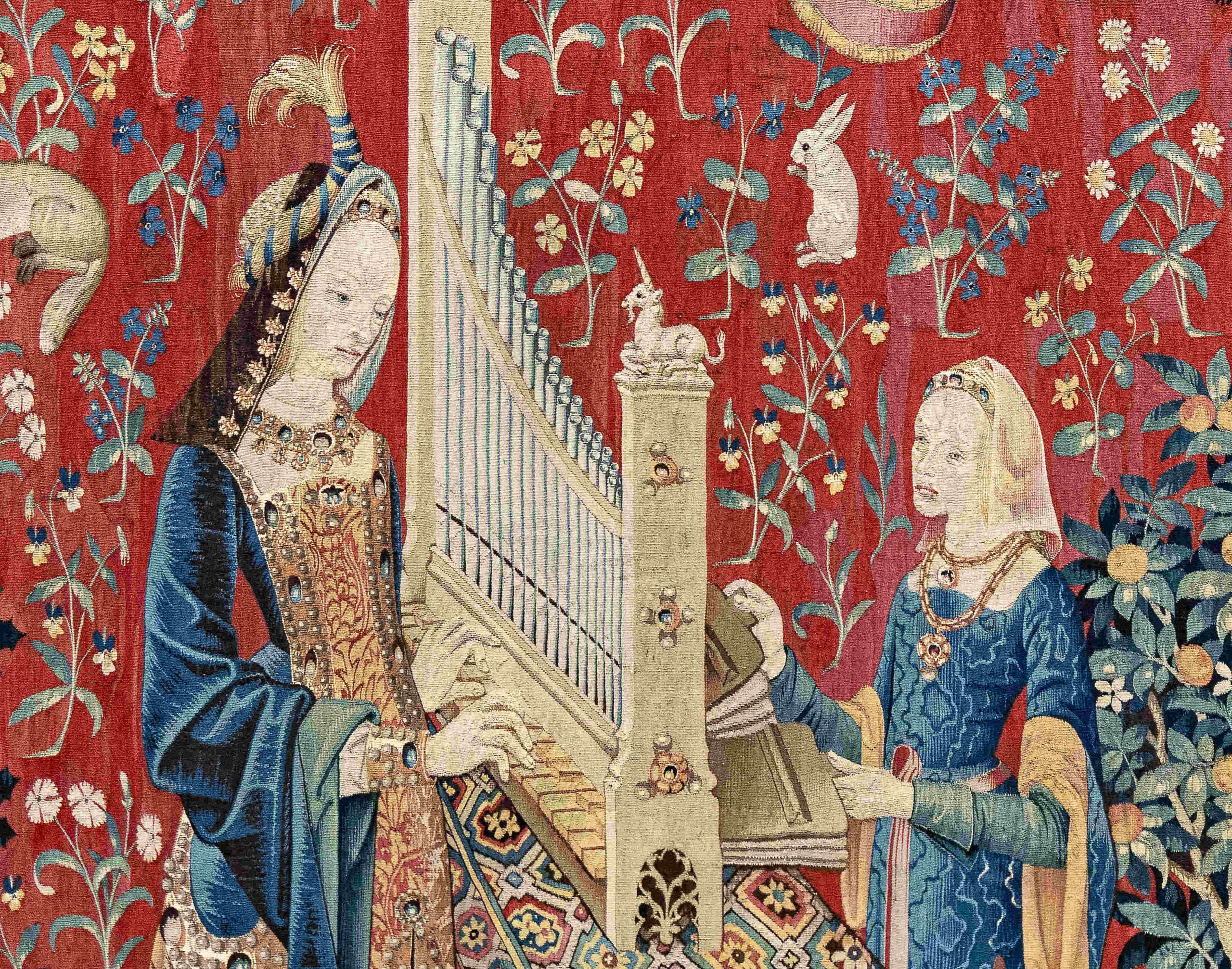
Photograph by Didier Descouens, Public domain, via Wikimedia Commons
Date:
1484-1500 ca.
Location:
Musée de Cluny – Musée national du Moyen Âge, Paris
Author:
Anonymous (Flemish workshop, probably Paris or Brussels)
Technique and materials:
Tapestry in woven wool and silk (high-warp weaving)
Dimensions:
Each panel approx. 3.6 × 2.5 m (the last one is slightly larger)
Provenance:
Commissioned for the Le Viste family (French nobility); discovered approx. 1841 at Boussac Castle
Sources:










_L%27Ou%C3%AFe_(La_Dame_%C3%A0_la_licorne)_-_Mus%C3%A9e_de_Cluny_Paris_cropped_for_musicians.jpg)