Both medallions depict the emperor in profile on the recto and a hydraulic organ on the reverse.
First medallion: The organ has a hexagonal cistern on a flattened plinth, a wind chest of 0.90 m, 7 pipes held by an oblique bar and lateral uprights. Keyboard and pumps not visible; an oblique lever on the right indicates the bellows mechanism. The organist, an adolescent dressed in a long tunic, holds a triangular object in his hand. The overall height of the instrument reaches almost 2 metres.
Second medallion (British Museum): The organ is similar to the previous one but with an unadorned cistern and 8 pipes, held by vertical uprights and a transverse bar. The treble pipes are to the right of the keyboard, which is on the other side of the instrument. The organist wears a tunic belted at the waist reaching to mid-leg and holds a triangular object. Behind him two large sheets and an open cylindrical box are visible. Both medallions document the depiction of the young organist and the structure of the late antique hydraulis, confirming the celebratory and symbolic use of the instrument at the imperial court.
The Contorniates of Nero
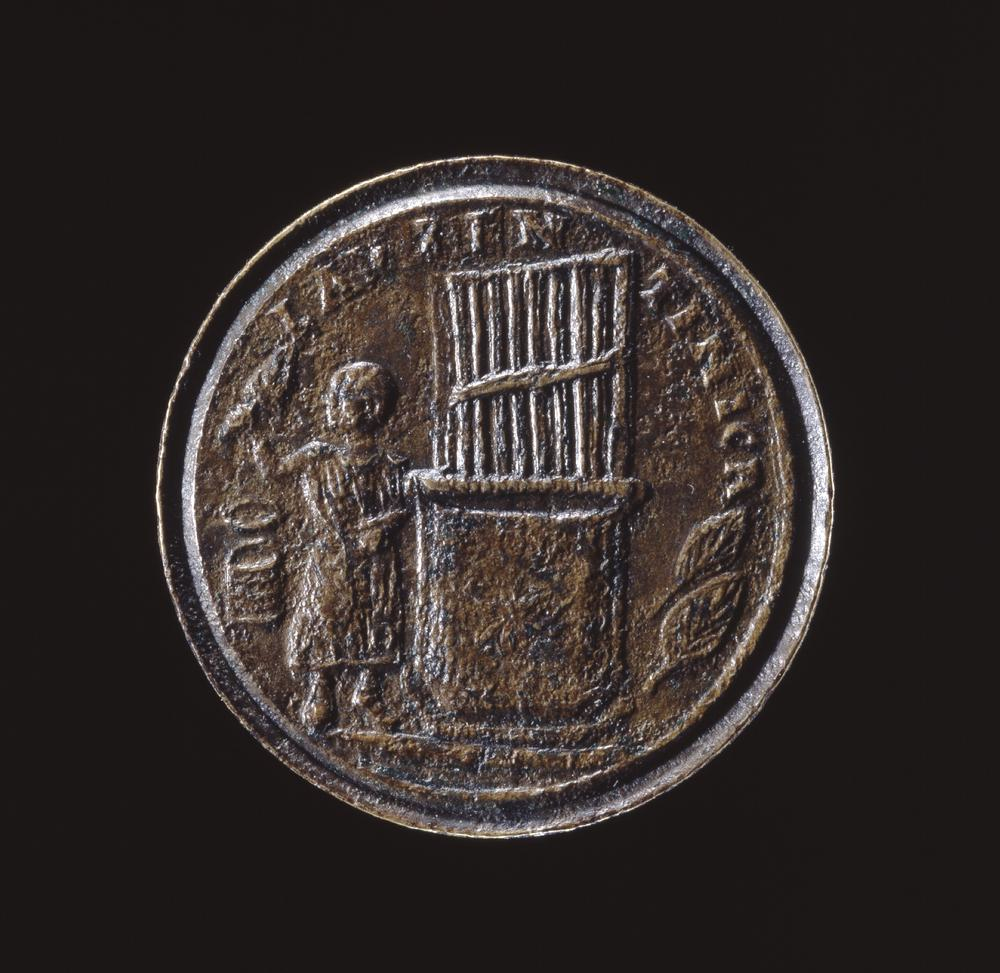
© The Trustees of the British Museum
Date:
second half of the 4th century
Location:
First: not documented; second: British Museum, London
Author:
Anonymous
Technique and materials:
Metal contorniates (medallions)
Dimensions:
Not documented; first depicted organ: approx. 2 m height (wind chest 0.90 m, pipes 0.90–0.80 m); second depicted organ: not quantified
Provenance:
Not documented
Sources:
The Hellenistic-Medieval Organ by Jean Perrot