This is a small funerary monument discovered in Bulgaria in 1936 and little known in France until the exhibition of Treasures of Bulgarian Art held in Paris in the spring of 1963. Near Tatarevo, a small village in the Borissovgrad region, excavations brought to light this white marble stele composed of a quadrangular base and a column in the form of a prism. On the front face of the base three figures are depicted: on the left, standing, a gladiator in iron armour protected by a large rectangular shield; on the right his defeated opponent, seated on the ground with his right hand raised to beg for mercy; between the two a curly-haired summa rudis. The latter does not hold the usual rod but carries a kind of large sword. His gesture clearly indicates that he is ordering the winner to refrain from executing the wounded man: the phase of combat most often depicted in gladiatorial scenes can be recognised here.
Above the figures, at mid-height of the column, the amphitheatre organ is depicted on a much smaller scale. This is again a hydraulic organ, with a tall and narrow water cistern, two pumps, a wind chest and a row of nine pipes. The cistern resting on a plinth appears hexagonal and widens toward the top, below the wind chest. The latter is formed by two superimposed elements, of almost equal thickness. On each side of the wind chest, protruding slightly downward, two rounded mechanisms can be seen representing the pumps. Two figures, perhaps children, are seated on them; they are seen from behind, but with their faces turned toward the audience. They are certainly operating the bellows levers, despite the strange position of the arms of the one on the left. Below the figures the monument bears the following inscription: “ΕΠΙΠΤΑΣ ΠΟΥΛΣΑΤΩΡ” (“Epiptas pulsator“). Epiptas is a Thracian name, otherwise unknown. In Latin the adjective “pulsator” generally means “one who strikes” but sometimes also, from the end of the first century of our era, “one who plays a stringed instrument.” But it is possible that Epiptas designates here a particular category of gladiators. The figure depicted between the two fighters might be the fencing master (doctor), the trainer, himself engaged on this occasion in playing the hydraulic organ while coordinating the movements of his pupils. Indeed, contrary to the opinion of J. Colin, the orchestra of the amphitheatre was not necessarily composed of specialised musicians. A well-known Pompeian graffito actually shows an armed gladiator playing the cornu during the parade. Whatever the case, it must be acknowledged that the hydraulis depicted on this stele figures there as a secondary decorative motif, and we think in the end that it is there for no other reason than to evoke the particular atmosphere of combat in the arena.
The Monument of Tatarevo
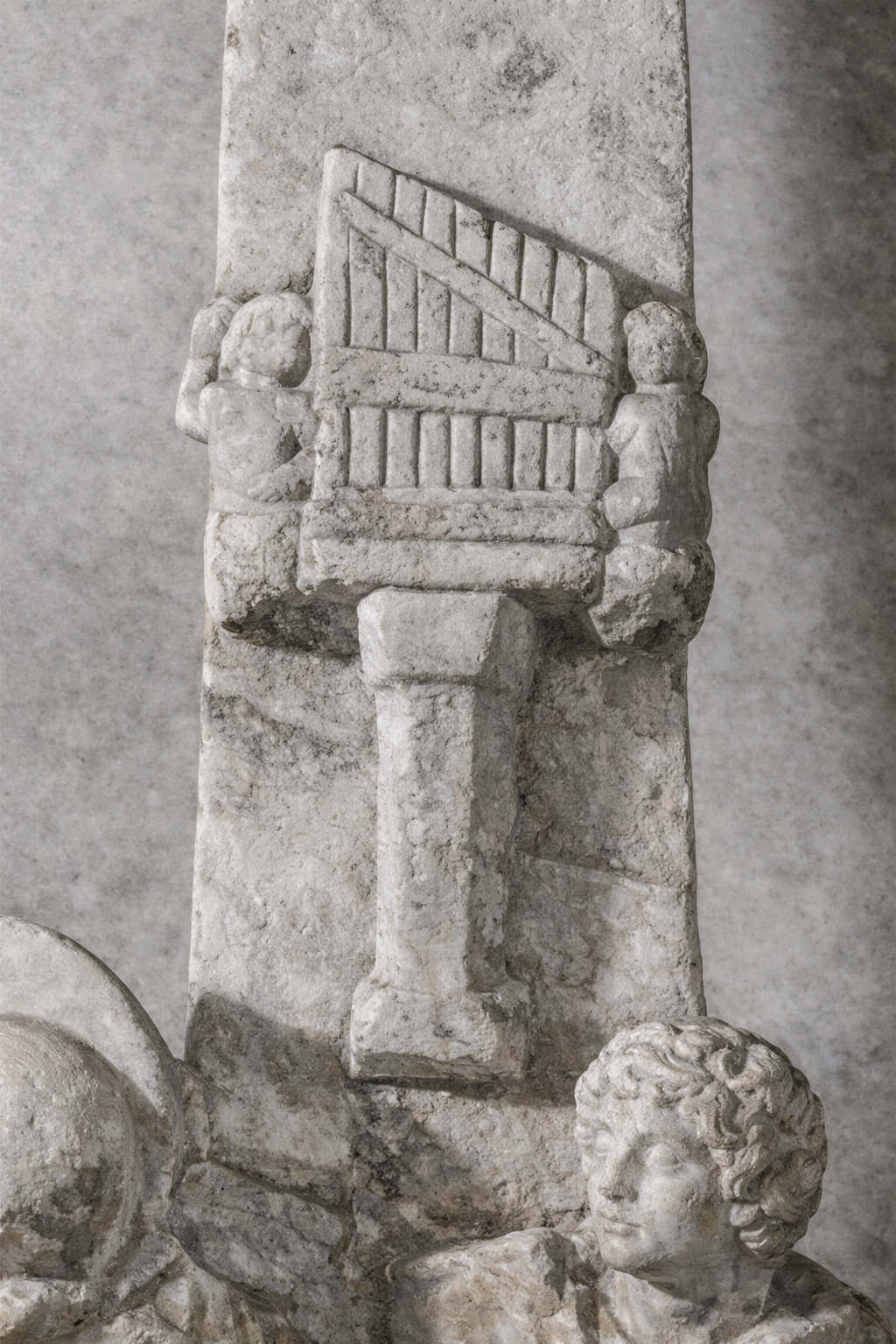
Digital reconstruction using artificial intelligence from a low-resolution photograph
Date:
between 2nd and 3rd century AD
Location:
Bulgaria
Author:
Anonymous
Technique and materials:
Carved marble
Dimensions:
Total height 1.05 m (base + prismatic column)
Provenance:
Unearthed in 1936 near Tatarevo, Borissovgrad region (Bulgaria)
Sources:
The Hellenistic-Medieval Organ by Jean Perrot