A hydraulic organ can be seen on a small bronze vessel: it is said to have been found in Reims in 1852 and is part of the Gréau collection. Ovoid in shape, it is decorated with motifs arranged in two registers: at the bottom various animals can be seen — lion, boar, panther, antelope — taking part in a venatio; above, a munus is depicted comprising two pairs of gladiators in action, whose names appear inscribed above the frieze.
Between the two groups of combatants the organ is installed, its principal elements clearly recognisable. The plinth, composed of two distinct parts, is also placed on a narrow decorated stand. The water cistern, almost square in shape, is decorated with three small circles arranged in a triangle. On each side are the pumps, whose levers are not visible; however, a bellows operator can be seen on the right, apparently working on his knees. It is possible that the lever he operates is situated behind the organ and controls both pumps simultaneously. The wind chest supports eight pipes whose graduation is very pronounced: the largest is approximately five times the height of the smallest. The treble pipes are to the organist’s right, of whom only the head appears.
We note that once again the hydraulic organ appears in a scene illustrating the moment of combat immediately preceding the killing of the defeated opponent; it is probable that the instrument traditionally played at this pathetic moment.
The Vase of Reims
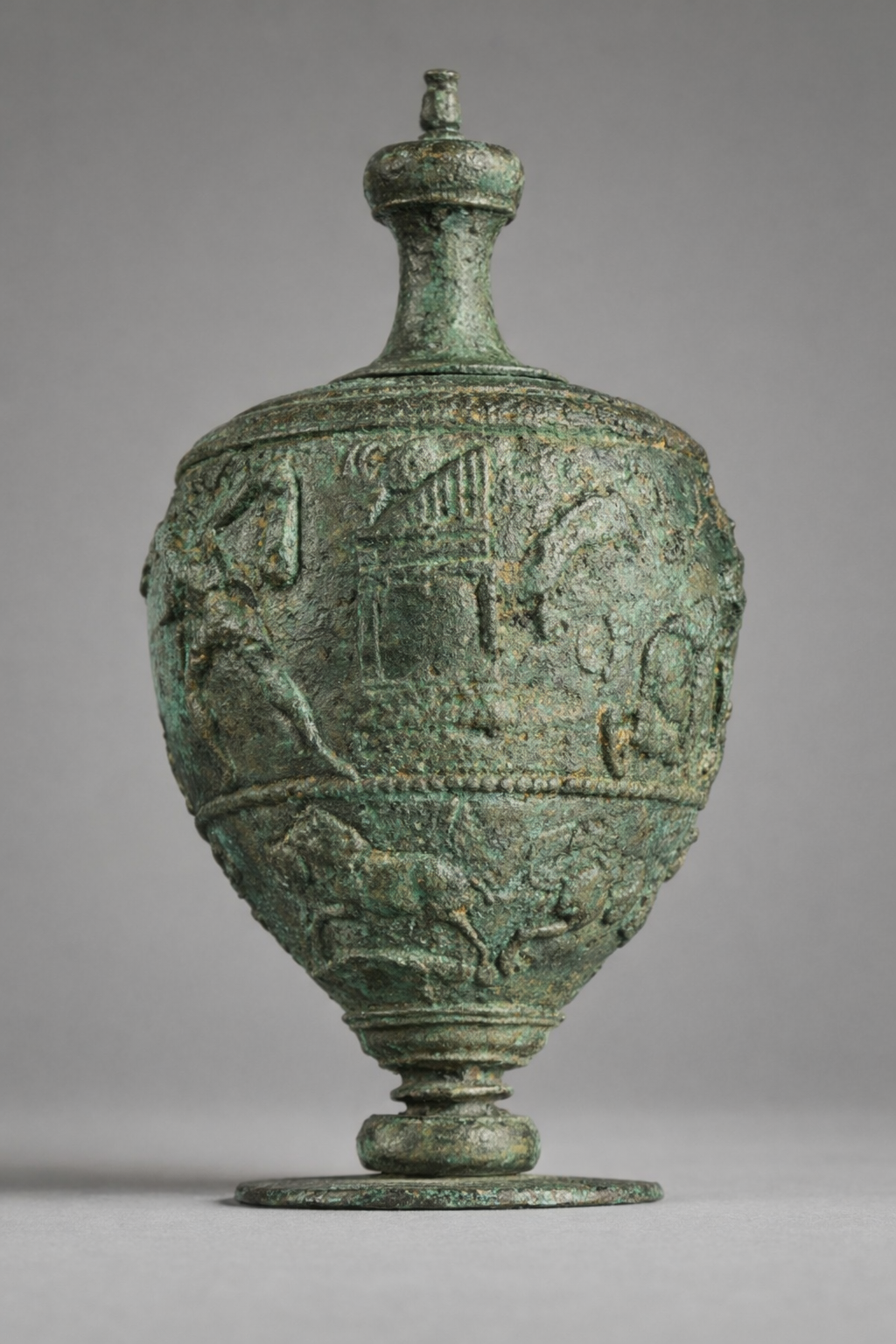
Digital reconstruction using artificial intelligence from a low-resolution photograph
Date:
between 2nd and 3rd century AD
Location:
Petit Palais, Paris; from the Gréau Collection
Author:
Anonymous
Technique and materials:
Bronze
Dimensions:
Height 8.5 cm; max. diameter 4.5 cm
Provenance:
Reims, France
Sources:
The Hellenistic-Medieval Organ by Jean Perrot