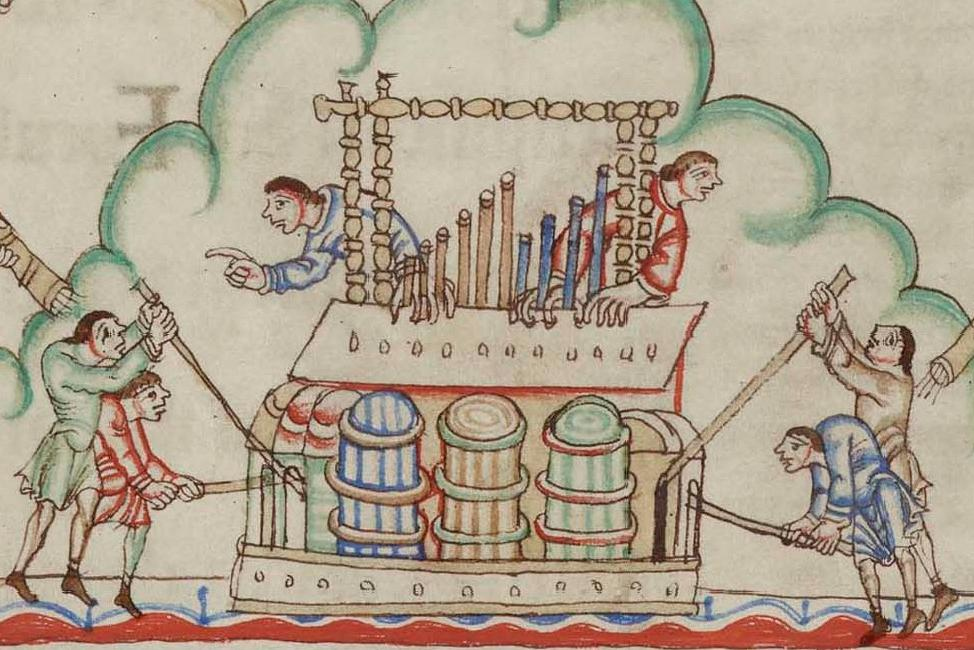
The organ illustration from the Eadwine Psalter (Canterbury; Cambridge, Trinity College, MS R.17.1), c. 1150 AD, has appeared in a number of published works, often accompanied by quotations and descriptions that are comical, in honest error, or that are palpably false. The image itself illustrates some of the hazards encountered in musical iconography, particularly when dealing with visual material dating from the Middle Ages, material that often provides the only clues to the musical practice of that period. The image shows two men apparently in the act of playing an organ while watching the four men who seem to be pumping with levers. One of the players seems to be admonishing the pumpers with his right hand in a gesture that adds a realistic touch of humanity. The instrument has two sets of pipes arranged in a single row, each in graduated height, and each controlled by one of the musicians. There are three barrel-shaped cisterns surrounded by circles at the front of the instrument and five pumps: two on the right and three on the left. On top of the wind chest (for want of a better word to describe the table-like plane) and in front of the pipes are eleven mysterious rectangular-ovoid forms — it is not known whether they are buttons, keys, or levers — all approximately identical.
There is a kind of framework that rises in front of the players and extends above the pipes. In sum, there are enough details in the image to indicate that an organ of some kind is being represented, even if the details are imprecise and puzzling in some respects.
This representation of an organ, however, cannot be fully accepted as evidence of twelfth-century English organ construction, because it strongly resembles an earlier representation contained in the Utrecht Psalter, which was written between 816–34 AD in the diocese of Reims, France. Although the relationship is evident, the Utrecht Psalter’s ninth-century representation of an organ varies in a number of details from that of the twelfth-century Canterbury version.
In the earlier image, there are the same two players and four pumpers in more or less the same positions, including the gesture of domestic realism that seems to have crossed the centuries with ease. The instrument has two sets of pipes arranged in the same way, except that the musician on the left has one fewer than in the Canterbury image. At the front there are only two cisterns, but each has a funnel on top, and although indistinct, as if in a rough approximation of volume shading, there appear to be only four pumps, each with some connection from the top to the main body of the instrument. A major difference in this drawing is in the position of the players’ hands, which are clearly touching certain keys or levers that correspond in position to the eleven mysterious shapes in the Canterbury drawing. A similar framework rises in front of the players, but is more complete in its details at the top of the vertical uprights.
In the case of the Utrecht Psalter illustration, one may also conclude that some details are imprecise and obviously unrealistic, but that there is a certain amount of truth in the representation. The question is made still more complicated by the findings of various scholars, including Kathleen Schlesinger, a musicologist, and the art historians Gertrude Benson and Dimitri Tselos, indicating that the Utrecht Psalter itself was in all probability copied from an earlier source. Some art historians, such as Tikkanen and Engelbregt, have maintained the opinion that the Psalter was an original Carolingian creation. In the latter case there is the possibility that the instrument was copied from a real model, but in the former case the possibilities are more complex.
In any case, the Canterbury drawing shows that the artist misunderstood the Utrecht model, which is not a representation of the pneumatic organ related to the modern one, but is instead a representation of the ancient hydraulic organ and a double. The Canterbury artist’s unfamiliarity with hydraulic organ construction is seen in a number of alterations: instead of the functional cisterns surmounted by funnels leading into a wind chest, he drew a cluster of three slightly differentiated cylinders — perhaps as a symbol of the Holy Trinity; the rudimentary perspective of the Utrecht artist that rendered the tops of the four cylindrical pumps as ovals was interpreted as hemispheres. The Canterbury artist also seems ignorant of the way in which the hydraulis is played, as shown by the changes in hand positions and in the details of the instrument. Here too the Utrecht artist is at fault, although he associated the finger position with what appear to be keys. In both images the framework is useless as drawn, but is executed with more care in the Utrecht version. Other differences of detail in the number of pipes and in their surface details, in the positions of the pump handles, etc., indicate that the Canterbury version was not drawn by someone familiar with the real instrument. Instead the Utrecht version, although plausible in some details, indicates that the artist was also working from an image or description and not from a real instrument. This conclusion was also reached by Jean Perrot, whose examination of all the details led him to declare: “Clearly whoever drew the scene was not working directly from a model, but simply relying on his own imagination, drawing on his own ideas and his reading. Indeed, it is even more likely that this is a misinterpreted copy of an illustration from some older source.”
The Eadwine Psalter
Trinity College, Cambridge
Date:
1150
Location:
Trinity College, Cambridge, United Kingdom
Author:
Anonymous
Technique and materials:
Illustrated drawing with imprecise details (similar to ancient hydraulic organ, with perspective misunderstandings)
Dimensions:
Not documented
Provenance:
Canterbury, England
Sources: