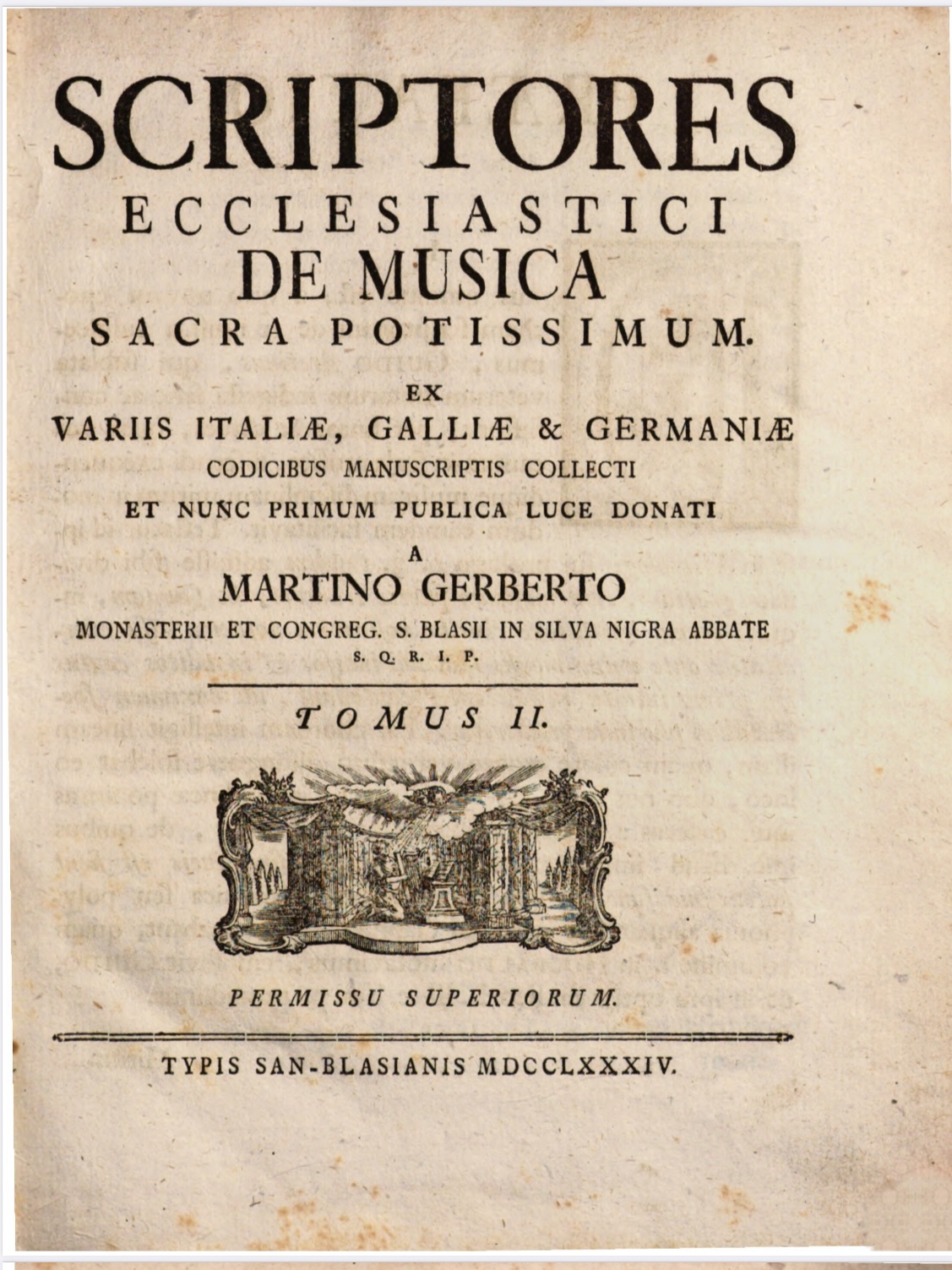
These texts in the anonymous treatise De Mensura Fistularum in Organis describe the mathematical and proportional criteria used in the construction of medieval organ pipes. The passages illustrate the ratios between length, diameter and musical intervals, dwelling on the procedures for calculating consonances, the arrangement of ranks, and the methods for measuring pipes in relation to the theoretical systems of medieval music. Some sections also include directions for the construction of cymbals and the organistrum, within the framework of medieval organological and craft practices.
On the measure of pipes in organs
Build a pipe of whatever measure you think fit, for example one and a half ells in length. Divide its width into eight parts and consider one eighth part beyond the measure; divide what remains up to the plectrum into nine parts, and of these assign eight to the second pipe: this will be its length from the plectrum upward, and thus you obtain a tone between the two pipes.
Measure the third from the second in the same way as you measured the second from the first, and you will have two tones between three pipes. Measure the fourth from the first thus: take the first and add one third of the diameter; then divide what remains up to the plectrum into four parts, and assign three to the fourth pipe: you will thus obtain the interval of a fourth (diatessaron).
Measure the fifth again from the first thus: take the first and add half its diameter; divide what remains up to the plectrum into three parts and assign two to the fifth pipe: this will be its length from the plectrum upward. In every case always consider the measure from the plectrum: here you obtain the fifth (diapente).
Measure the sixth from the fifth as you measured the second from the first, because in both cases you have a tone. Measure the seventh from the sixth as you did between the fifth and sixth, because here too there is a tone.
It remains to explain the pipe called synemmenon. Measure it from the fourth thus: take the fourth and add one third of the diameter; divide what remains up to the plectrum into four parts and assign three to a new pipe not yet measured: this will be its length from the plectrum upward. Place it between mese and paramesa, and you will obtain the trite synemmenon.
Since the octave and the fifteenth must be placed in relation to the fundamental strings, their measure must also be described. Take the longer pipe derived from the first and add the entire diameter to it; divide the rest up to the plectrum into two parts and assign one to another pipe: this will be double in pitch. From this double, measure another in the same way: it will be quadruple with respect to the first. Do the same for the other ranks, but the quadruple proportion fits only the first ones, not the others.
Another method
You may build the first pipe with whatever length and width you prefer; all the others will have the same width. Take the first and measure the width of the inner cavity. The diameter is thus defined: divide it into eight parts and place one of these (one eighth) at the top of the first pipe. From that point up to the plectrum divide into nine parts and, discarding the ninth, transfer the remaining eight to the second pipe, from the top to the plectrum: this will be the second pipe.
Then, in the second, remove two eighths of the diameter (or rather one, according to practice) and add them to its length; divide what remains again into nine parts and, discarding the ninth, with the remaining eight obtain the third pipe: these eight parts constitute the length of the third pipe from the plectrum upward.
Take the first pipe again and add one third of the diameter to its length; divide the rest into four parts and, eliminating the fourth, with the remaining three obtain the fourth pipe: thus the interval of a fourth (diatessaron) is completed, composed of tone, tone and semitone. Always consider the measure from the plectrum to the top.
Take the first pipe again and add half the diameter; divide the rest into three parts and, eliminating one, with the remaining two obtain the fifth pipe.
Then take the fifth pipe, add one eighth of the diameter at the top and divide the rest into nine parts; discarding the ninth, obtain the sixth.
Here the synemmenon is introduced: take the fourth pipe, add half the diameter and divide the rest into three parts; one of these constitutes the synemmenon pipe. From here the seventh is also obtained.
Take the sixth pipe, add one eighth of the diameter and divide the rest into nine parts: one of these will give the seventh.
Take the first pipe, add the entire diameter and divide the rest into two parts: one of these will be the length of the eighth pipe.
Then take the fourth and add one third of the diameter; divide the rest into four parts and, eliminating one, with the remaining three obtain the seventh.
These constitute the seven distinctions of sounds. From the sixth the eighth is then obtained: it takes two parts of the diameter and, divided into nine parts, with the ninth together with the diameter removed, generates the eighth.
Subsequently the procedure follows the alphabet: take the first pipe, add the entire diameter and divide the rest into two parts; one is discarded, the other constitutes the eighth, that is the doubling of the first.
Up to this point one has the fifth composed of tone, tone, semitone and tone. Then from the eighth the ninth is obtained in the same way, belonging to the second order: it is another eighth with respect to the first of the grave order.
Finally, the second of the second order is measured as the second of the first order, and so on for all the others.
In the preceding operations you have measured each element in relation to the other: in the same way you will now proceed, determining the tenth from the ninth, and all these seven as the previous ones. You will verify that you have measured correctly if the first contains two lengths of the eighth and one diameter, and the first contains four fifteenths and three diameters. Some are surprised that there are three and not two: the reason is this: four lengths produce three intervals.
If one wished to build three ranks (registers) or more in the organ, the same procedure is followed: as the second was measured from the first, so the third will be measured from the second, and so on.
Care must be taken to measure from the top of the pipe to the tongue of the plectrum, and not to leave excessive length below the plectrum, especially with a narrow bore. Here then is the complete measure of the pipes.
If you want to cast cymbals (plates) that are perfectly sonorous, take two parts of clay and one third part of hairs collected where the tanners have discarded them from hides; mix everything well and with this mixture make moulds surrounded by wood, leaving them to dry in the air until hardened.
Then turn the main mould as you please, without a fixed measure. After having made it uniform, trace its outline on a perfectly flat board, marking the beginning and end and joining the points with a line. Divide the line into 19 parts and, eliminating the nineteenth, build the second mould with a width equal to 18 parts: you will thus have the second cymbal.
Then divide the second mould again into 19 parts, eliminate the nineteenth and build the third with the remaining 18: you thus obtain the third cymbal.
Divide the third mould into three parts and one of these again into 19: having eliminated the nineteenth and maintained the two main parts, you obtain the mould for the fourth cymbal, which corresponds to the semitone.
Then divide the outline of the fourth into 18 parts, eliminate the nineteenth and obtain the mould for the fifth cymbal.
Divide the outline of the fifth into 19 parts, eliminate the nineteenth and build the sixth mould with the remaining 18: you will have the sixth cymbal perfectly proportioned.
Divide the outline of the sixth into 18 parts, eliminate the nineteenth and obtain the last (note G).
To obtain the synemmenon between the sixth and eighth, divide the lower outline of the sixth into three parts, then one of these again into 19; eliminate the nineteenth and, adding the two whole parts, obtain the synemmenon to be placed between F and G.
Finally you have the preparation of the clay: over it you can apply wax as you please, working it to the desired thickness and covering the first mould with a longer membrane.
When the ends of the membrane coincide at the outline, having removed the excess part, the length of the sixth pipe is obtained. Between this and the seventh the synemmenon must be inserted. At this point the measure returns to reference the fourth.
Then spread the wax outline on a board, marking the ends of the length with points, draw a line between the points and follow in all things the measure of the clay model, assigning to each element a height proportionate to the seventh part of its perimeter.
Again, concerning the measure of pipes (from the Admont manuscript)
Once the consonance of the organ pipes is known, the method of measurement is established as follows. The first pipe is made at the builder’s discretion, and all the others will have the same width.
The second is measured from the first: the diameter is taken, and one eighth of the diameter is added to the length of the first pipe. From there to the plectrum nine equal parts are divided; having eliminated the ninth, the remaining eight constitute the length of the second.
For the third, proceed from the second: two eighths of the diameter are subtracted, the rest is divided into nine parts, and having removed the ninth, the length of the third is obtained.
Then return to the first: take one ninth of the diameter and divide the remaining length into four parts; having removed one part, the fourth is obtained, which produces the interval of a fourth (diatessaron).
Again from the first: take half the diameter, divide the rest into three parts and, having eliminated one part, obtain the fifth.
For the sixth: take one eighth of the diameter of the fifth, divide into nine parts and, having eliminated the ninth, obtain the sixth.
The seventh is derived from the sixth by the same procedure (division of the diameter and lengths).
The eighth, finally, is derived from the first: add the entire diameter and divide the rest into two equal parts; by eliminating one the length of the eighth is obtained.
From this the upper fifth (diapente) is obtained through tone, tone and semitone.
This same proportion is to be maintained for all the subsequent seven pipes. In this way the first will contain twice the length of the eighth plus one diameter; similarly the eighth will be twice the fifteenth with the diameter, and the first will be four times the fifteenth with three diameters.
If the builder wishes to extend the scale beyond 15 or 16 pipes, he must build a third system (alphabet) as he did the second with respect to the first.
Measure of the organistrum:
From C measure nine steps to the string support point. From D again nine steps. From C four steps. From C three steps. From D three steps. From F four steps, the first ending on B flat. From E three steps, the first ending on A. If one wishes to add the high C (which forms an octave with the low C), it is found by measuring four steps from G to the end.