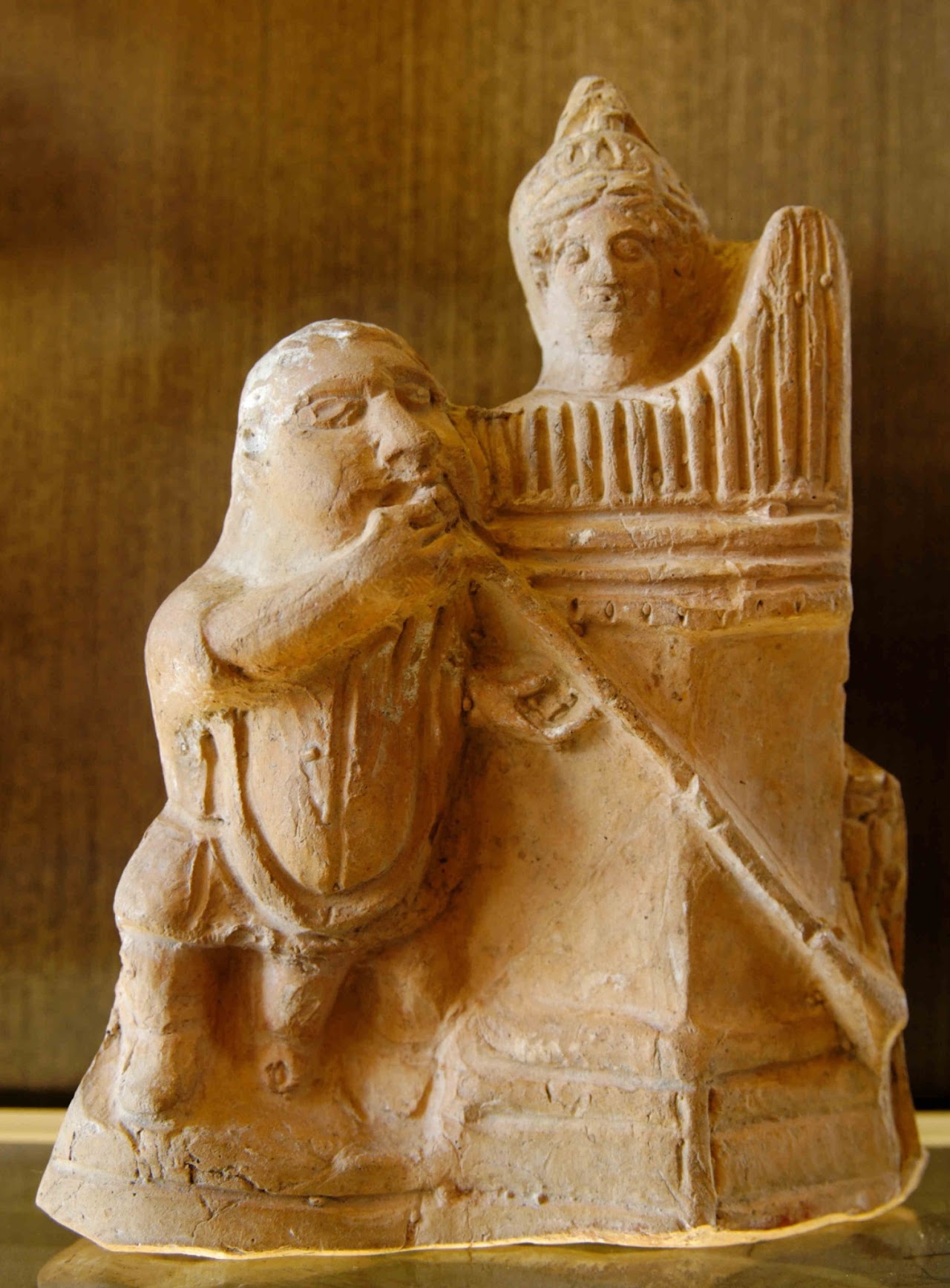
This terracotta statuette is probably the oldest known representation of an organ; it comes from Alexandria, the very birthplace of the engineer Ctesibius. Originally part of the Gréau collection, it is now in the Louvre Museum.
Most experts estimate that the piece predates the Christian era and is probably contemporary with the end of the Hellenistic period. Although rather roughly made, it gives an idea of what the ὄpγανον ὑδραυλικόν might have looked like at that time. The instrument corresponds to the descriptions of Hero and Vitruvius: a large water cistern rests on a very elevated plinth and to the right a pump can be seen whose lever is not depicted. We do not know whether there is one on the left, as its position is masked by the trumpet player. The wind chest, whose width seems almost equal to the height of the cistern, is decorated with longitudinal grooves. There are fourteen visible pipes, with the treble pipes placed to the organist’s right; however, neither bar nor uprights to hold them can be seen. Their height does not decrease regularly but remains roughly the same from the seventh pipe onward. It is evident that the modeller wished to emphasise the head of the organist, who is once again a woman, in this case with a severe and graceless face. On a thick head of hair, which covers part of her forehead, a sort of diadem is placed.
The trumpet player, “dwarfish and deformed,” conceals a large part of the organ; he blows carelessly into his instrument, whose bell almost drags along the ground. This is clearly a caricature or a comic scene, judging by the ridiculous attire of the figures.