The scene depicted resembles the previous one: we are once again at the theatre. The medallion is oval, showing two people in actor’s costume: the one on the right, clad in a long sleeveless tunic, holds a double thyrsus in his left hand and brandishes a theatrical mask triumphantly in his right, while the other, of decidedly smaller stature, appears to be an adolescent. He wears a long garment covering his legs and a sleeved tunic. With his left hand he grasps a kind of scroll, simultaneously presenting in his right a large palm, the emblem of victory, to the triumphant-looking actor.
Between the two figures and in the foreground of the scene a small pipe instrument is placed on the ground, and in this case there is no doubt whatsoever that it is a real organ. A relatively thick wind chest decorated with ornamental lines supports seven pipes of decreasing height from left to right, held by a slightly oblique bar without visible lateral uprights. The keyboard is not depicted, either because it is on the other side of the wind chest, or — quite probably — because the artist judged it unnecessary to depict it at such a small scale.
The wind chest rests on a rectangular base somewhat less wide and slightly taller. Could this base correspond to the water cistern and this be a hydraulic organ? Or is it merely a simple plinth and the instrument a small “pneumatic” one supplied by bellows and corresponding to the definitions of Pollux and Saint Augustine? We think the first hypothesis must be taken into consideration. If, as it seems, the absence of bellows is not sufficient argument to eliminate the second, the existence of such a base cannot be justified unless it is assimilated to the “arca,” that is, the water reservoir. We will further note the resemblance of the instrument depicted here to that of the Rheinzabern vase, and one must also not forget the vast proportions of a Greco-Roman theatre, which would have ill-suited the small and uncertain sounds of a little instrument lacking a hydraulic compressor. The medallion bears the following inscription: “NICA PART(HE)NOPAEE.” This wish of victory to the actor Partenope, with the palm presented to the same, implies the idea of a competition and this terracotta, like the contorniates, is probably a good-luck charm.
The Medallion of Orange
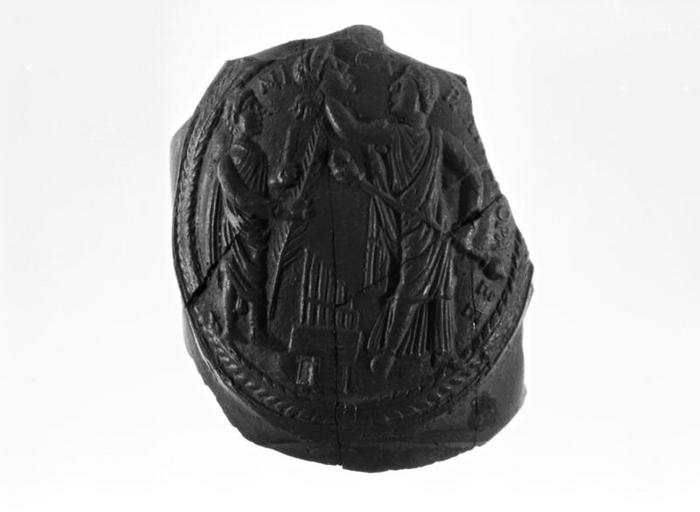
© Musée d’Archéologie nationale, Dist. GrandPalaisRmn / Loïc Hamon
Date:
between 2nd and 3rd century AD
Location:
Archaeological Museum of Saint-Germain-en-Laye, France
Author:
Anonymous
Technique and materials:
Moulded terracotta (used as contorniate)
Dimensions:
10 × 11.3 cm (minor/major axes)
Provenance:
Orange, Provence
Sources:
The Hellenistic-Medieval Organ by Jean Perrot