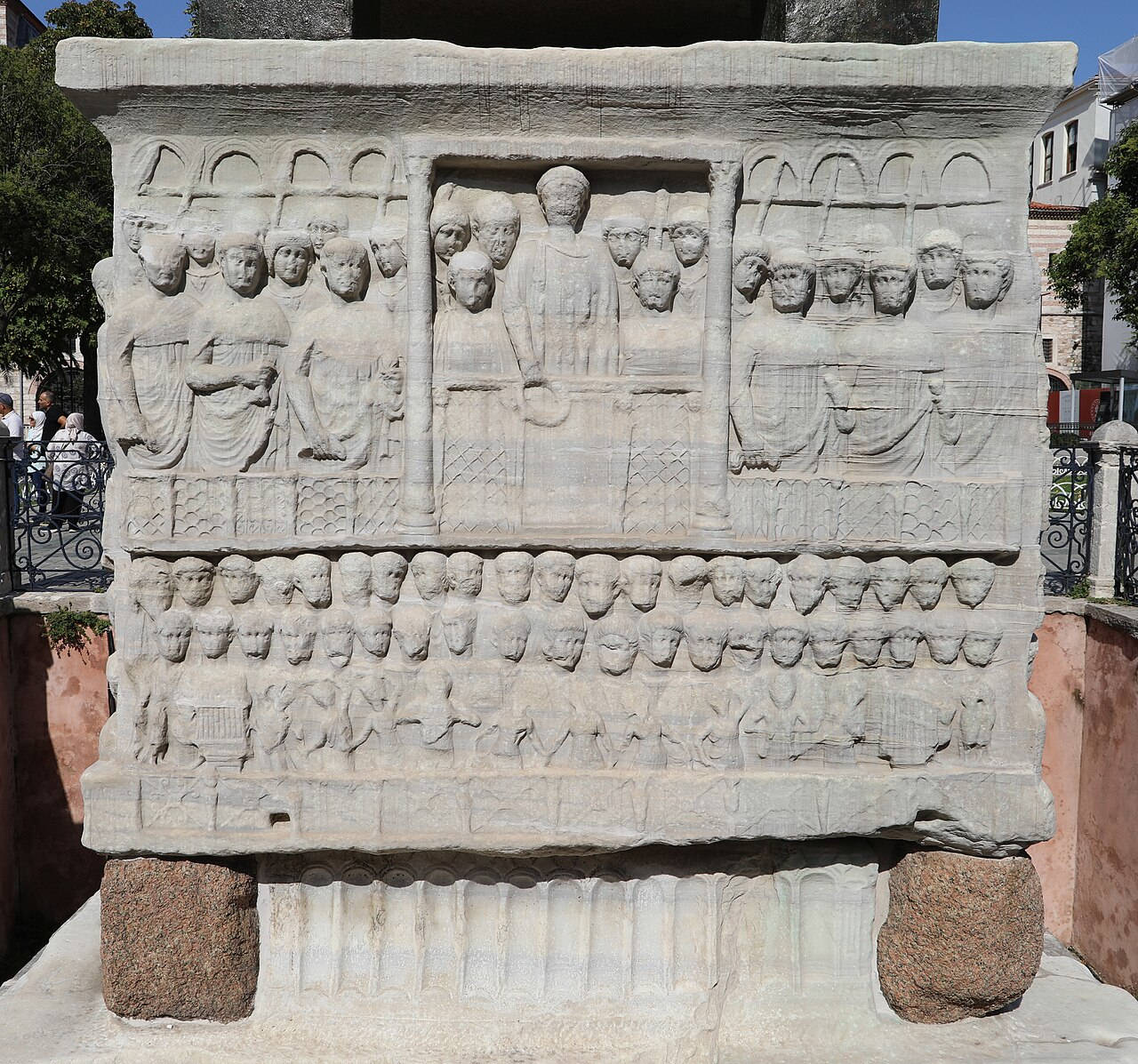
At the base of the obelisk erected in 390 by Theodosius the Great at the centre of the Hippodrome of Byzantium, various circus scenes are carved: one of these shows an orchestra composed of various instruments, syringes, aulos and two organs. The emperor stands upright in the pulvinar surrounded by his dignitaries, holding in his right hand the crown he is about to offer the winner. Below him, in front of some forty spectators, the dancers, carried away by the music, perform their evolutions. Each organ is placed at the two ends of the orchestra; these are not, however, hydraulic organs: the appearance is completely different, these instruments being supplied by large bellows. The right organ consists of eleven pipes held by an oblique bar and has a wind chest serving as its base, connected by means of a long tube to a large bellows on which two boys have climbed. The left organ is almost identical, but has only eight pipes whose mouths are clearly visible. The organist pushes his head right beside the treble pipes and the bellows on which two boys stand is depicted on the same side.
The ventilation system of these two organs poses an embarrassing problem. It does not seem to us that the bellows depicted here are wind generators, since one cannot easily imagine the young operators being forced to raise the upper board to fill them with air immediately before hastily climbing on top to empty them. In any case the organ would only have been able to sound for a brief moment. It seems to us more plausible to imagine that other manually operated bellows produced the wind, which was then channelled through ducts into those shown on the bas-relief. The latter would thus have played the role of regulator-compressors, the weight of the boys serving the function of the stones placed on the bellows of modern organs.