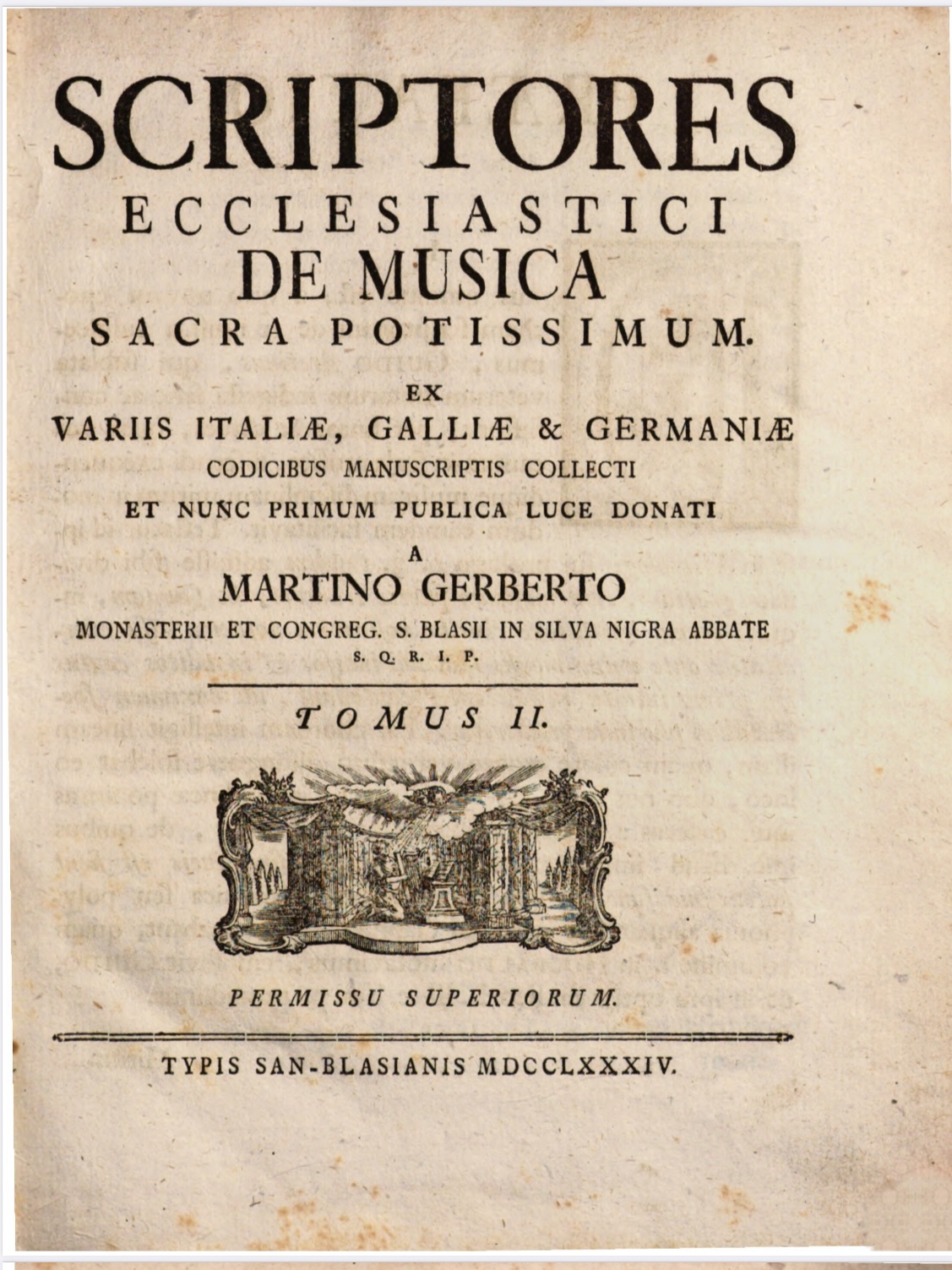
These passages from the De musica of Ioannes Cotton deal with the nature of musical sound, the classification of instruments and the role of music in medieval theoretical and ecclesiastical tradition. The text distinguishes between natural and artificial instruments, mentions organs, cymbals and stringed instruments within the framework of music theory, and also introduces the concept of diaphony or organum, linking it to medieval polyphonic practice and the terminology of the organ.
On the number of instruments of musical sound.
It must furthermore be known that there are two kinds of instruments of sound: the natural and the artificial; the natural may in turn be mundane or human, and the mundane, according to the philosophers, is the harmonious dissonance of celestial motion, which is properly called harmony. The natural human instrument consists in the cavities of the throat, which we call arteries, which are naturally disposed to receive and return the air, from which natural sound arises. The artificial instrument, on the other hand, is that which produces sound not by nature but through the agency of art. Natural sound may be distinct or indistinct: that which contains consonances within itself is distinct, while that in which no consonance can be recognised is indistinct, as in the laughter or lamentation of men, in the barking of dogs or the roaring of lions. In the same way one can observe the distinction between defined and undefined sound in artificial instruments too: for the whistle used to attract birds, or a vessel covered with a membrane, with which children play, produce an indistinct sound, while in the sambuca, strings, cymbals and organs the variety of consonances is clearly distinguished. Therefore that sound which we have defined as indistinct is in no way admitted by music, but only the distinct, which is properly called “phthongus”, belongs to music; for music is nothing other than the harmonic movement of voices. We have said these things especially against the ignorant, to correct the error of those who foolishly believe that any sound is musical. It must further be added that, since there are three genera of musical melody — enharmonic, diatonic and chromatic — the first has been abandoned for its excessive difficulty and the third for its excessive softness, while usage has preserved the intermediate one.
On the power of music and on those who first used it in the Roman Church.
It must not be left unmentioned that musical song possesses great force in moving the minds of listeners: for it soothes the hearing, elevates the mind, incites combatants to war, calls back those who have fallen and are in despair, comforts travellers, disarms thieves, calms the wrathful, cheers the sad and distressed, reconciles the discordant, removes vain thoughts and calms the fury of madmen. For this reason we read in the book of Kings that King Saul, tormented by a demon, was calmed when David played the lyre, while, when the sound ceased, he returned to being agitated. Similarly, it is told that a certain madman was freed from madness through the song of the physician Asclepiades. It is also recorded that Pythagoras succeeded in diverting a dissolute young man from unbridled passion by means of a musical mode. Music indeed possesses, according to different modes, different powers: with a certain kind of song one can drive someone to dissolution, while with another one can quickly lead him back to repentance, as Guido reports concerning a young man.
Since, then, music has such great force in moving the minds of men, its use was rightly received in the holy Church. It began to be practised in the Roman Church through the martyr Saint Ignatius and also through Saint Ambrose, bishop of Milan. After them, the most blessed Pope Gregory, assisted — as it is handed down — by the Holy Spirit who dictated to him, composed the chant and gave the Roman Church that repertory with which throughout the year the divine office is celebrated.
That the Lord is to be praised through song is also demonstrated with great authority by ancient Scripture: in the book of Exodus it is read that, after the drowning of Pharaoh, Moses and the children of Israel sang a hymn to the Lord. The Psalmist also, not ignorant of this art, praised God with the decachord, which is a musical instrument, and also exhorts us to sing, saying: “Sing to the Lord a new song, his praise in the assembly of the saints”. And he did not wish God to be praised only with the natural voice, but also with instruments constructed by musical art, when he admonishes saying: “Praise the Lord with the sound of the trumpet, with the psaltery and the lyre, with timbrels and dances, with strings and with the organs”. Since, then, the authority of this discipline is found already in the Old Testament, and since such religious men have sanctioned it in the Church, and finally since its force is so effective in moving the minds of men, as has been said, who could despise the study of this science? Who would not devote himself to it with all his effort? However, since not only the official sacred chants have been set to music in the holy Church, but also other composers of songs existed not long before our own times, I see nothing to prevent us from composing songs as well. For although today new compositions are not necessary in the Church, we can nonetheless exercise our talent in the rhythms and song of the plaintive verses of the poets.
Since we mutually ask for and grant the freedom to compose, it seems appropriate to set forth some rules for the composition of song.
XXIII. On diaphony, that is, on organum
We now wish to treat briefly and concisely of diaphony, so that we may satisfy, as far as possible, also in this field the desire of the reader.
Diaphony is therefore a harmonic dissonance of voices, which is performed by at least two singers: in such a way that, at each breath, both agree on the same note or at the octave.
This manner of singing is commonly called organum, because the human voice, by opportunely producing a dissonance, reproduces the likeness of the instrument called organ.
“Diaphony” means indeed “double voice” or “dissonance”.
But before giving the rules of organum, we wish to touch briefly on the movements of voices, the consideration of which is useful for this purpose.
For, since organum is realised through consonances, and their constitution varies according to the movements of voices, there is no doubt that treating these matters at this point is useful.
The movements of voices occur by arsis and thesis, that is by elevation and lowering.
And indeed every neuma — except the simple ones and the repercussed ones — is formed from a twofold movement.
We call a simple neuma a virga or a point; a repercussed neuma, on the other hand, is that which Berno calls the distropha or tristropha.
Arsis and thesis sometimes join with each other (arsis with arsis, thesis with thesis), sometimes one with the other (arsis with thesis).
But this joining occurs partly between similar movements, partly between different ones.
For movements are different when one part has more or fewer sounds than the other, or when the voices are more conjoined or more separated.
In these combinations, whether between similar or different movements, it is found that one movement can be prepositum to another, that is placed above, or “subpositum”, that is placed in the lower parts; then “appositum”, when at the same note at which the previous movement ends the following one begins; then “interpositum”, when a movement is placed below another and is less grave and less acute; finally “mixtum”, that is partly interpositum, partly subpositum, or prepositum or appositum.
If I were to give examples of all these things, I would bring more tedium than usefulness to the reader because of the excessive prolixity, especially since anyone who is an attentive student of chants can understand them on his own.
The same neumes vary in their movements according to the different properties of the modes. We wish to propose an example of this, so that from it not only the learner may advance in the art of organising (that is, making organum), but also he who wishes to compose a new song may have a model of modulation.