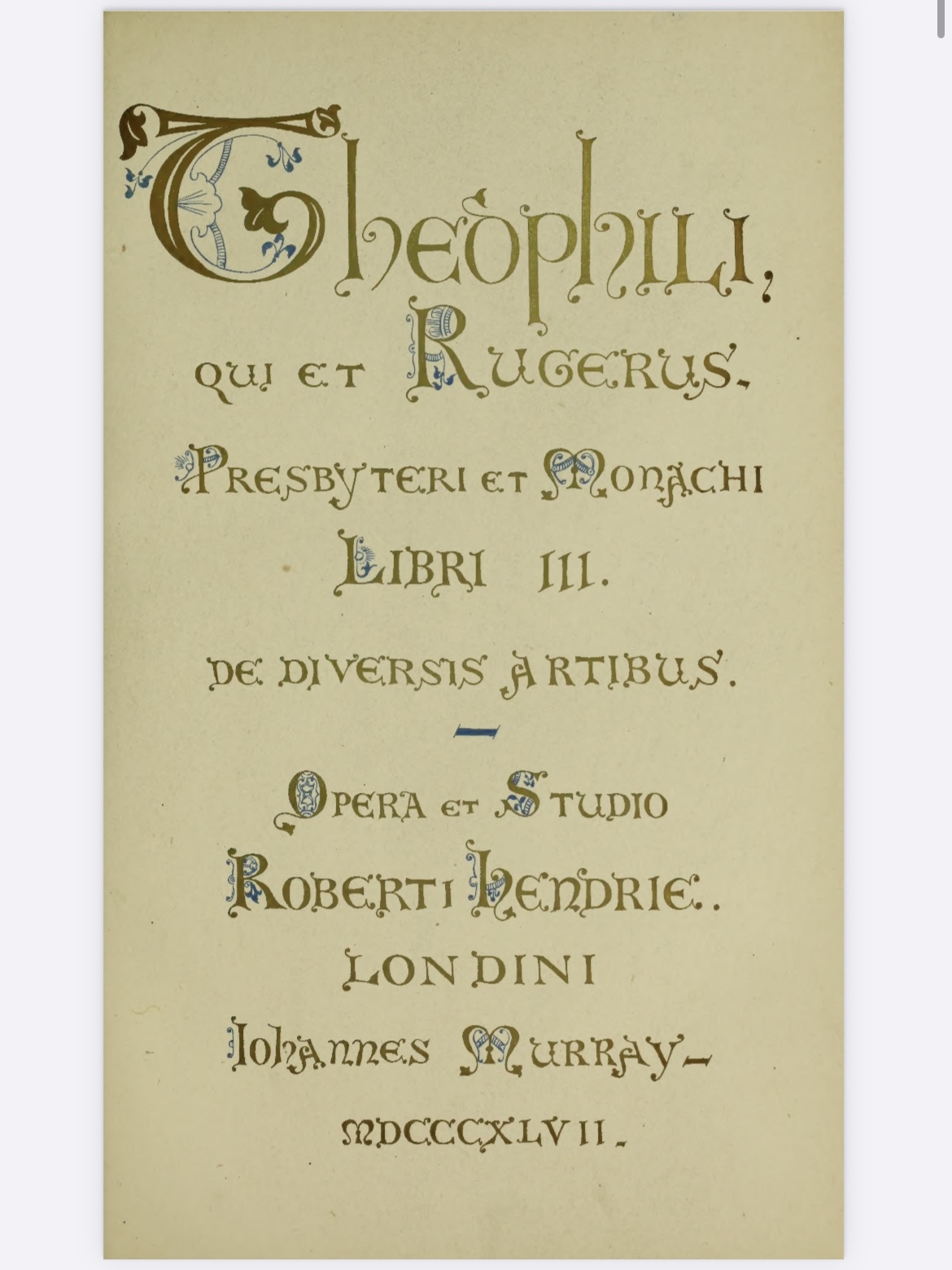
These chapters of the De diversis artibus by Theophilus describe the construction of a medieval organ, focusing both on the fabrication of pipes and on the making of the wind chest, sliders and bellows. The text documents with remarkable precision the craft techniques employed in working copper, in soldering and in assembling the various parts of the instrument. Of particular relevance are the directions concerning the ventilation of the organ, the air-supply systems and the arrangement of the sliders, which show a fully developed organbuilding conception in the medieval context.
BOOK III – CHAPTER LXXXI – ON ORGANS
The organ-maker must first of all possess knowledge of measurement, how grave, acute and superacute pipes must be measured; he may then make for himself an iron rod long and thick according to the measure he wishes the pipes to have; this must be round, filed and polished with the greatest care, thicker at one end and slightly tapered, so that it may be placed in another curved iron, by which it is surrounded, in the manner of the wood in which the auger is turned; and at the other end it should be thin, according to the measure of the lower end of the pipe that must be placed on the bellows.
Then pure and very sound copper is thinned, so that the impression of a nail may appear on the other side. When this has been traced and cut according to the measure of the iron for the longer pipes, which are called grave, an opening is made according to the precept of the teaching, in which the valve must be placed, and it is scraped all around a little according to the measure of the rod; and tin is spread over it with the soldering iron, and it is scraped on one edge for the length on the inside, and on the outside on the other edge, and is thinly covered with tin.
Which tinnings, before the lines just made are scraped, are lightly smeared, the copper being heated with fir resin, so that the tin may more easily adhere. This being done, this copper is bent around the iron and is firmly bound around with an iron wire of moderate thickness, so that the tinned lines may fit together. This wire must first be passed through a very small hole that is at the thin end of the iron, and be twisted twice around it, and so be carried down winding to the other end, and be there similarly fixed.
Then, with its joints fitting together and carefully secured, it is placed with its binding, as with the iron, before the furnace on the burning coals; and the boy, sitting and blowing lightly, holds in his left hand a thin piece of wood, to the split top of which a small cloth is fixed with resin, and in the right hand a long piece of tin beaten thin may be held, so that, as soon as the pipe has become hot, he may anoint the joint with the cloth filled with resin, and the tin applied may liquefy, and he must carefully solder the joint together.
This being done, the pipe being cold, the iron is placed in the instrument prepared like that of a turner; and the curved iron being placed, and the wire slackened, one hand can turn the curved iron, the other, both hands being provided with gloves, can firmly hold the pipe, so that the iron may be brought around and the pipe remain stationary, until it appears elegant to the eyes, as if it were turned.
The iron being then removed, the pipe is lightly struck with a hammer near the opening, above and below, so that this round form may be depressed almost to the centre for the space of two fingers; the valve may be made of rather thicker copper, like a half-wheel, and be soldered around the round part, above, like the pipe, and be so placed in the lower part of the opening that its edge stands equally under it, neither projecting below nor above.
He may also have a soldering iron of the same width and roundness as the valve. With this, heated, he may place small particles of tin on the valve, and a little resin, and may carefully pass the hot iron so as not to move the valve, but so that the tin, being melted, may adhere in such a way that no wind can escape at its circumference, but only through the upper opening.
This being done he may bring it to his mouth and blow first lightly, then more strongly, and then with force; and according to what he discerns with his hearing, he may arrange the sound, so that if he wishes it strong, the opening is made wider; if weaker, however, it is made narrower.
In this order all the pipes are made; he may make the measure of each one, from the valve upward, according to the prescribed rule; but from the valve downward, all will be of one measure and the same thickness.
BOOK III – CHAPTER LXXXII – ON THE ERECTION OF THE ORGAN
In making the frame on which the pipes must stand, consider whether you intend to have it of wood or of copper. If of wood, procure two pieces of plane-tree wood, very dry, two and a half feet in length, and in width rather more than one; one four, the other two fingers thick, which must not be knotty, but without fault. Which, being carefully joined together, in the lower part of the thicker wood a square hole must be made in the centre, four fingers wide, and around it edges of the same wood must be left of one finger in width and in height, in which the bellows may be placed.
In the upper part of the side, however, small recesses are made, through which the wind can reach the pipes. But the other part of the wood, which must also be the upper, is measured inside equally, where seven or eight small openings are disposed, in which the sliders are carefully joined, so that they may have an easy way of being drawn out or replaced, yet in such a way that no air can escape between the joints.
In the upper part, however, small openings are cut opposite the lower ones, which may be rather wider, in which so many pieces of wood may be joined, so that between these and the larger ones the openings of the wood remain empty, through which the wind may rise to the pipes; since in these same pieces of wood openings must be made in which the pipes must be fixed.
The openings in which the sliders are inserted in the front must be widened, like inclined windows, through which these sliders are introduced and removed. In the back, under the end of these sliders, holes are made equally wide and long of the measure of two fingers, through which the wind can rise from the lower parts to the upper, so that when the sliders are pressed over them these holes may be closed by them; when, however, they are drawn back they may again remain open.
In those pieces of wood that are joined above the sliders, openings are made carefully and in order, according to the number of pipes of each tone, in which these pipes are placed, so that they may stand firm and receive the wind from the lower parts.
But on the handles of the sliders are marked letters, according to the rising and falling of the sound, by which it can be known what tone it is. In each of the sliders single thin holes are made, half a little finger in length, at the front, near the handles, in the direction of the length, in which single copper nails with heads can be placed, which can pass through the small windows in the middle, by means of which these sliders are drawn from the upper side of the frame downward, and the heads of the nails appear above, so that when the sliders are withdrawn from the sounding instruments, they cannot be entirely extracted.
These things being thus arranged, these two pieces of wood, which complete the organ case, are joined together with cheese glue; then those parts that are joined above the sliders, in which the holes exist, are also finished all around with care and scraped.
BOOK III – CHAPTER LXXXIII – ON THE ASSEMBLY OF THE BELLOWS
In building the wind chest, join two pieces of plane-tree wood, in the manner described above, a foot in length, of which one should be a palm thick and the other three fingers; they should be rounded at one end, like a shield, and there a foot and a half wide, while at the other end they should be flat, a palm wide.
When these have been carefully fitted together, make in the rounded part of the thicker piece of wood the openings you wish, according to the number of bellows, and in the flat part one single opening, which must be larger. Then hollow out, from each opening, a channel leading to the larger one, through which the air may pass toward the bellows in operation; and so you will glue these woods with casein glue and will wrap them with a cloth of linen, new and strong, which you will spread with the same glue so that it adheres. You will also make strong iron bindings, tinned inside and out, so that they do not detach from the wood; you will fix them with long headed nails, also tinned, so that between two openings there is a binding that embraces each piece of wood from the upper side to the lower.
Then procure a curved piece of oak, sound and strong, which from one end, starting from the curve, has a length of a foot and from the other of two; you will bore it at both ends with a large auger, as the hubs of plough wheels are bored. But since the holes cannot meet because of the curve, make an iron with a round head, similar to an egg, and with a long thin stem provided with a handle; let it be slightly curved near the head, and with it, once heated, burn the inside of the holes in the curved part until they meet perfectly.
This being done, work this wood making it square in shape, so that each side is a palm wide, according to the measure of the wind chest in the flat part.
After this, join this piece of wood, from the longer side, to the lower opening of the organ frame, so that in the same wood a projection one inch long is made, which can be inserted or forced into that opening, and that the joint is so precise that no air can escape. You will join in the same way the other end to the bellows, will fix this wood with casein glue and will wrap the entire piece, including the joint, with a cloth, to which you will also apply a wide copper band that embraces the edge of each piece of wood.
These operations being completed, if you wish to place the organ beyond the thickness of the wall, so that inside the monastery nothing is seen but the frame with the pipes, while the bellows are on the other side, you must arrange the construction so that the sliders can be drawn toward the bellows, and in the wall itself an arch will be constructed in which the player may sit; his seat will be arranged so that he may hold his feet above the bellows.
There is also a square opening at the centre of the arch, through the wall, through which the frame with the pipes is exposed; and the neck of the bellows, which is in the wall under the opening, is made stable with stones, fixed at its joint and supported by two long iron nails inserted uniformly in the wall. To this opening a wooden window is hung which, when closed and secured with lock and key, prevents any stranger arriving from knowing what is contained therein.
Outside, above the organ, a heavy drape can be suspended, stretched internally on a wooden framework in the shape of a dome, to protect from dust; it hangs from the ceiling by a cord which, arranged with skill around a pulley above the ceiling itself, is pulled while the organ sounds, raising the covering, and, when the singing is ended, is lowered again above the organ.
This covering also has a cusp, made of the same fabric, stretched on four pieces of wood arranged in a triangle, on whose summit there is a small wooden sphere to which the cord is fixed.
The bellows and the frame on which they rest, arrange as you prefer, according to the configuration of the place.
BOOK III – CHAPTER LXXXIV – ON THE COPPER CONSTRUCTION AND ITS BELLOWS
Arrange the length and width of the case according to the number of the pipes, and make a form in beaten clay; once dry, cut it to the size you desire and cover it with wax, thinned with care between two sticks of equal thickness by means of a round piece of wood.
Then incise in this wax the openings of the sliders and the lower hole through which the air may enter; adding the air ducts with the funnel, cover the whole with the same clay once, then a second and a third time. And when the form is dry, cast in the same way as the form of the thurible mentioned above was made.
You will also model the wind duct in clay, with the air outlets branching inferiorly in every direction, after the likeness of the roots of a tree, and converging at the top in a single opening. After having arranged it with measure and incised it with a knife, cover it with wax and proceed as above.
And when you have cast the case, you will fix inside, at a height of one finger from the bottom, a sheet of beaten copper, arranged uniformly under the openings of the sliders, so that these may rest on it and may be drawn out and reinserted easily; these sliders being covered with a thin layer of clay, you will pour the rest of the case of molten lead everywhere, above the sliders to the top.
This being done, you will remove this lead and mark precisely the openings of the pipes in the sliders; then you will bore this lead carefully with a thin iron or with an auger.
Then you will make the air passages under the sliders; you will insert each slider in its own place and replace the lead, fitting them to the frame by striking with the hammer, so that no air can escape except through the openings in which the pipes are placed.
When the wind chest has been cast and finished, and the pipe of each air duct has been fitted to its fitting, it must be joined and firmly fixed below to the organ frame, so that the air may find its passage freely and can in no way escape through the other joints.
Care must also be taken that in front of the opening of each pipe there hangs a thin sheet of copper, capable of closing the air passage, so that, when the bellows press down blowing, this sheet rises and the air may escape freely; and when the bellows rise to refill with air through their own valve, this sheet completely closes the opening and does not allow the air already emitted to return.