The accompanying label is somewhat ambiguous, which may suggest that the work was produced by two hands. In reality, the triptych currently on display is the result of a heterogeneous assembly, carried out around 1883, made up of several panels from two polyptychs from Asciano: an Assumption painted by Giovanni di Paolo for the church of Sant’Agata, and two lateral panels (Saint Augustine and Saint Michael) painted by Matteo di Giovanni for the church of Sant’Agostino.
The Polyptych of Asciano, painted by Matteo di Giovanni, was dismembered in the nineteenth century; its central panel (also an Assumption) therefore left for England where it can still be found (London, National Gallery); the others, apart from the two lateral panels, are now scattered in various collections around the world.
The panel of the Assumption of the Virgin painted by Giovanni di Paolo comes instead from a third altarpiece, the Polyptych of San Galgano, also dismembered, of which it formed the central part (the lateral panels and predella of this polyptych are today visible at the Pinacoteca Nazionale in Siena).
The two images of the Assumption — that of Matteo di Giovanni in London, as well as that of Giovanni di Paolo here — are inspired by the model painted at the Antiporto di Camollia in Siena, a fresco now lost, attributed to Simone Martini, although the latter did not have the opportunity to complete the work of which he was the draughtsman.
The fidelity of the Sienese painters to the great models that formed the civic identity of the city is such that the structure of this Assumption by Giovanni di Paolo, derived from that of Simone Martini, is broadly the same as the work by Matteo di Giovanni whose place it has now taken in the Museo di Asciano.
At the centre of the panel, on the axis of symmetry, painted larger than all the other figures to affirm her pre-eminence over them, Mary is dressed in the white cloak she always wears when depicted as the Virgin of the Assumption. This is richly ornamented, a sign that the Virgin is making her way toward the heaven of which she is called to be the queen. This cloak is slightly parted at the level of the maternal womb, discretely indicated to recall that she miraculously bore Christ. She is surrounded by seraphim forming a sort of evanescent throne carrying her toward heaven, while a circle of musical angels inherited directly from Simone Martini accompanies this ascent with an undulating movement.
Remaining on earth, in the lower part of the work, on this axis of symmetry, Thomas — who has already touched Christ’s wound to overcome his disbelief once — receives, in accordance with the legend, the belt that the Virgin has let slip, having just left the tomb now seen empty.
As the eye rises toward the top of the image, and at the same pace approaches the firmament, the musical angels give way to the saints and prophets of the Old Testament, a sign of the imminence of the journey’s end. At the top, as befits, the figure of Christ appears, arms outstretched, preparing to welcome Mary into his kingdom.
Resurrection of the Virgin by Giovanni di Paolo
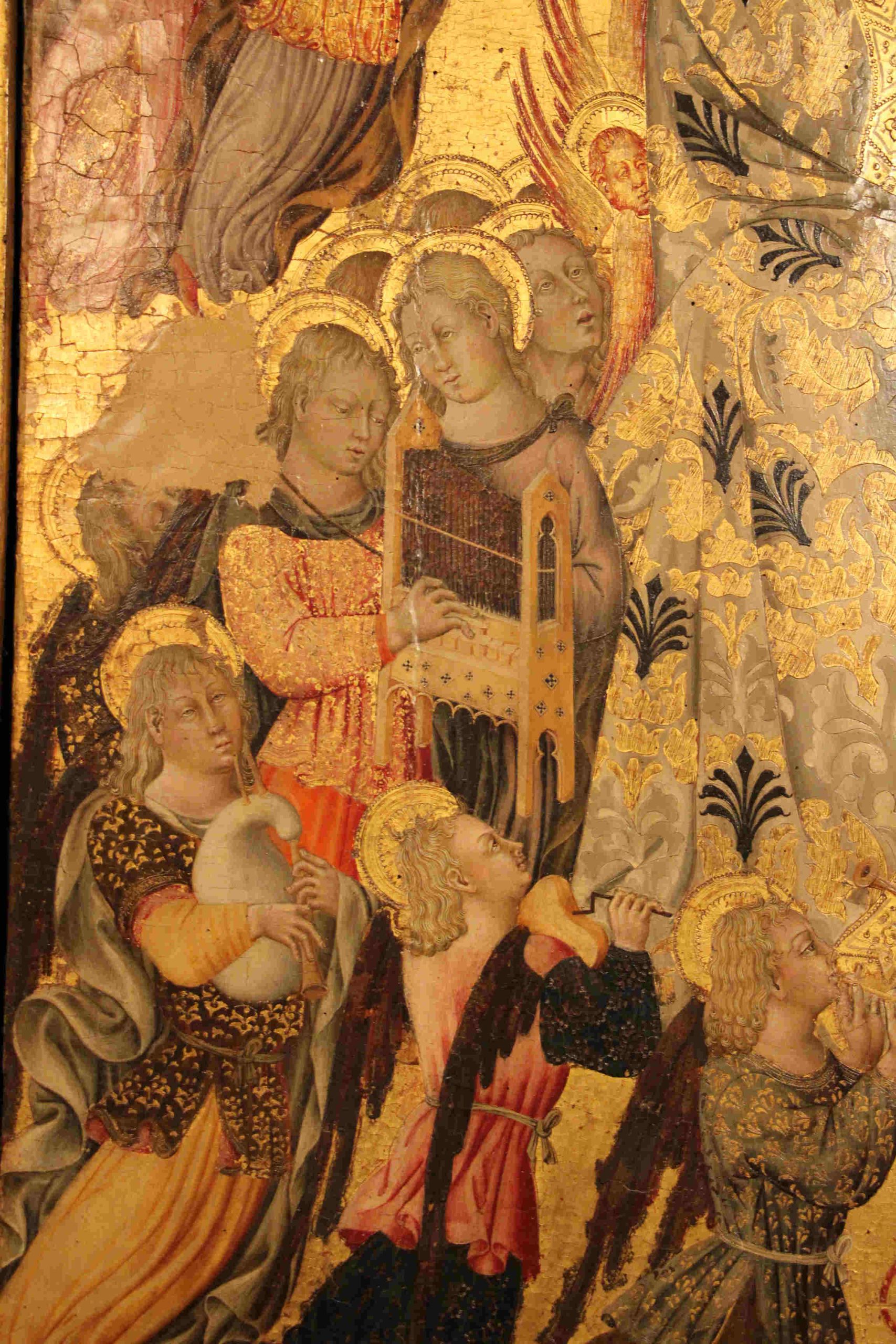
Francesco Bini, CC BY 3.0, via Wikimedia Commons
Date:
1385
Location:
Palazzo Corboli Museum, Asciano, Siena
Author:
Giovanni di Paolo (central panel from the Assumption altarpiece)
Technique and materials:
Tempera and gold on panel
Dimensions:
Not documented
Provenance:
Churches of Asciano (Sant’Agata, Sant’Agostino) and Siena; dismembered in the 19th century, inspired by the lost model by Simone Martini at the Antiporto di Camollia
Sources: