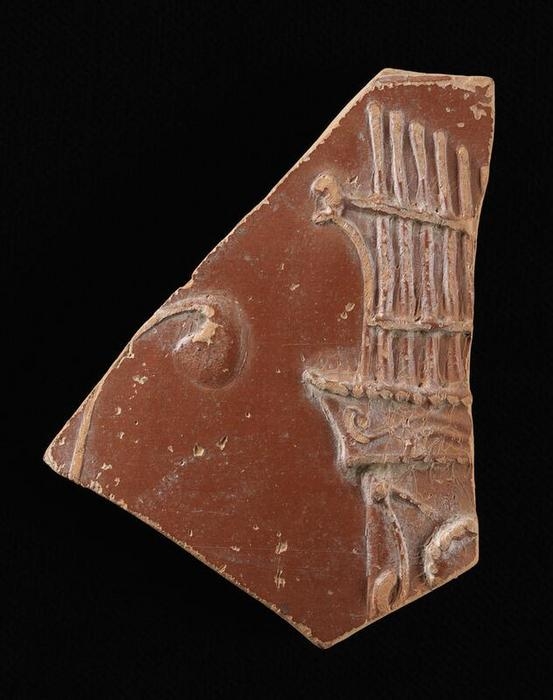
In 1948, while studying various fragments of Samian ware from Lezoux preserved in the Saint-Germain Museum, it was possible to find the image of a hydraulic organ on a polygonal terracotta shard.
On the left of the fragment the upper part of a leaf ensemble can be seen, while further to the right the organ appears. Although the instrument cannot be seen in its entirety, this is a hydraulic organ. The water cistern, of which only the upper left part can be seen, is decorated near its circumference with curved garlanded lines and an oval motif at the centre. The wind chest, which on the only visible left section has a curious keeled form, is also very elaborately decorated with festooned borders and, along its length, with foliage of graceful lines. Six pipes can be seen, held by two transverse bars resting on a curved vertical upright. The keyboard is in all probability on the other side of the organ, whose front face is shown here. Assuming that the oval motif of the wind chest indicates its central section, one may imagine that the complete organ comprised nine pipes.