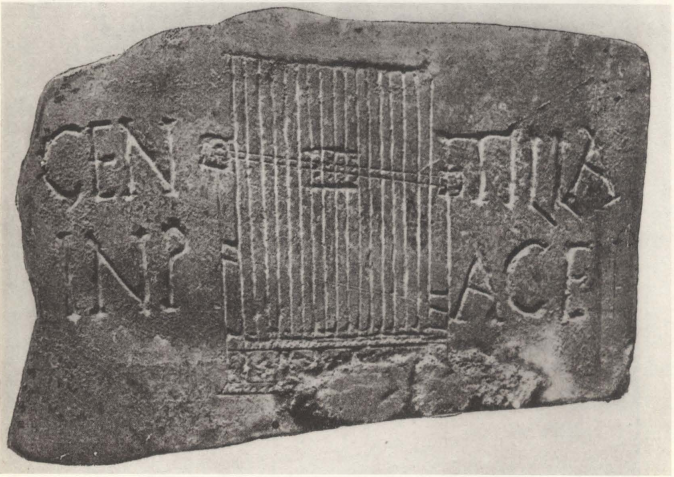
In 1936 Father Bellarmino Bagatti published a graffito bearing a Christian inscription with a very mysterious drawing in which he believed he could see a weaver. The terms refer to a woman whose activity is what can be seen in the drawing.
It is a marble fragment found in the underground cemetery of Commodilla, near Ostia.
Even a cursory examination shows that this is in fact an organ. Sixteen pipes of equal diameter and slightly decreasing in height from left to right can be clearly distinguished. Near their feet pipe mouths appear to be present. At the ends of the row of pipes two unequal uprights rise, at the top of which the usual holding bar is fixed; this joint is decorated with a rounded motif resembling that of the Rusticus organ. At the centre of the bar there is a rectangular plaque of a width corresponding to five pipes, which perhaps bore an inscription. On each vertical upright two notches can be seen, higher on the left than on the right and separated by an equal space. A small oblique bar very discreetly traced unites the two sides.
The wind chest is of pneumatic type and its lower section widens to give it a more solid base. It bears a decoration of geometric figures; the keyboard is not visible. This is in this case a small table positive, the favourite instrument of a Christian woman.