This beautiful jewel of reddish sardonyx, preserved at the British Museum in London, is of unknown origin: it is only known to come from the Hertz collection. Oval in shape, it depicts a finely engraved hydraulic organ with its organist and two bellows operators in full activity.
The instrument, of imposing dimensions, is of the type commonly encountered in iconography. On a plinth the water cistern can be seen, cylindrical, decorated at top and bottom with a circular band probably intended to reinforce its structure, and a vertical bar placed in front probably serves an identical role. On each side of the cistern a pump comprising a cylinder with a clearly visible piston is found. At the upper part of the cylinder a tube is fixed reaching the wind chest. From here the wind is undoubtedly conducted directly into the canon mousikos, which is also connected with the neck of the pnigeus. This arrangement is, from a mechanical point of view, completely efficient. To the piston a connecting rod is attached, integral with a lever, each of which is operated by a young boy: the one on the left holds his almost at the peak of its stroke, while the one on the right holds his almost at the bottom. The pumps work alternately so as not to allow the water in the cistern to drop and to maintain stable wind pressure at the wind chest. The latter is wide and appears slightly curved. There are approximately thirteen pipes, the smallest to the right of the organist; they are fitted with the usual oblique bar but the lateral uprights cannot be distinguished. Above the pipes the head and part of the organist’s bust appear. At the top right of the gem the following inscription can be read: “WAA,” which certain epigraphists interpret as: “AM(ICUM) V(OTUM) V(OVIT)” (“He has fulfilled an affectionate vow”).
The Gem of the British Museum
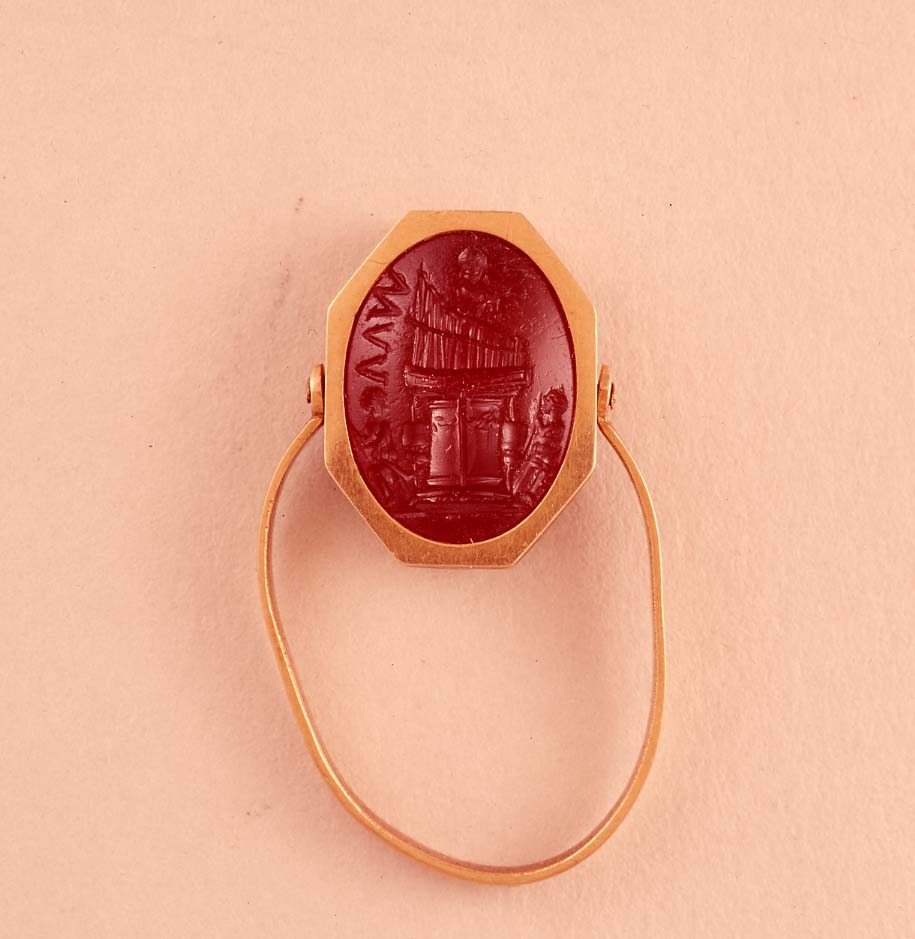
© The Trustees of the British Museum
Date:
3rd century AD
Location:
British Museum, London
Author:
Anonymous
Technique and materials:
Engraved reddish sardonyx
Dimensions:
13 x 9 mm
Provenance:
Unknown, former Hertz collection
Sources:
The Hellenistic-Medieval Organ by Jean Perrot