On the first floor of the convent complex of San Paolo fuori le Mura, in Rome, there is a small museum housing Christian inscriptions found in the areas adjacent to the basilica of the same name; among these is a large marble slab depicting a hydraulic organ.
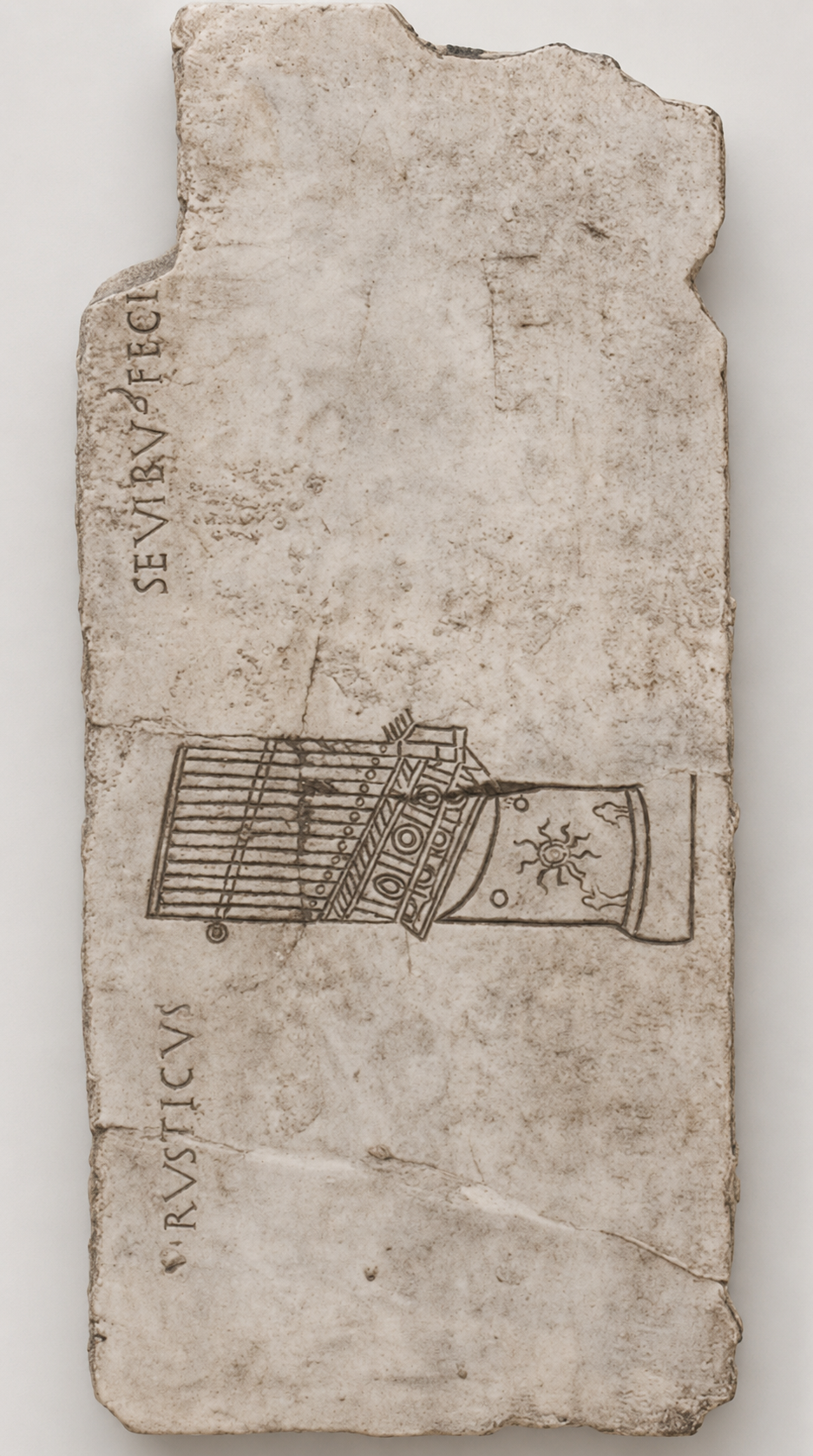
This is a rectangular slab, found under the altar of the Confession of Saint Paul and would have formed part of the ancient floor of the basilica in the time of Sixtus V. It shows the image of a hydraulic organ engraved in the marble without perspectival care but with certain interesting details.
The water cistern appears to be cylindrical, rests on a plinth and displays very unusual decorative motifs. At the centre is a sun surrounded by rays and at the bottom, on each side, a very imprecisely drawn figure; at the top there are two small circles. According to the monks of San Paolo, the sun would represent the divine light shining over the entire world.
Above the water cistern, drawn frontally without pumps, a wind chest of a surprisingly unusual form is fitted. Its slightly oblique front face shows two panels, a lower one that is almost horizontal and an upper one almost vertical, both decorated with geometric designs including bars and circles. The three-quarter view of this portion of the organ allows a glimpse of the wind chest’s back face: it forms a kind of box from which five small levers emerge, probably corresponding to the stop sliders.
Above and in front of the wind chest the keyboard of fifteen keys, longer than wide and juxtaposed like those of a modern keyboard, is drawn; they do not appear to correspond exactly to the axis of the pipes, because these are twelve rather than fifteen, all with mouths, a detail clearly and visibly distinguished. They seem to decrease from right to left, but perhaps this is merely the effect of perspective created by the oblique position of the wind chest. They are held, in their upper third, by a transverse bar bearing a small circular decorative motif at the centre and a larger one on the left. These ornaments, already encountered on the Carthage terracotta, are also present on the Aquincum organ. It is further worth noting that the upper end of the pipes is subjected to a kind of rectilinear bar whose function is not clear. The well-drawn inscription reads: “Rusticus se vibu feci” or “Rusticus se vivu(s) feci(t)” (Rusticus made this monument himself while alive). He was perhaps an organist or a builder of hydraulic organs, probably a Christian.