
Various instrumentalists are once again gathered around King David in this document generally dated to the first third of the thirteenth century: a cornetto player, a viol player, a cymbal player seated and holding a small hammer in both hands, and an organist can be distinguished.
The organist, dressed in a long robe, is seated on an ornate seat. With his left hand toward the instrument he grasps one key per hand in the evident act of pulling or pushing it back; due to a perspectival defect in the drawing the two pulling assistants are depicted on the two sides of the wind chest, being seated on opposite sides. Eleven pipes held by a horizontal bar are present and the perspectival error prevents one from deciding whether the treble pipes are to the right or left of the organist. The largest pipe is twice the height of the smallest; the mouths are not drawn. The wind chest, which appears to consist of two large wooden boards placed side by side (still the same technique as the monk Theophilus), rests on two tall robust columns between which passes a curved wind conductor ending in a conflatiorium.
Into this the mouthpieces of two large bellows of surprisingly modern appearance are fitted, with their wide intake valve and respective leather articulation. Both are operated, one per hand, by a single assistant whose smiling attitude suggests that the work is not arduous. Comparing their size with that of the musicians, the length of the bellows reaches at least one metre.
It is finally worth noting that the organist appears to be positioned outside the scene in which the concert takes place.
The Manuscript of Cividale del Friuli (Psalter of Saint Elizabeth)
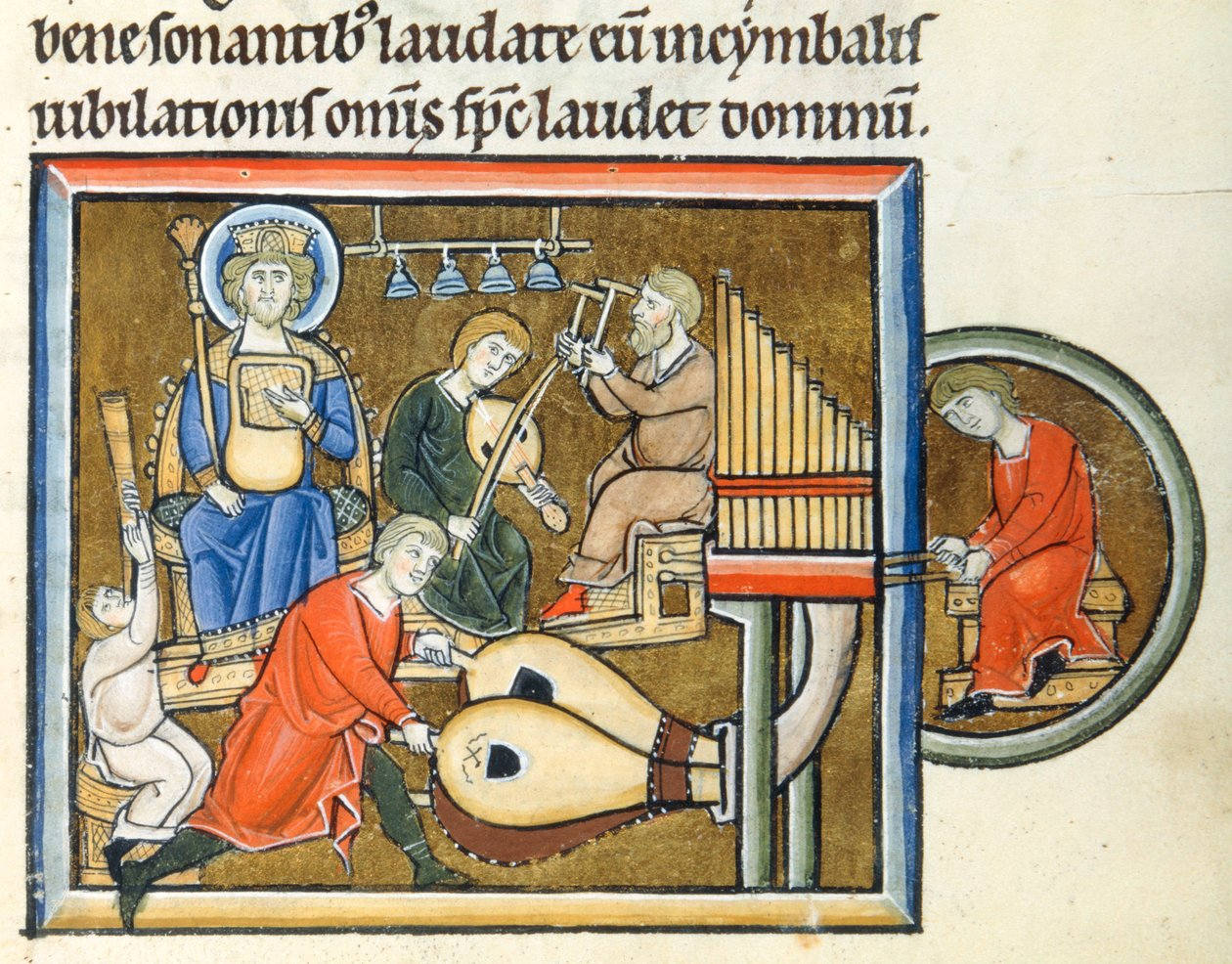
unknown artist, circa 1201-1208, Germany, Public domain, via Wikimedia Commons
Date:
first third of the 13th century
Location:
Archaeological Museum of Cividale del Friuli
Author:
Anonymous
Technique and materials:
Miniature (pen and ink, tempera and gold leaf on parchment)
Dimensions:
Not documented
Provenance:
Not documented
Sources:










_and_musicians_playing_chime_bells,_vielle,_pipe_organ_and_long_horn.jpg)