An amphitheatre scene is depicted in a graffito traced on one of the walls of a Roman villa discovered beneath the Basilica of Saint Sebastian in Rome. It is a simple sketch, the naive work of a child or, at least, of a non-professional. Two pairs of gladiators can be seen fighting to the sound of a hydraulic organ, a trumpet and a horn. On the left the tubicen blows into his instrument, which he holds tilted downward; on the right the cornicen plays standing up. Between these two musicians, on a slightly more recessed plane, the organ is installed. This has a very elevated plinth supporting a water cistern that is taller than it is wide; on each side are the pumps, whose connecting rods are visible. The levers are operated by two people in short garments, who hold them with both hands. The upper part of the cylinders appears joined to the wind chest, which is very flat, on the sides of which two young figures can be seen whose role escapes us. There are approximately twelve pipes held by an oblique transverse bar resting on two vertical uprights.
The Graffito of the Via Appia
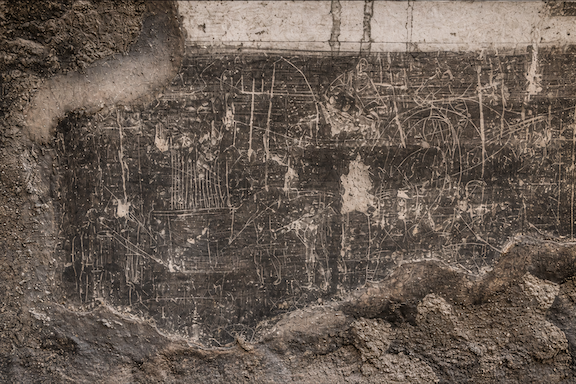
Digital reconstruction using artificial intelligence from a low-resolution photograph
Date:
between 2nd and 3rd century AD
Location:
Not documented
Author:
Anonymous (naive, possibly a child or non-professional)
Technique and materials:
Wall graffito (simple sketch)
Dimensions:
Not documented
Provenance:
Via Appia, Rome (Roman domestic context)
Sources:
The Hellenistic-Medieval Organ di Jean Perrot