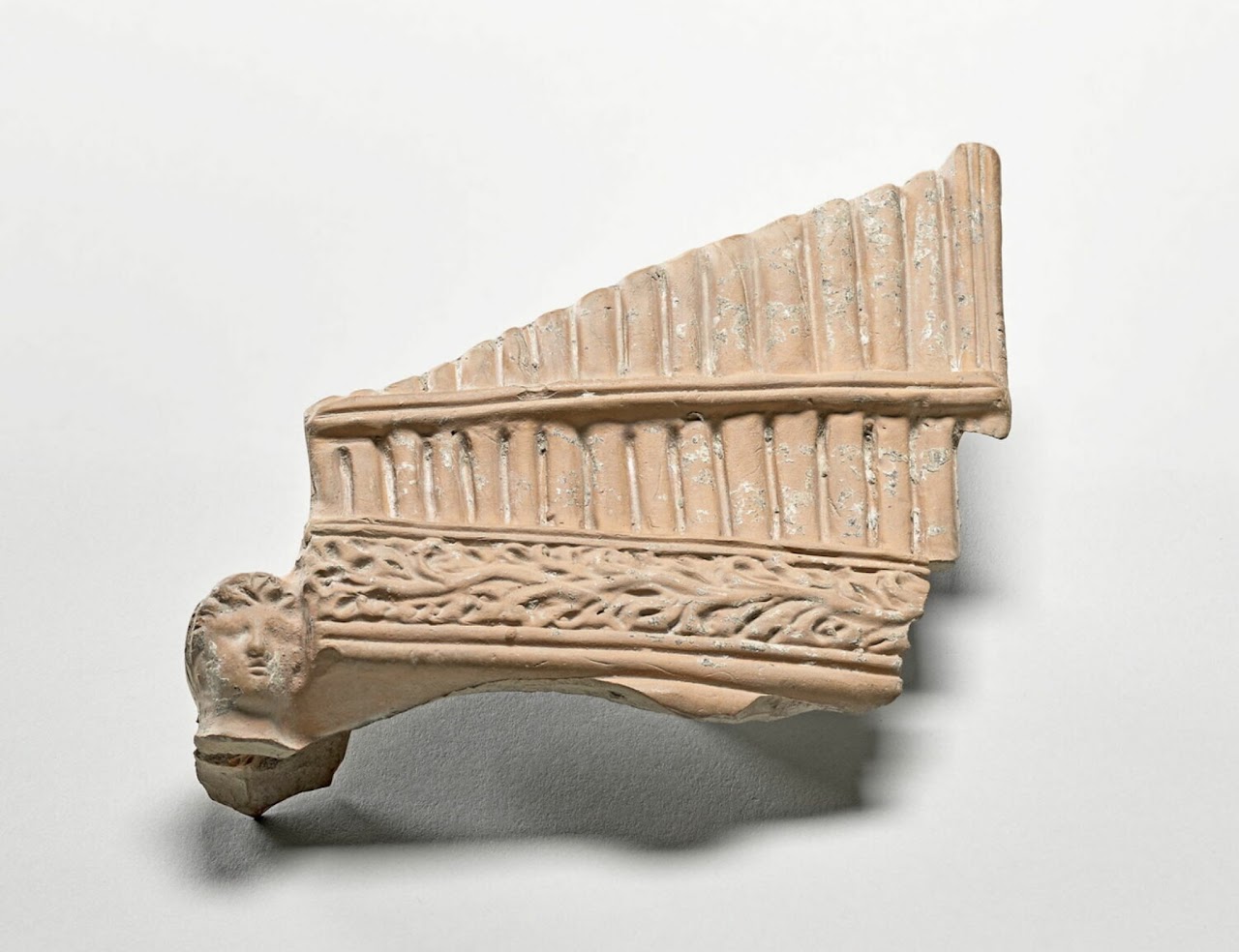
This terracotta, probably predating our era, comes from excavations carried out in the Kusuk-Kolah area in 1852 by Mazoillier and Langlois, and is preserved in the Louvre Museum. The piece, which does not appear complete, is of fine craftsmanship; it is very elegantly designed and represents the upper part of an organ. Fourteen or fifteen pipes of regularly decreasing height from right to left are held in place by means of an oblique bar decorated with a transverse notch resting on two vertical uprights. The one on the right is clearly visible, embellished with two parallel grooves. The pipes, whose mouths cannot be seen, are arranged on a wind chest whose pediment is gracefully decorated with a leaf motif framed by mouldings.
To the left and below the wind chest appears the head of a young man, perhaps the bellows operator. Indeed it is impossible for this to be there merely as an ornament, given that it projects distinctly downward. Moreover, a small fragment still attached to the lower part of the wind chest proves that the instrument did not end at that point: it is, in short, a hydraulic organ.
It is worth noting that, judging from the ornamentation of the wind chest indicating its front face, the organist had the treble pipes to his right.