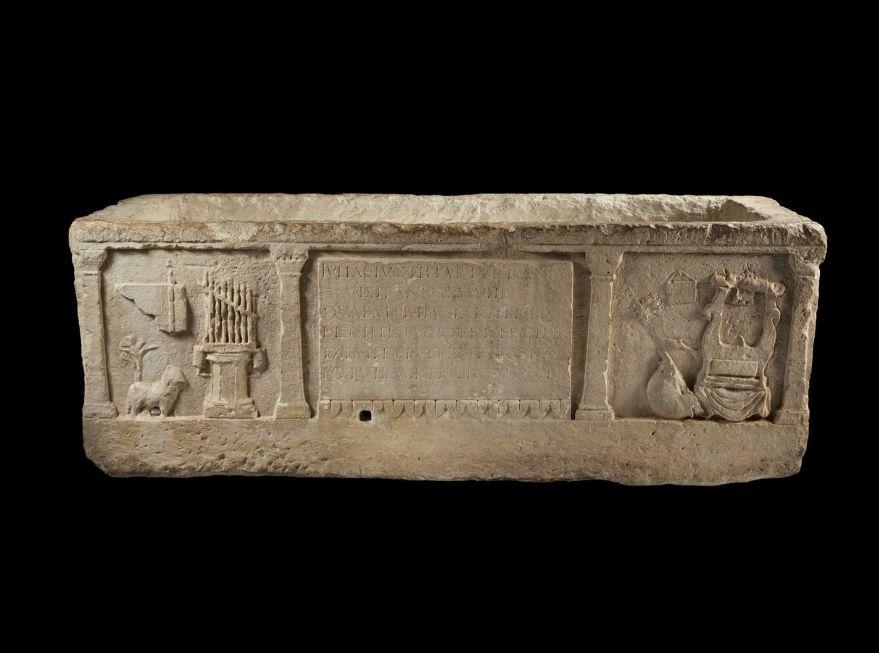
This beautiful white marble sarcophagus preserves the memory of a young organist, whose inscription reads: “Juliae Luc(i) filiae Tyrraniae vixit ann(os) XX m(enses) VIII quae moribus pariter et disciplina ceteris feminis exemplo fuit. Aurarcius nurui, Laurentius ucxori” (“To Julia Tyrrania, daughter of Lucius. She lived twenty years and eight months. By her good conduct as by her learning she was an example to other women. Autarcius to his daughter-in-law. Laurentius to his wife”).
The accomplishments of this young woman, snatched so soon from her husband’s affection, were above all musical in character, and indeed on the sides of the inscription musical instruments are depicted: on the left a hydraulic organ and a syrinx in its case; beside the organ an animal that appears to be a sheep, with a small tree in the background.
The organ is drawn with skill. On a sturdy plinth the hexagonal water cistern rises, its edges decorated with mouldings. The upper section presents a kind of platform of the same shape whose rectangular faces are ribbed along all edges. On both sides of the platform the two pumps can be seen, which in turn are fitted with a large cylinder with its air duct on the lower section. The latter descends first vertically, then bends at right angles to enter the cistern. All of this implies a piston that can be operated from above, of which neither connecting rod nor lever can be seen. Above the platform of the cistern stands the wind chest, but any registration accessories or keyboard attachments are absent. The keyboard is certainly on the other side of the organ, since it was customary to depict the instrument frontally. The eight pipes are all of very similar diameter. They are so large that the tallest alone measures as much as the wind chest, cistern and plinth combined.
The favourite instrument of Julia Tyrrania is not without elegance: one readily imagines the prestige of this young woman, proudly stationed behind the bronze pipes she loved to sound. Before this instrumentalist so gifted in her art, thought turns to that Aelia Sabina of the Aquincum inscription, similarly mourned by her husband who extolled her musical talent for posterity.
Some have wished to identify this Julia as a Christian: it has been observed that the names Autarcius and Laurentius are frequent in Christian epigraphy. This may be, but we have no means of judging.