The Cantigas were strongly influenced by the poetry and music of the troubadours, the poets and singers of Occitania, what is now southern France. From the late eleventh to the late thirteenth century, the troubadours developed various song styles, the most famous being fin’amor, refined or perfect love. For the troubadours, perfect love was unrequited. The typical fin’amor song follows these themes: I am in love with an unavailable woman; she is perfect physically and in personality; my life would be complete if only she loved me; but she does not know I exist — or — she knows I exist and cruelly rejects me; therefore I want to die. The cultural influence of the troubadours extended well beyond Occitania and long after the troubadours’ own lifetimes. For example, the language of fin’amor was co-opted to describe the Virgin Mary, and much of the Renaissance song repertory continued the fin’amor theme established by the troubadours (including, for example, John Dowland’s Come again, sweet love doth now invite).
Cantiga 50 portrays psalteries of not much greater interest, but in a more typically extravagant setting. The instruments are semi-trapezoidal with a central soundhole and three other holes (or inlays), but the players’ hands appear to be in slightly different positions. The left player is frontal but depicted with many more details: he wears a noble capa (with fur collar and armhole) with gold embroidery along the margins. His companion is slightly turned toward him. He wears a cloak with gold-embroidered borders and a caperón (a detachable hood, often worn as a headdress). These two nobles are set against the characteristic coffered background of the Cantigas manuscripts.
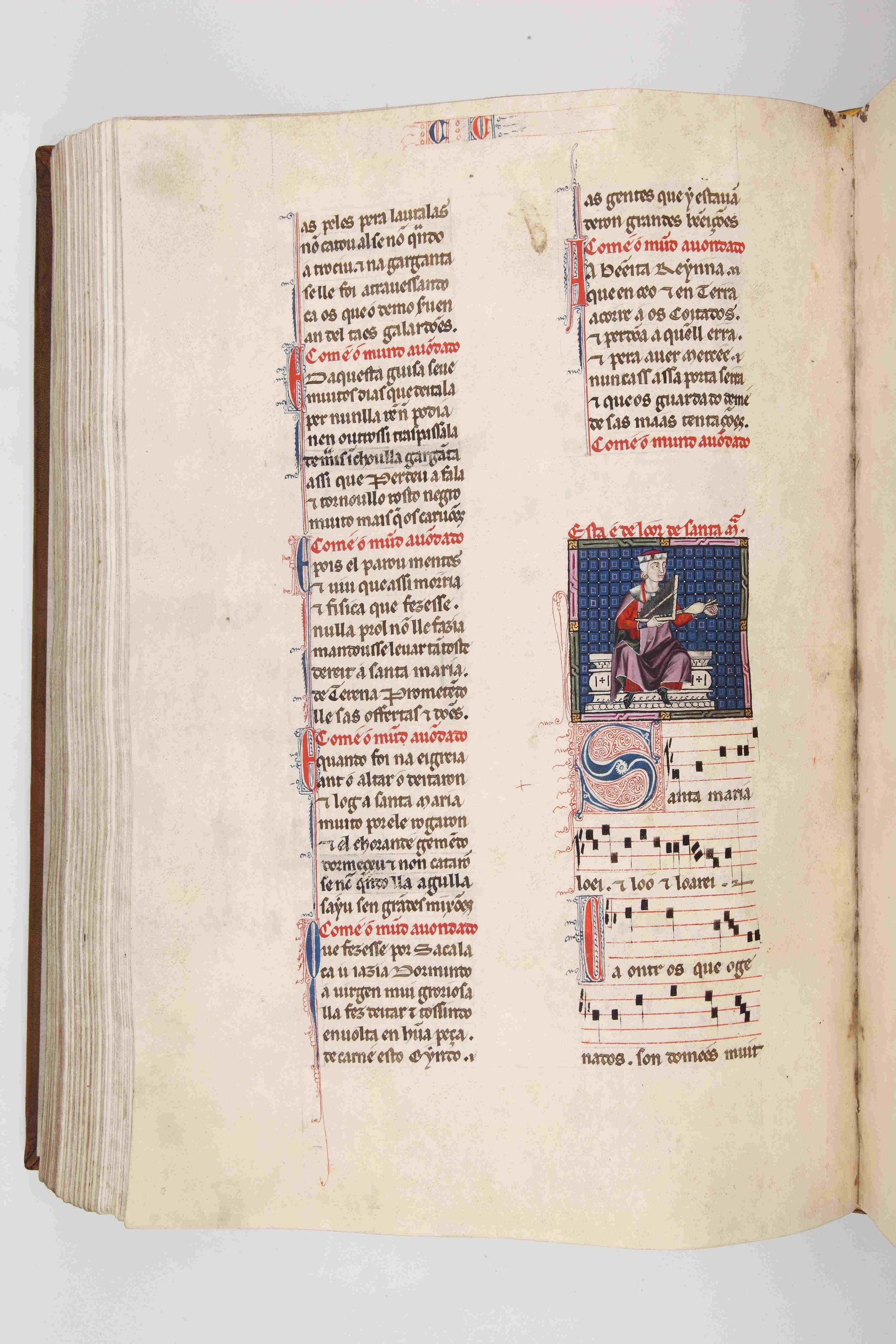
Portative Organ from the Cantigas de Santa Maria
Date:
1221-1284
Location:
Royal Library of the Monastery of San Lorenzo de El Escorial, near Madrid
Author:
Anonymous, Circle of Alfonso X, King of Castile
Technique and materials:
Illuminated miniature
Dimensions:
361 f.: parch.; 404 × 274 mm
Provenance:
It probably belonged to Seville Cathedral, until it passed to the Escorial Library collection at the request of Philip II
Sources: